
Identifying the Flaws in…
Monetary sovereignty and external constraints: Identifying the flaws of modern monetary theory

Introduction
Garzón Espinosa’s paper is a well-structured summary of the post-Keynesian and structuralist critique of Modern Monetary Theory (MMT). However, as a critique of MMT itself, it fundamentally misfires. The author repeatedly claims that MMT ignores external constraints, minimises imported inflation, and overlooks the geopolitical hierarchy of currencies. Yet, a close reading of the primary MMT literature reveals that the framework already incorporates these exact insights. Garzón Espinosa is essentially tilting at windmills, arguing against a caricature of MMT rather than the operational reality of it.
Let’s break this down step-by-step.
Step 1:
The Myth that MMT “Rejects” External Constraints
Garzón Espinosa asserts that MMT “rejects ‘external constraint’ altogether and replace[s] it with ‘real resource constraint’”. He argues that MMT ignores the balance of payments limitations faced by developing nations.
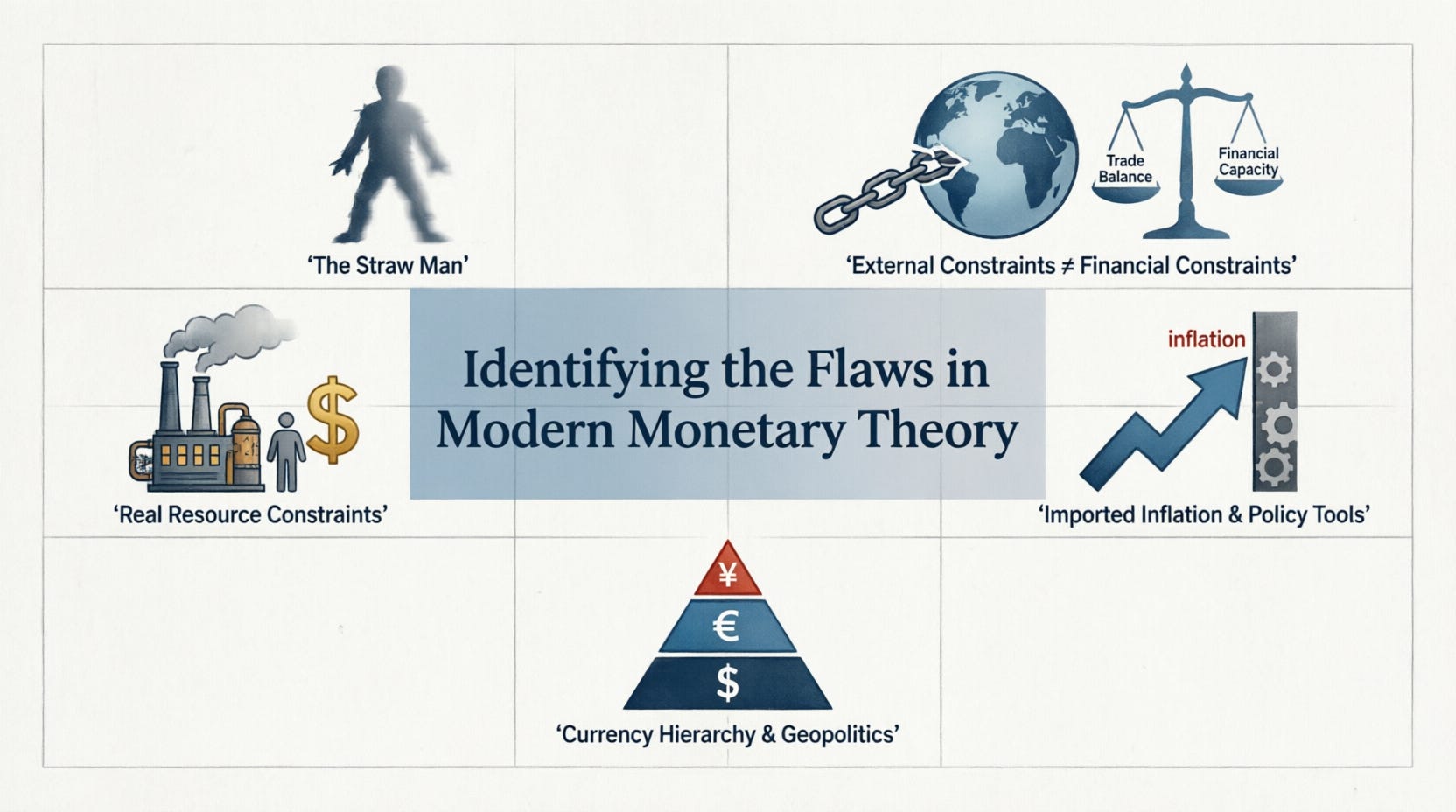
Rebuttal: This is a misrepresentation of the MMT position. MMT explicitly distinguishes between financial constraints (which a sovereign currency issuer does not face) and real resource constraints (which it absolutely does). A currency-issuing government can always afford to purchase anything for sale in its own currency, but if it lacks the domestic productive capacity to replace imports, or the export capacity to earn foreign exchange, it faces a very real limit to its material prosperity.
Professor Bill Mitchell addresses this directly, stating:
“There are external constraints on governments who seek to maintain full employment and generate material prosperity for the citizens of a nation.” From “There is no internal MMT rift on trade or development”, published 10 January 2019.
Mitchell further clarifies that the ultimate limit is not financial, but physical:
“the worst-case scenario for a nation, irrespective of its government’s currency-issuing capacity, is defined by the real resources that such a nation can access.”
Therefore, MMT does not “reject” external constraints; it correctly identifies them as constraints on real resources rather than money. For the UK, this means His Majesty’s Treasury can always fund the NHS or a green energy programme in sterling terms, but the actual limit is whether we have the engineers, materials, and physical capacity to build it without triggering inflation.
Step 2:
The “Imported Inflation” Straw Man
The paper claims that MMT “minimises its importance” when addressing the problem of imported inflation caused by currency depreciation in developing economies.
Rebuttal: Garzón Espinosa actually quotes Professor L. Randall Wray on this exact topic in his “Discussion” section, but then paradoxically concludes in his final remarks that MMT “hardly considered” the issue. Wray’s original text explicitly acknowledges the risk of inflation pass-through and provides the MMT policy solutions, which include targeted state intervention rather than surrendering monetary sovereignty.
Wray writes:
“the MMT principles apply to all sovereign countries. Yes, they can have full employment at home. Yes, that could lead to trade deficits. Yes that could (possibly) lead to currency depreciation. Yes that could lead to inflation pass-through. But they have lots of policy options available if they do not like those results. Import controls and capital controls are examples of policy options. Directed employment, directed investment, and targeted development are also policy options.”
MMT’s point is that a developing nation facing imported inflation has a choice: it can impose austerity and maintain a fixed exchange rate (which guarantees mass unemployment and poverty), or it can float the currency, accept some imported inflation, and use industrial policy, capital controls, or targeted import controls to build domestic food and energy sovereignty. It is a political choice about who bears the cost, not an ignorance of the macroeconomic mechanics.
Step 3:
The Currency Hierarchy and Geopolitics
Perhaps the most glaring error in the paper is the claim that MMT ignores the geopolitical and military power that underpins the hierarchy of currencies. Garzón Espinosa argues that MMT treats monetary sovereignty as a purely institutional or binary issue, failing to account for the US dollar’s hegemony.
Rebuttal: This claim is demonstrably false, and Garzón Espinosa contradicts himself by citing MMT authors who explicitly developed the “currency hierarchy” framework. Professor Eric Tymoigne, a leading MMT scholar, has written extensively on how political and economic power dictate a currency’s place in the global system.
Tymoigne explains:
“The position of a monetary instrument in the hierarchy is determined by its degree of liquidity within the considered area... As such, political power (like the ability to impose and collect tribute or tax debts) and economic power (the size of reserves if conversion is possible, or the ability to collect on bank debts) influence the place in the hierarchy.”
MMT fully recognises that the US enjoys an “exorbitant privilege” backed by its geopolitical and military dominance. The analytical contribution of MMT is not to deny this hierarchy, but to point out that developing nations suffer because they have voluntarily or involuntarily surrendered their monetary sovereignty (e.g., by borrowing in US dollars or pegging their currencies). The solution MMT proposes is precisely to reclaim that sovereignty to escape the subordinate tier of the hierarchy.
Step 4:
The UK Context and the Illusion of Self-Imposed Constraints
Finally, we must apply this to the UK fiscal context. Garzón Espinosa notes that states often “self-impose spending constraints”
For the UK, a sovereign currency issuer with a floating exchange rate and debt denominated in sterling, there is no operational financial constraint.
As Professor Bill Mitchell explicitly notes regarding the British government:
“But whatever is available for sale in UK Pounds – including all the unemployed and underemployed workers – can be purchased at any time by the national government. There is never an intrinsic financial constraint on that capacity.”
From “The moronic activity of the rating agencies”, published 1 October 2012.
The constraints facing the UK Chancellor of the Exchequer are entirely self-imposed political choices (such as the fiscal anchors and debt rules) and the real resource capacity of the British economy. If the UK government chooses to act like a household or a Eurozone member—pretending it can run out of its own currency—it will unnecessarily constrain public investment in infrastructure, the NHS, and a green energy programme. The external constraint for the UK is not a lack of sterling, but the availability of real resources and the exchange rate impact on imported goods. As MMT correctly identifies, the policy response to that is not to adopt orthodox austerity, but to strategically manage the external account through industrial policy and, if necessary, targeted capital management.
Conclusion
Eduardo Garzón Espinosa’s paper is a useful primer on the structuralist and post-Keynesian critiques of orthodox economics. However, it fails as a critique of Modern Monetary Theory because it ignores the vast body of MMT literature that already addresses external constraints, imported inflation, and the geopolitical currency hierarchy. MMT does not deny these realities; it provides a coherent operational framework for understanding them and offers policy pathways—such as the mobilisation of idle domestic resources and the rejection of foreign-currency debt—to navigate them.
Bibliography
Garzón Espinosa, E. (2024) ‘Monetary sovereignty and external constraints: identifying the flaws of Modern Monetary Theory’, The Economic and Labour Relations Review.
Mitchell, B. (2012) ‘The moronic activity of the rating agencies’, Bill Mitchell – Modern Monetary Theory (Blog), 1 October.
https://billmitchell.org/blog/?p=21129
Mitchell, B. (2019) ‘There is no internal MMT rift on trade or development’, Bill Mitchell – Modern Monetary Theory (Blog), 10 January.
https://billmitchell.org/blog/?p=41327
Tymoigne, E. (2024) ‘Currency Hierarchy’, Medium (Monetary Policy Institute), 22 July.
https://medium.com/@monetarypolicyinstitute/currency-hierarchy-193e22f7276d
Wray, L. R. (2014) ‘MMT and External Constraints’, Naked Capitalism, 25 February.
https://www.nakedcapitalism.com/2014/02/randy-wray-mmt-external-constraints.html
This is why the debate matters more in African economies: the binding constraint is often not whether government can create local currency, but whether local-currency spending reduces the need for scarce foreign currency or simply intensifies the queue for it. External public debt service in Sub-Saharan Africa has been rising as a share of revenue, which makes the FX side of sovereignty impossible to ignore.
Excellent work. And yes, I've written a lot on external constraints/balance of payments, this one is likely the best catch-all - https://darrenquinn.substack.com/p/the-thirlwall-trap-why-we-dont-need
My main point is no: we get that there are constraints, and you're close to correct with the fixed exchange ones in how they work, but they're not bounded by a mathematical law and have more flexibility than Post-Keynesian Structuralists recognise, yet they're still constrained.
There's more nuance to that again, depending on where you are on the spectrum of monetary sovereignty and what your institutional capabilities are, but in general, the above is the answer.