
Of Last Resort
The State, as issuer of currency, possesses a capacity to act as the ultimate backstop for financial panic, economic collapse, and social dislocation

An (Info) Graphic Novella

“The Conservative belief that there is some law of nature which prevents men from being employed, that it is ‘rash’ to employ men, and that it is financially ‘sound’ to maintain a tenth of the population in idleness is crazily improbable – the sort of thing which no man could believe who had not had his head fuddled with nonsense for years and years….”
(J. M. Keynes)
Of Last Resort is an exploration of a singular idea: that the state, as issuer of currency, possesses a capacity to act as the ultimate backstop for financial panic, economic collapse, and social dislocation. It is a capacity that was discovered by accident in 1866, theorised by Bagehot, deepened by Keynes, radicalised by Minsky, and consistently denied by those who insist that public money is merely recycled private earnings.
The formalisation of the Bank of England’s role as lender of last resort emerged from the financial collapse of Overend, Gurney and Company on 10 May 1866 (Flandreau, 1996).

That institution, the largest discount house in London, had accumulated extensive loan losses and, when it suspended payments, a bank run spread across London, Liverpool, Manchester, Norwich, Derby and Bristol (Hauser, 2016). Observers characterised the event as an “earthquake” having torn through the City (Fulmer, 2022).
Walter Bagehot’s Lombard Street: A Description of the Money Market (1873) constituted the classic statement of the lender-of-last-resort function (Bagehot, 1873). Bagehot had been convinced by the 1866 crisis, and by earlier episodes, that the Bank of England should not curtail credit to conserve its own liquidity during an internal drain of specie. Rather, the Bank ought to lend freely, at a high rate of interest, and on good banking securities. This prescription, subsequently termed “Bagehot’s dictum”, held that the Bank alone commanded the confidence necessary to serve other institutions during a panic (Bagehot, 1873). The imperative derived from a structural observation: in the absence of a central liquidity provider, a solvent institution facing a temporary liquidity shortage could be destroyed by a run, and the resultant contraction of credit could bring down the entire financial system.
The importance of this function was underscored by the statutory framework then in operation. The Bank Charter Act 1844 (7 & 8 Vict. c. 32), sometimes referred to as the Peel Banking Act, had institutionalised bullionism by creating a fixed ratio between the Bank’s gold reserves and the notes it could issue (Flandreau, 1996).
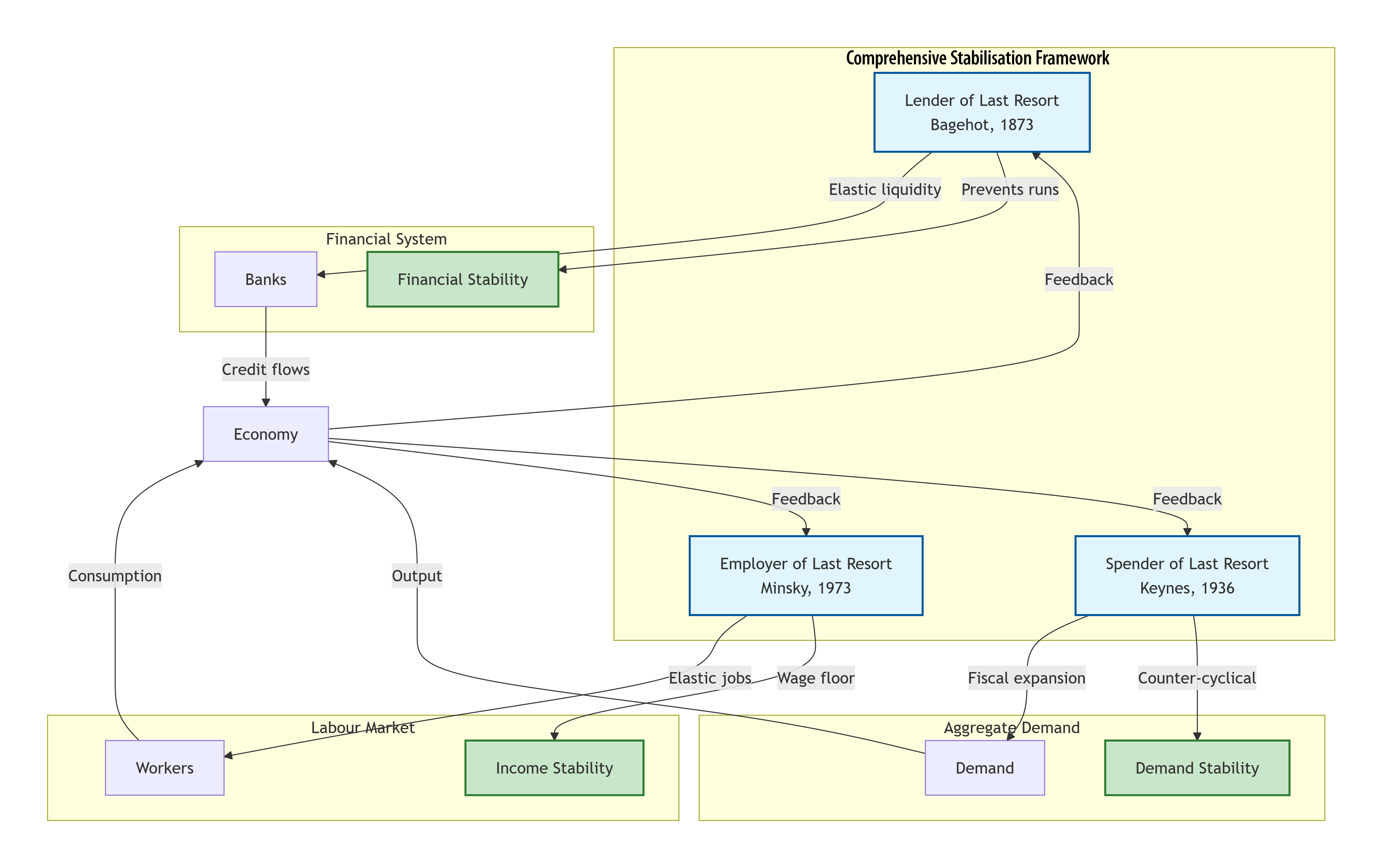
The Act restricted the powers of British banks and gave exclusive note-issuing powers to the Bank of England. It also barred any new banks of issue and placed strict curbs on the issuance of notes by country banks. The government retained the power to suspend the Act in case of financial crisis. That power was exercised in 1847, in 1857, and during the 1866 Overend Gurney crisis (Flandreau, 1996).
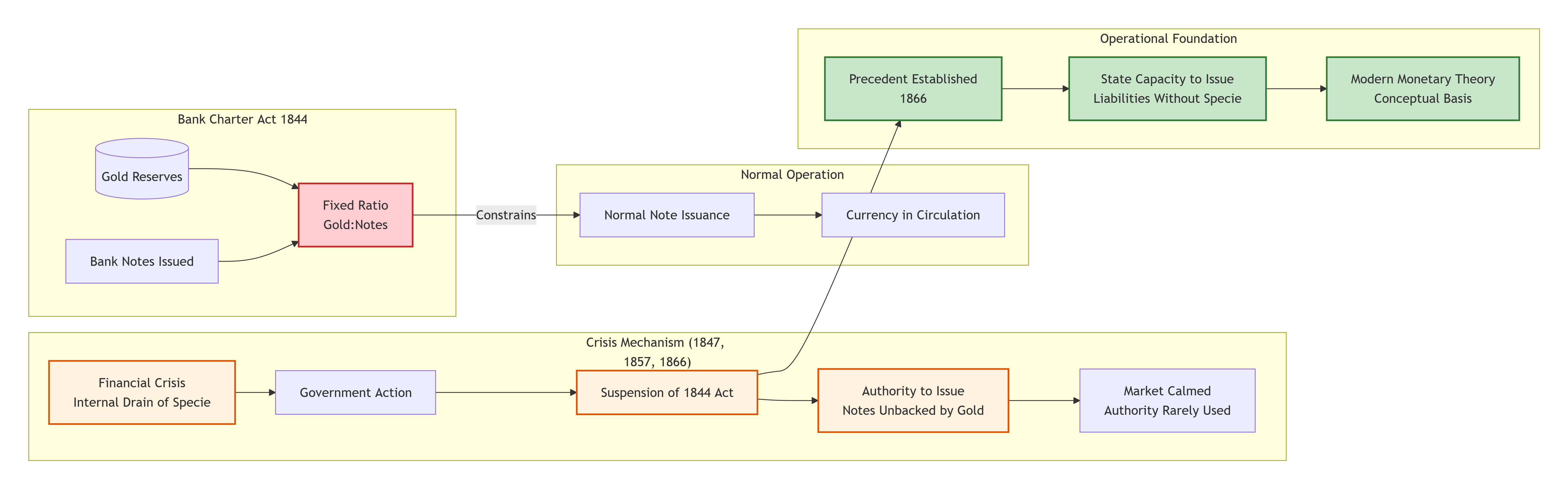
On 11 May 1866, the government suspended the 1844 Bank Charter Act, authorising the Bank to issue notes unbacked by its stock of gold. The suspension announcement itself calmed the market; the Bank never actually used the authority to issue beyond the statutory limit (Flandreau, 1996, p. 24). The action highlighted the Bank’s implicit government backing and its emerging role as lender of last resort. The relaxation of the 1844 Act’s constraints, effected through the suspension mechanism, began a transformation in the British state’s fiscal capacity. By enabling the monetary authority to expand its balance sheet in extremis without being bound by the gold reserve ratio, the 1866 precedent established that the state possessed, in practice, a capacity to issue liabilities not strictly backed by specie. This capacity, though exercised only sparingly, constituted the operational foundation upon which later understandings of sovereign currency-issuing power would be built.
John Maynard Keynes subsequently elaborated a framework within which the state’s role extended beyond the provision of liquidity to the banking sector. Keynes theorised that the government could act as “spender of last resort” during a deep economic downturn, using fiscal expansion to shift aggregate demand and increase output (Keynes, 1936). He argued that when private agents panicked and hoarded money, the only way to prevent depression was for the government to spend. Keynes also advocated a policy of full employment, contributing to the 1944 White Paper on employment policy and writing extensively on the tactics and problems of maintaining full employment (HM Government, 1944). His analysis rejected the notion that mass unemployment was a necessary or natural state, and he supported direct job creation on useful tasks as a means of increasing national wealth.
The post-war settlement, informed by Keynesian premises, accepted that public spending and taxes should adjust counter-cyclically to stabilise aggregate demand. That settlement unravelled during the 1970s. The Heath government, having come to office in 1970 with a non-interventionist objective, abandoned that strategy as unemployment reached one million in January 1972 (Bank of England, 1972). Chancellor Anthony Barber’s budget of March 1972 injected an estimated £2.5 billion into the economy through increased pensions, benefits and tax reductions, largely financed by government borrowing (HC Deb, 21 March 1972). Barber stated: “I do not believe that the stimulus to demand I propose will be inimical to the fight against inflation” (HC Deb, 27 March 1972). The budget required £3.4 billion in government borrowing (Laidler and Parkin, 1976). With inflation at 7.3 per cent, the government introduced an official growth target of 5 per cent, with Barber forecasting UK growth at 10 per cent within two years.
From a Modern Monetary Theory perspective, the characterisation of the Barber boom as merely “over-eager state spending” is insufficient (Mitchell and Fazi, 2017). The analytical framework would distinguish between the fiscal expansion undertaken by the Heath government and the concurrent deregulation of bank credit. The resultant conclusion is that the fiscal stimulus was not inherently flawed in its scale, but the operational error lay in the combination of that expansion with a financial deregulation that MMT would identify as a structural failure to manage the monetary transmission mechanism.
An MMT analysis does not view the 1972 Budget’s fiscal expansion—tax cuts of £1 billion and an increase in public sector borrowing of £3.4 billion—as a transgression of some natural fiscal limit. The government’s objective of achieving a 5 per cent growth rate to close a perceived output gap is, in principle, consistent with MMT’s functional finance approach. However, the operational error was one of miscalibration, not of principle. The Treasury’s contemporaneous estimates indicated a large and growing output gap during the “depression of early 1972,” which justified the stimulus. Subsequent analysis by the Bank of England revealed that this estimate was a real-time mismeasurement; by the end of 1972, there was effectively no output gap (Bank of England, 2025). The fiscal expansion was thus applied to an economy already at or near full capacity, generating demand-pull inflation rather than increasing real output.
The more significant element, from an MMT perspective, was the simultaneous deregulation of the banking system through the Competition and Credit Control (C&CC) policy, implemented in 1971 (Bank of England, 1971).
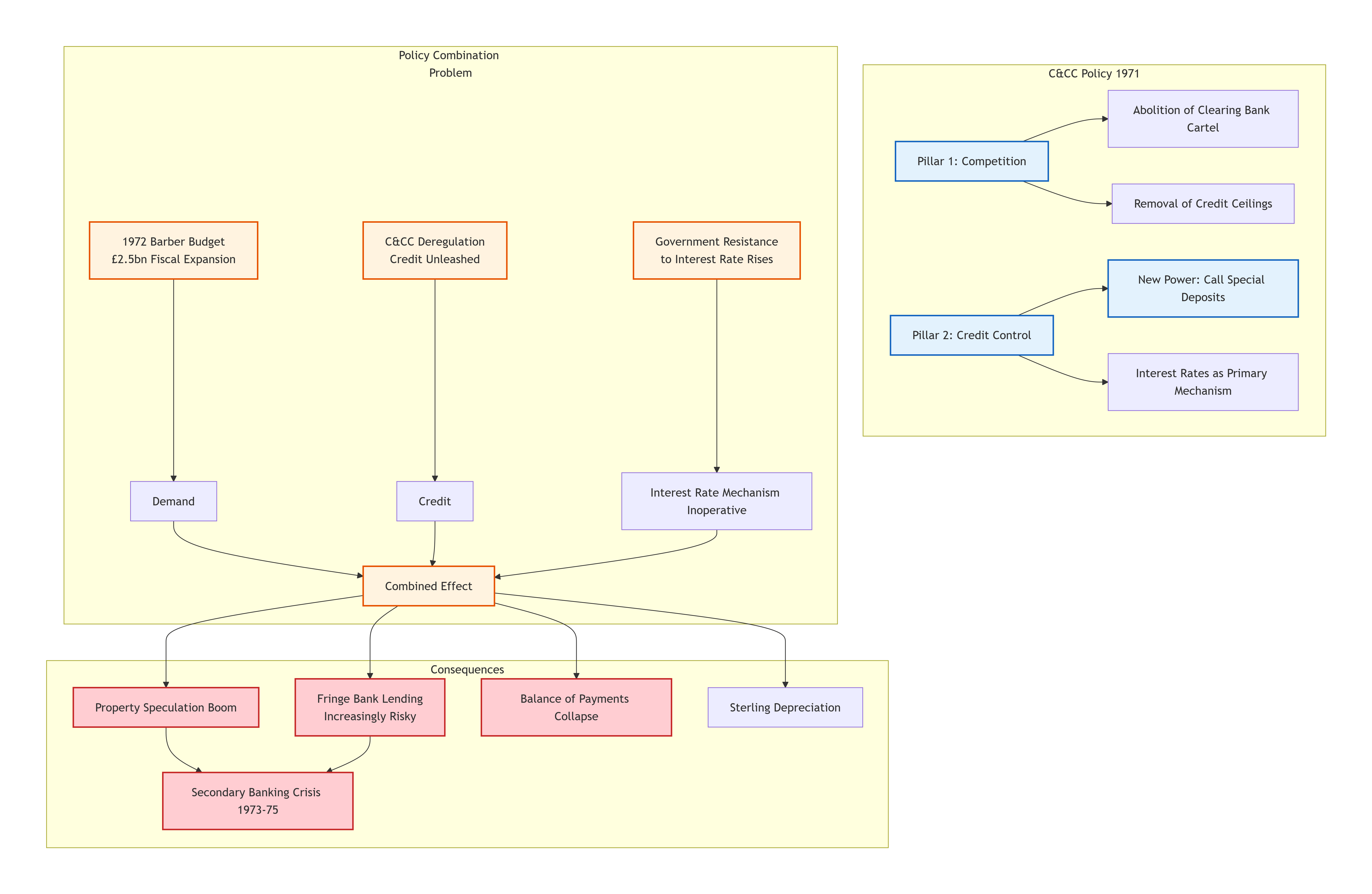
This policy was designed to replace administrative credit controls with a market-based system using interest rates as the primary mechanism for managing credit expansion. It rested on two pillars: the abolition of the clearing bank “Cartel” and the removal of credit ceilings (the “competition” side), and the Bank of England’s new power to call “special deposits” to reduce credit (the “credit control” side).
The C&CC policy directly created the conditions for the subsequent secondary banking crisis of 1973–75. It unleashed a flood of credit that had been artificially repressed. The government’s simultaneous expansionary fiscal policy and its unwillingness to accept higher interest rates when credit conditions demanded it compounded the effect. The consequence was that the newly available credit was channelled not into productive manufacturing investment, but into a speculative boom in property and personal finance, which encouraged unregulated “fringe” banks to lend in increasingly risky ways (Reid, 1982).
The Hoover Institution analysis identifies this period as an “active fiscal”/”passive monetary” policy regime (Bordo, Bush and Thomas, 2025).
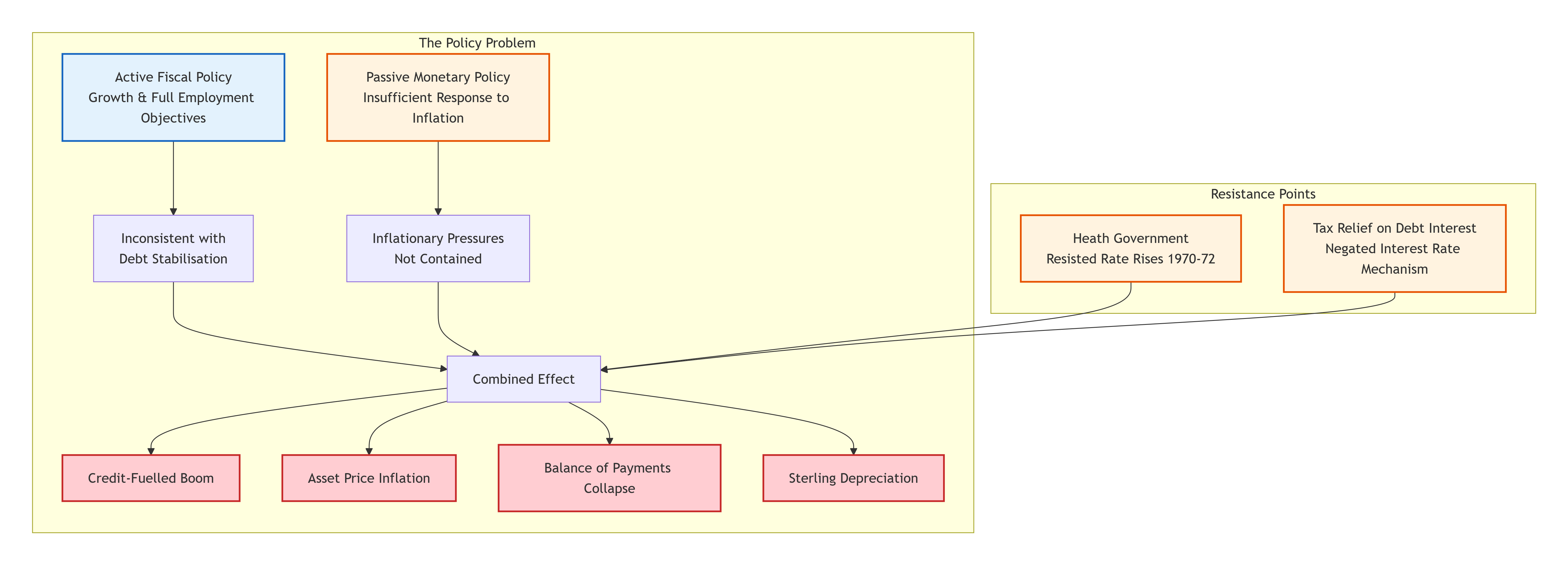
Fiscal policy was geared towards objectives—growth and full employment—that were not consistent with debt stabilisation, and monetary policy did not respond sufficiently to rising inflation. The Heath government, and Prime Minister Ted Heath in particular, resisted advice from the Bank of England to raise interest rates in response to inflationary pressures on multiple occasions in 1970, 1971 and 1972. This reluctance was further undermined by the introduction of tax relief on debt interest, which allowed companies to write off interest rate increases against tax, thus negating a key principle of the C&CC framework (Bordo, Bush and Thomas, 2025).
The Barber boom, therefore, was not a case of the state spending “too much.” Rather, it was a case of the state ceding its control over the money supply to an unregulated private banking sector while simultaneously running a fiscal expansion. The C&CC deregulation removed the administrative levers that had previously constrained bank lending, and the government’s refusal to use the interest rate weapon meant that the new market-based system for credit control was rendered inoperative. The inevitable result was a credit-fuelled boom in asset prices and demand, a collapse in the balance of payments, and a sharp depreciation of sterling.
The Thatcher government, elected in 1979, effected a rhetorical and policy reversal. The 1981 Budget raised taxes during a recession, with the stated objective of reducing the public sector borrowing requirement (HC Deb, 09 March 1981). This action reversed the post-war consensus that public spending and taxes should adjust counter-cyclically. The government argued that Keynesian demand management had been found wanting and should be discarded in favour of monetarist policies. The rhetorical framework accompanying this shift was articulated by Margaret Thatcher in December 1983 and again in 1984: “There is no such thing as public money. Money comes from taxpayers and ratepayers” (Thatcher, 1983; HC Deb, 06 December 1984). The assertion that the state has no source of money other than that which people earn themselves constituted a direct repudiation of the operational logic that had been established by the 1866 suspension—namely, that a sovereign monetary authority possesses the capacity to issue liabilities without prior taxation. The imposition of this fiscal constraint, presented as a fundamental truth rather than as a policy choice, re-introduced an artificial limitation on public spending analogous to the gold-reserve constraint that the 1866 suspension had temporarily removed.
The intellectual trajectory that culminated in Hyman Minsky’s employer-of-last-resort hypothesis originated in his direct engagement with the poverty and employment debates of the early 1960s. Minsky, then at the University of California, Berkeley, was a vocal critic of the Kennedy and Johnson administrations’ approach to the War on Poverty (Minsky, 1965). He insisted that the high-investment path chosen by post-war fine-tuners would generate macroeconomic instability, and that the War on Poverty would never significantly lower poverty rates. From a Minskyan perspective, the orthodox strategy—stimulating private investment through tax incentives and public procurement—contained multiple weaknesses: it raised capital’s share of income, nurtured unstable financial relations, increased wage inequality, and could generate inflation.
Rather than viewing private investment as the preferred route to full employment, Minsky proposed an alternative framework. One of the first formal statements of this alternative appeared in his 1973 article, “The Strategy of Economic Policy and Income Distribution” (Minsky, 1973). The central principle was that the state should act as employer of last resort (ELR). The proposal held that a sovereign government, operating in its own currency, should offer employment at a minimum wage to all those ready, willing and able to work but unable to find work in the private sector. This arrangement would create an infinitely elastic demand for labour at the minimum wage.
Minsky’s description of the ELR policy encompassed several operational characteristics. He favoured jobs that increased socially useful output and provided better public services and goods. He proposed that such jobs be guaranteed by the public sector on a project-by-project basis at a minimum wage. He further specified that employment should be located in the places where people needed work, and that the programme should take people as they were, without imposing preliminary barriers to entry. Minsky viewed the ELR as an institutional stabiliser analogous to the central bank’s function as lender of last resort. He connected the two functions directly: just as the lender of last resort provides an elastic supply of liquidity to the financial system, the employer of last resort provides an elastic supply of jobs to the labour market (Minsky, 1986). The ELR policy addressed both the level and the composition of government deficits during downturns, ensuring that the price of labour had a floor and that financial instability did not become detrimental to aggregate demand and output.
The implementation of ELR-type policies has been limited and episodic, rather than constituting a permanent institutional fixture. In 2009, the United Kingdom government announced a job guarantee for all young people, primarily through the Future Jobs Fund. This initiative was explicitly inspired by the employer-of-last-resort concept and the work of Hyman Minsky (Ali, 2011). The intention was to extend the scheme over time. The Future Jobs Fund was, however, scrapped in May 2010 following a change of government. Argentina’s Plan Jefes programme, implemented in the early 2000s, provided a closer approximation to the ELR model, offering direct employment to heads of households in community projects (Kostzer, 2008). India’s Mahatma Gandhi National Rural Employment Guarantee Scheme, which guarantees 100 days of wage employment per rural household per year, has operated at scale, serving 33 million households in May 2020 (CMIE, 2020). No advanced economy has yet adopted a permanent, universal employer-of-last-resort programme as Minsky envisioned it.
The Job Guarantee Proposal for the United Kingdom
Download - A Counter-Inflationary Job Guarantee for the United Kingdom
The MMTUK policy paper, A Counter-inflationary Job Guarantee for the United Kingdom (Pino, Armstrong and Laughton, 2026), constitutes a direct operationalisation of Minsky’s employer-of-last-resort hypothesis.

The proposal translates Minsky’s theoretical framework into a concrete institutional design for the British economy, establishing a permanent, voluntary Job Guarantee programme offering employment at a socially inclusive wage to all individuals willing and able to work.
Buffer stock mechanism. The JG operates as an employment buffer stock, expanding during economic downturns to absorb displaced workers and contracting as private-sector employment recovers. This mechanism directly mirrors Minsky’s conception of the state stabilising the labour market by providing an elastic supply of jobs at a fixed wage (Tcherneva, 2018). The fixed JG wage serves as a nominal anchor for the economy, replacing unemployment as the primary inflation-control mechanism. The proposal estimates that under a high-uptake scenario, participation would peak in the first year before declining by roughly half within four years as workers transition back into private employment, illustrating the automatic stabiliser function (Pino, Armstrong and Laughton, 2026).
Wage anchoring. The initial JG wage is set at £15 per hour (approximately £31,200 annually), benchmarked against the Joseph Rowntree Foundation’s Minimum Income Standard (Stone and Padley, 2025). This wage functions as a price anchor for the entire labour market. The proposal establishes a tripartite Job Guarantee Wage Commission, comprising trade unions, employer organisations, and government representatives, to conduct annual wage reviews ensuring consistency with productivity growth, inflation targets, and living-cost developments. The JG wage is adjusted annually by the sum of productivity growth and the inflation target, embedding the programme within the macroeconomic stabilisation framework (Pino, Armstrong and Laughton, 2026).
Counter-cyclical operation. The programme’s automatic stabiliser function is clearly specified: JG expenditure expands when private demand falls and contracts as private hiring recovers. This counter-cyclical dynamic stabilises aggregate demand, household incomes, and prices throughout the business cycle. The proposal estimates that under a high-uptake scenario, participation would peak in the first year before declining by roughly half within four years as workers transition back into private employment, illustrating the automatic stabiliser function (Pino, Armstrong and Laughton, 2026).
Non-displacement principle. The proposal incorporates a robust non-displacement principle: JG activities must not replace or displace existing public-sector jobs or commercially viable private-sector work. Employment is restricted to additional activities serving unmet social, environmental, or community needs. This safeguard ensures the ELR supplements rather than substitutes for existing employment (Pino, Armstrong and Laughton, 2026).
Voluntary participation. The JG is explicitly voluntary and operates alongside the existing benefit system. Participation is not a condition for receiving benefits, distinguishing it from workfare schemes. This voluntariness preserves the ELR’s character as an employment guarantee rather than a coercive labour-market intervention (Pino, Armstrong and Laughton, 2026).
Phased implementation. The proposal recommends a four-year phased rollout. Phase One (Years 1-2) involves partial regional implementation in approximately 30 per cent of UK local authorities, selected based on need, administrative capacity, and partnership readiness. Phase Two (Years 3-4) extends the programme to full national coverage, embedding the JG as a permanent labour-market institution. At the beginning of Year 4, universal priority access comes into effect, with all work-eligible individuals matched to Job Guarantee roles on equal terms (Pino, Armstrong and Laughton, 2026).
Anticipated Benefits of the UK Job Guarantee
Fiscal outcomes. Under a hypothetical full nationwide implementation, gross programme costs are estimated at £24.7–£82.6 billion, with £17.9–£53.4 billion recouped through reduced benefit expenditure, higher income tax and National Insurance receipts, and health-related savings.
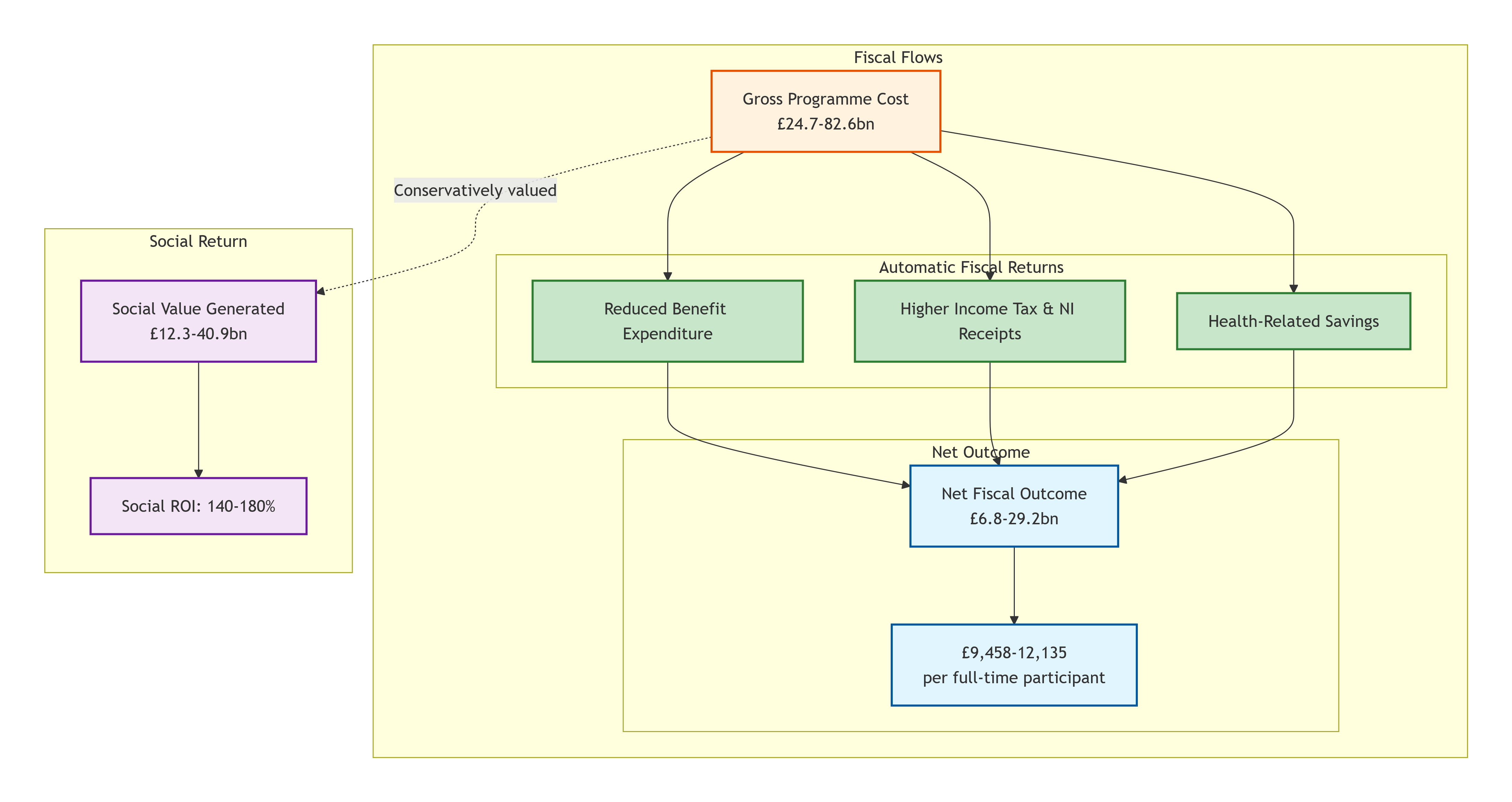
This implies a net fiscal outcome of £6.8–£29.2 billion, or approximately £9,458–£12,135 per full-time participant. The net fiscal cost per participant is substantially lower than the gross wage cost, reflecting automatic fiscal returns (Pino, Armstrong and Laughton, 2026).
Output and employment effects. Aggregate output is estimated to rise by 0.6–2.6 per cent in the first year, with private-sector employment increasing by 0.2–0.7 per cent. Over the first five years, the programme is estimated to raise average annual GDP growth by approximately 1.3 per cent under low uptake and 4.2 per cent under high uptake, generating cumulative private-sector employment gains of approximately 1.6 per cent and 5.3 per cent respectively. These effects reflect sustained wage-driven consumption, adjusted for import-demand leakages (Pino, Armstrong and Laughton, 2026).
Social value. Social value generated is estimated at £12.3–£40.9 billion, corresponding to a social return on investment of 140–180 per cent. This calculation incorporates the value of work undertaken by participants (conservatively assuming 50 per cent of the productivity of comparable non-JG employment) and the monetised value of health improvements using the Quality-Adjusted Life Year framework. Many broader benefits—including family stability, educational attainment, crime reduction, skills preservation, and regional economic rebalancing—fall outside these calculations, suggesting the true social return is likely considerably higher (Pino, Armstrong and Laughton, 2026).
Anti-inflationary function. The JG functions as a counter-inflationary mechanism. The fixed JG wage anchors pay formation across the economy, stabilising prices without relying on unemployment as the primary inflation-control instrument (Wray, 1998).
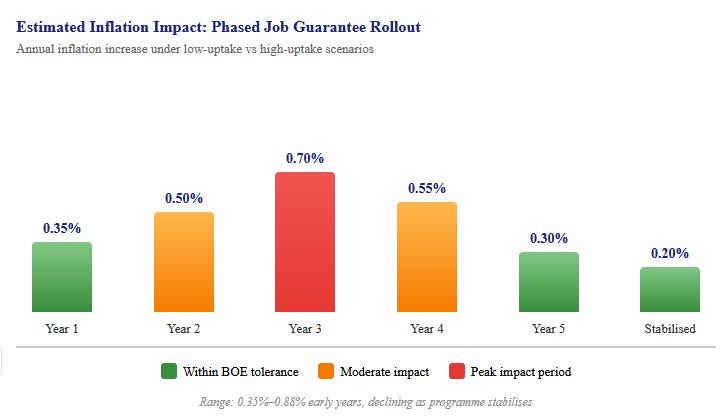
Modelling suggests any initial inflationary impact from raising the wage floor would be small, temporary, and within the Bank of England’s typical tolerance range. Under a phased rollout, the estimated annual inflation impact ranges from 0.35 per cent to 0.88 per cent in the early years, declining as the programme stabilises (Pino, Armstrong and Laughton, 2026).
Environmental and regional benefits. The proposal directs employment toward labour-intensive environmental projects—retrofitting, conservation, flood resilience, and ecosystem restoration—supporting net-zero commitments. It alleviates regional inequalities by directing jobs to areas with the highest unemployment and serves as a mechanism for a just transition, providing employment bridges for workers exiting high-carbon industries (Pino, Armstrong and Laughton, 2026).
Health and social outcomes. The proposal anticipates major improvements in mental and physical health, family stability, child wellbeing, educational attainment, crime reduction, and community safety. These outcomes are both socially significant and fiscally relevant, as they reduce pressure on health, welfare, and social-care systems (Pino, Armstrong and Laughton, 2026).
A Comprehensive Suite of Stabilisation Instruments
The combination of lender-of-last-resort (LOLR), employer-of-last-resort (ELR) and, by extension, a third category—spender of last resort (SLR)—would furnish the state with a comprehensive suite of stabilisation instruments.
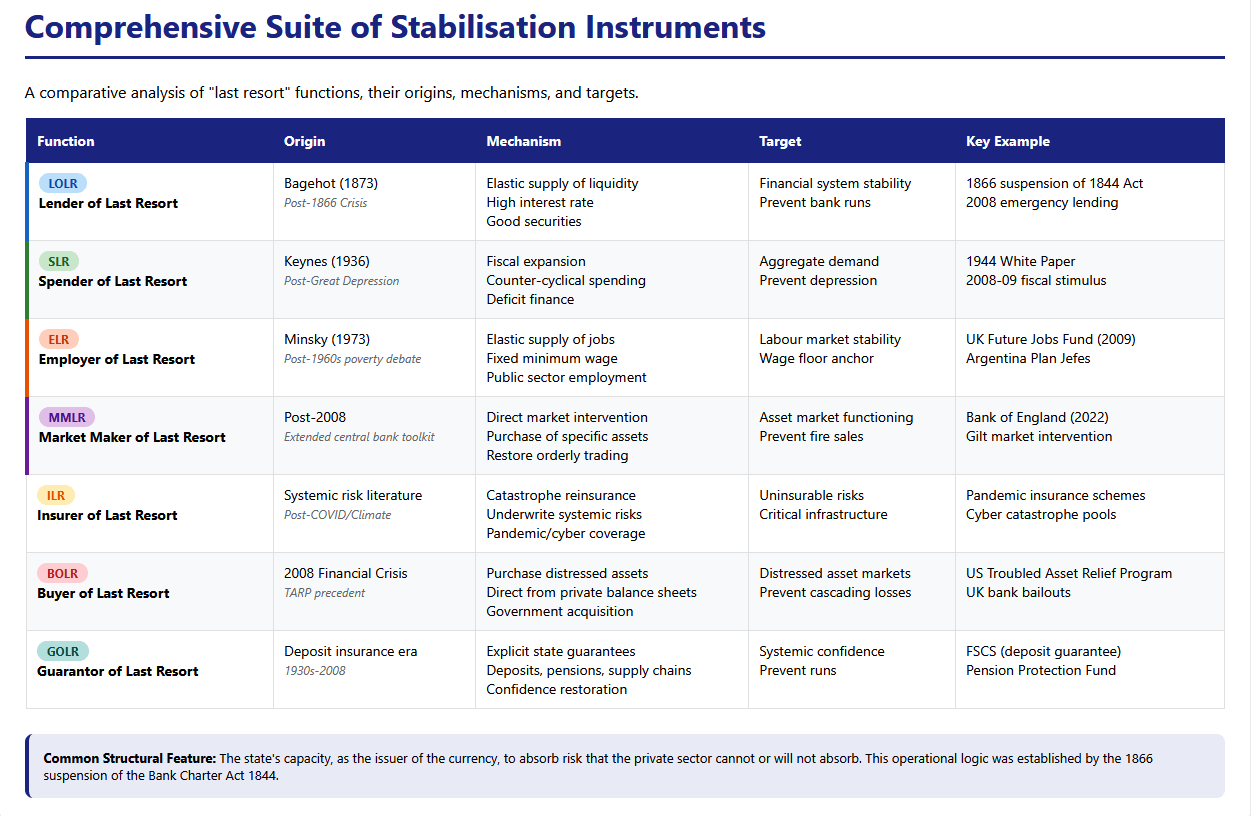
The lender-of-last-resort function provides an elastic supply of liquidity to the financial system during a panic, preventing solvent institutions from failing due to a temporary shortage of cash. The employer-of-last-resort function provides an elastic supply of jobs to the labour market during a downturn, preventing a collapse in aggregate demand and maintaining the wage floor. The spender-of-last-resort function—derived from Keynes—provides for fiscal expansion when private sector demand has collapsed, ensuring that the government does not compound a private sector deleveraging with its own contraction. The three functions are complementary. The LOLR stabilises asset prices and the payments system. The ELR stabilises income flows and the consumption base. The SLR stabilises aggregate demand when both private investment and consumption are insufficient. Together, they address the financial, real and demand-side dimensions of a crisis.
Several additional facilities of last resort merit investigation. The market-maker of last resort (MMLR) would see the central bank intervene directly in specific asset markets—government bonds, corporate debt, or mortgage-backed securities—to restore orderly trading when private market-makers withdraw. The Bank of England’s 2022 gilt market intervention constituted an instance of this function (Bank of England, 2023). The insurer of last resort would see the state provide catastrophe reinsurance or underwrite systemic risks that private insurers cannot price or absorb—pandemics, natural disasters, or cyber-attacks on critical infrastructure. The buyer of last resort would see the state purchase distressed assets directly from private balance sheets, as occurred during the 2008 financial crisis with the US Troubled Asset Relief Program. The guarantor of last resort would see the state provide explicit guarantees on bank deposits, pensions, or critical supply chains, thereby preventing runs and ensuring continuity of essential services. Each of these facilities addresses a distinct form of market failure: illiquidity, uninsurability, distressed asset sales, and loss of confidence. Their common structural feature is the state’s capacity, as the issuer of the currency, to absorb risk that the private sector cannot or will not absorb. The operational logic established by the 1866 suspension—that a sovereign monetary authority possesses the capacity to issue liabilities without prior taxation—underwrites each of these functions.
Bibliography
Ali, T. (2011) The UK Future Jobs Fund: Labour’s adoption of the ‘employer of last resort’ concept. MPRA Paper No. 29422. Available at: https://mpra.ub.uni-muenchen.de/29422/1/UK_Future_Jobs_Fund.pdf (Accessed: 3 August 2026).
Bagehot, W. (1873) Lombard Street: A description of the money market. London: Henry S. King & Co. Available at: https://www.econlib.org/library/Bagehot/bagLomb.html (Accessed: 3 August 2026).
Bank of England (1971) ‘Competition and Credit Control’, Quarterly Bulletin, June. Available at: https://www.bankofengland.co.uk/-/media/boe/files/quarterly-bulletin/1971/competition-and-credit-control.pdf (Accessed: 3 August 2026).
Bank of England (1972) ‘Commentary’, Quarterly Bulletin, Q1. Available at: https://www.bankofengland.co.uk/-/media/boe/files/quarterly-bulletin/1972/commentary-qb-1972-q1.pdf (Accessed: 3 August 2026).
Bank of England (2023) ‘Financial stability buy/sell tools: a gilt market case study’, Quarterly Bulletin. Available at: https://www.bankofengland.co.uk/quarterly-bulletin/2023/2023/financial-stability-buy-sell-tools-a-gilt-market-case-study (Accessed: 3 August 2026).
Bank of England (2025) ‘Muddling through or tunnelling through? UK monetary and fiscal exceptionalism’. Working Paper No. 1123. Available at: https://www.bankofengland.co.uk/-/media/boe/files/working-paper/2025/muddling-through-or-tunnelling-through-uk-monetary-and-fiscal-exceptionalism-online-appendices.pdf (Accessed: 3 August 2026).
Bordo, M.D., Bush, O. and Thomas, R. (2025) A Narrative Account of the Great Inflation in the UK 1961-1997. Hoover Institution Economics Working Paper 25115. Available at: https://hoover-s3-website.s3.us-west-2.amazonaws.com/s3fs-public/research/docs/25115-Bordo-Bush-Thomas.pdf (Accessed: 3 August 2026).
CMIE (2020) ‘Jobs returning, unemployment rate back at pre-lockdown levels’, The Times of India, 24 June. Available at: https://timesofindia.indiatimes.com/business/india-business/cmie-unemployment-rate-back-to-pre-lockdown-level-of-8-5/amp_articleshow/76540727.cms (Accessed: 3 August 2026).
Flandreau, M. (1996) Central Bank co-operation in historical perspective. OFCE Working Paper 96-06. Available at: https://www.ofce.sciences-po.fr/pdf/dtravail/WP1996-06.pdf (Accessed: 3 August 2026).
Fulmer, S. (2022) ‘United Kingdom: Bank of England Lending during the Panic of 1866’, Journal of Financial Crises, 4(2), pp. 1053-1073. Available at: https://elischolar.library.yale.edu/journal-of-financial-crises/vol4/iss2/48/ (Accessed: 3 August 2026).
HC Deb (1972) Budget Resolutions And Economic Situation, 27 March, vol 834. Available at: https://hansard.parliament.uk/commons/1972-03-27/debates/e2ee1798-c1c3-4add-9236-e82087765752/BudgetResolutionsAndEconomicSituation (Accessed: 3 August 2026).
HC Deb (1981) Budget Resolutions, 09 March, vol 1. Available at: https://hansard.parliament.uk/commons/1981-03-09/debates/BudgetResolutions (Accessed: 3 August 2026).
HC Deb (1984) Engagements, 6 December, vol 69, col 495. Available at: https://www.margaretthatcher.org/document/105809 (Accessed: 3 August 2026).
HM Government (1944) Employment Policy after the War (Cmd. 6527). London: HMSO.
Hauser, A. (2016) ‘The demise of Overend Gurney’, Bank of England Quarterly Bulletin, Q2. Available at: https://www.bankofengland.co.uk/-/media/boe/files/quarterly-bulletin/2016/the-demise-of-overend-gurney.pdf (Accessed: 3 August 2026).
Keynes, J.M. (1936) The General Theory of Employment, Interest and Money. London: Macmillan.
Kostzer, D. (2008) ‘Argentina: A Case Study on the Plan Jefes y Jefas de Hogar Desocupados, or the Employment Road to Economic Recovery’, Levy Economics Institute Working Paper, No. 534. Available at: https://www.levyinstitute.org/pubs/wp_534.pdf (Accessed: 3 August 2026).
Laidler, D. and Parkin, M. (1976) ‘Inflation in Britain: A Monetarist Perspective’, The Economic Journal, 86(343), pp. 477-503.
Minsky, H.P. (1965) ‘The Role of Employment Policy in the War on Poverty’, in The Poverty of Affluence. New York: Free Press.
Minsky, H.P. (1973) ‘The Strategy of Economic Policy and Income Distribution’, The ANNALS of the American Academy of Political and Social Science, 409(1), pp. 92-101. Available at: https://ideas.repec.org/a/sae/anname/v409y1973i1p92-101.html (Accessed: 3 August 2026).
Minsky, H.P. (1986) Stabilizing an Unstable Economy. New Haven, CT: Yale University Press.
Mitchell, W. and Fazi, T. (2017) Reclaiming the State: A Progressive Vision of Sovereignty for a Post-Neoliberal World. London: Pluto Press.
Pino, P., Armstrong, J. and Laughton, J. (2026) A Counter-inflationary Job Guarantee for the United Kingdom. London: MMTUK Policy Research Group. Available at: https://mmtuk.org/research/job-guarantee/ (Accessed: 3 August 2026).
Reid, M. (1982) The Secondary Banking Crisis, 1973-75. London: Macmillan.
Stone, J. and Padley, M. (2025) A Minimum Income Standard for the United Kingdom in 2025. York: Joseph Rowntree Foundation. Available at: https://www.jrf.org.uk/a-minimum-income-standard-for-the-united-kingdom-in-2025 (Accessed: 3 August 2026).
Tcherneva, P.R. (2018) ‘The Job Guarantee: Design, Jobs, and Implementation’, Levy Economics Institute Working Paper, No. 902. Available at: https://www.levyinstitute.org/pubs/wp_902.pdf (Accessed: 3 August 2026).
Thatcher, M. (1983) Speech to Conservative Party Conference, 14 October. Available at: https://www.margaretthatcher.org/document/105454 (Accessed: 3 August 2026).
Wray, L.R. (1998) Understanding Modern Money: The Key to Full Employment and Price Stability. Cheltenham: Edward Elgar.