
The Cure
Treating Malignant Metastatic Mismanagement

A Graphic Novella
Part 2 of a 3 part series.

The Real Resource Diagnosis

The United Kingdom is a currency-issuing state with a floating exchange rate. It is the monopoly creator of the pound sterling. It can never suffer a fiscal infarction, nor can it be involuntarily insolvent on obligations denominated in its own currency. Government spending is not, operationally, a matter of collecting tax receipts and then distributing them; it is a process by which the state instructs its central bank to credit the reserve accounts of commercial banks—a simple, electronic annotation of the ledger. Taxation exists not to fund spending but to manage aggregate demand, anchor the currency’s value, and create a public need for the state’s money. The only authentic clinical risk is not a deficit on a spreadsheet, but the potential for real resource exhaustion: a situation in which the government’s intention to purchase labour, steel, concrete, and pharmaceuticals exceeds the physical capacity of the economy to supply them without generating damaging inflation.
Applied to the NHS, this diagnosis transforms the clinical picture from one of terminal poverty to one of grotesque, wilful waste. The UK currently possesses an extraordinary abundance of the most critical real resource for healthcare: thousands of fully trained, unemployed or underemployed doctors, nurses, and allied health professionals. This is not a funding crisis; it is a deliberate refusal to mobilise the resources that sit in plain sight. Every unemployed doctor is an operating theatre that lies dark, a diagnostic clinic that remains unstaffed, a waiting list that continues to grow. The state is not a helpless observer at the bedside of a dying relative; it is a physician who possesses the full therapeutic arsenal and has chosen, on ideological grounds, to lock the drug cabinet and claim that the medicine does not exist.

A Therapeutic Protocol for National Recovery
An MMT-informed government would design fiscal policy according to real clinical outcomes, not arbitrary deficit targets. The treatment protocol to halt and reverse the NHS’s politikogenic decline involves three immediate interventions.
First, a Clinical Employment Guarantee
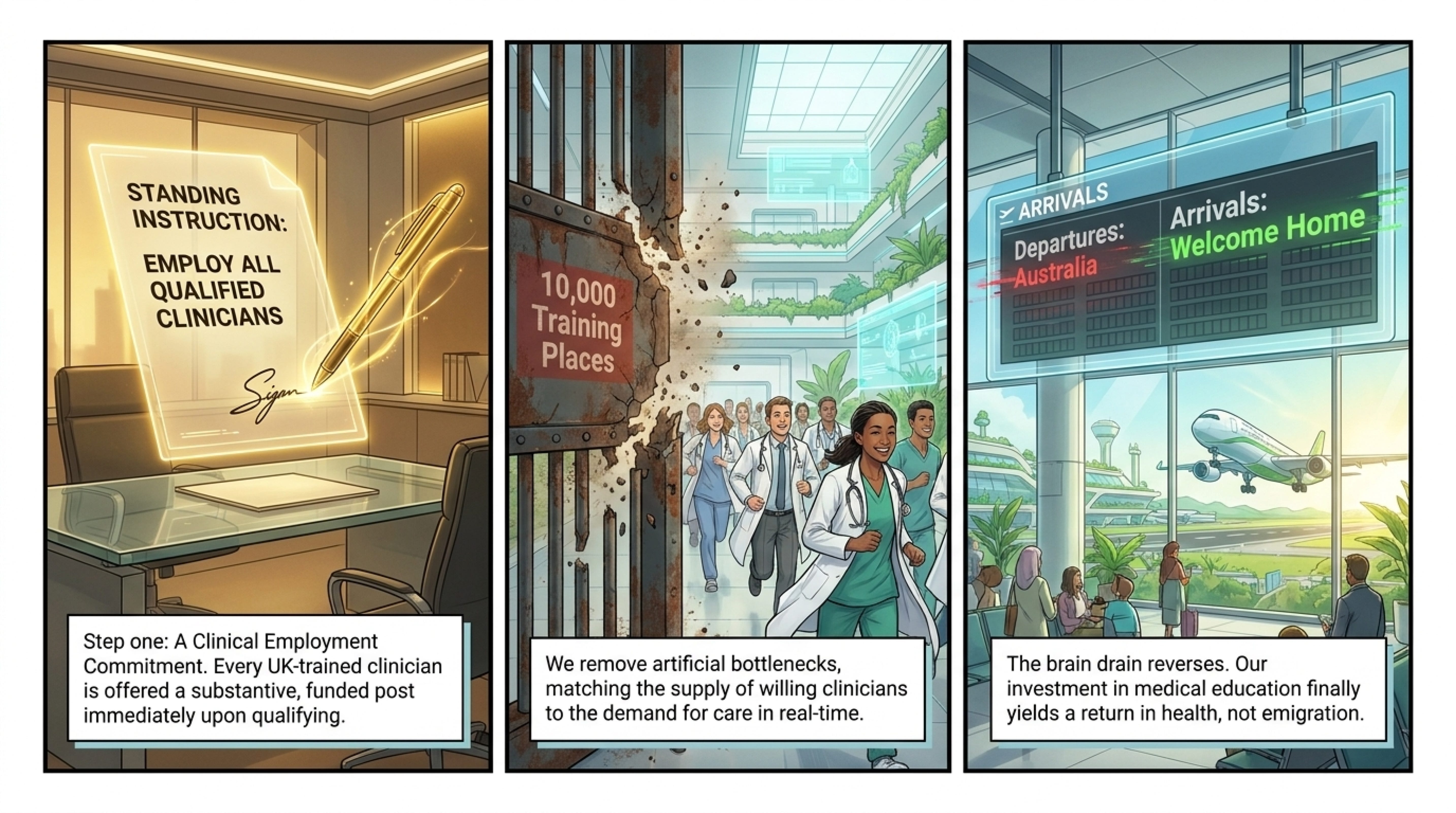
The Treasury must issue a standing instruction to NHS England: every UK-trained doctor, nurse, or midwife who passes their final examinations and wishes to serve in the public system shall be offered a substantive, funded post within three months. This is not a “recruitment drive”; it is an operational directive, executable via a simple amendment to the Department of Health’s Estimate. The artificial stricture of specialty training places—currently forcing thirty thousand doctors to compete for ten thousand posts—would be surgically removed. In its place: a dynamic workforce-planning mechanism, modelled on the Bank of England’s forecasting framework, that matches the supply of willing, qualified clinicians to the demand for care in real time. The cost? A ledger entry. The benefit? An instant reversal of the brain drain, an end to the moral scandal of medically induced unemployment, and a guarantee that the public’s immense investment in medical education yields a return in public health, not private emigration.
Second, Direct Public Investment to Reclaim Outsourced Services
As private contracts expire—as they do, in rolling succession, every quarter—the state would simply decline to renew them. Instead, NHS Property Services would be empowered to commission new, publicly owned diagnostic centres and surgical hubs, using the Treasury’s currency-issuing capacity to credit the accounts of construction firms, equipment manufacturers, and NHS trusts directly. This is not a “fundraising exercise”; it is an administrative operation, identical in mechanics to the Bank of England’s quantitative easing—but directed toward real, productive capacity rather than financial assets. The real resources—the bricks, the scanners, the thousands of clinicians currently idle—exist in abundance. The state need only coordinate what is already present, mobilising idle labour to treat the untreated. Every pound spent in this manner is a pound that circulates within the domestic economy, generating employment, tax receipts, and, most critically, health outcomes.

PFI was never a fiscal necessity; it was a distributional choice to guarantee private returns via public revenue streams—a deliberate channelling of state spending power into shareholder hands. Reversing it requires nothing more than the political will to redirect that power.

Third, Rigorous Redefinition of the Physician Associate Role
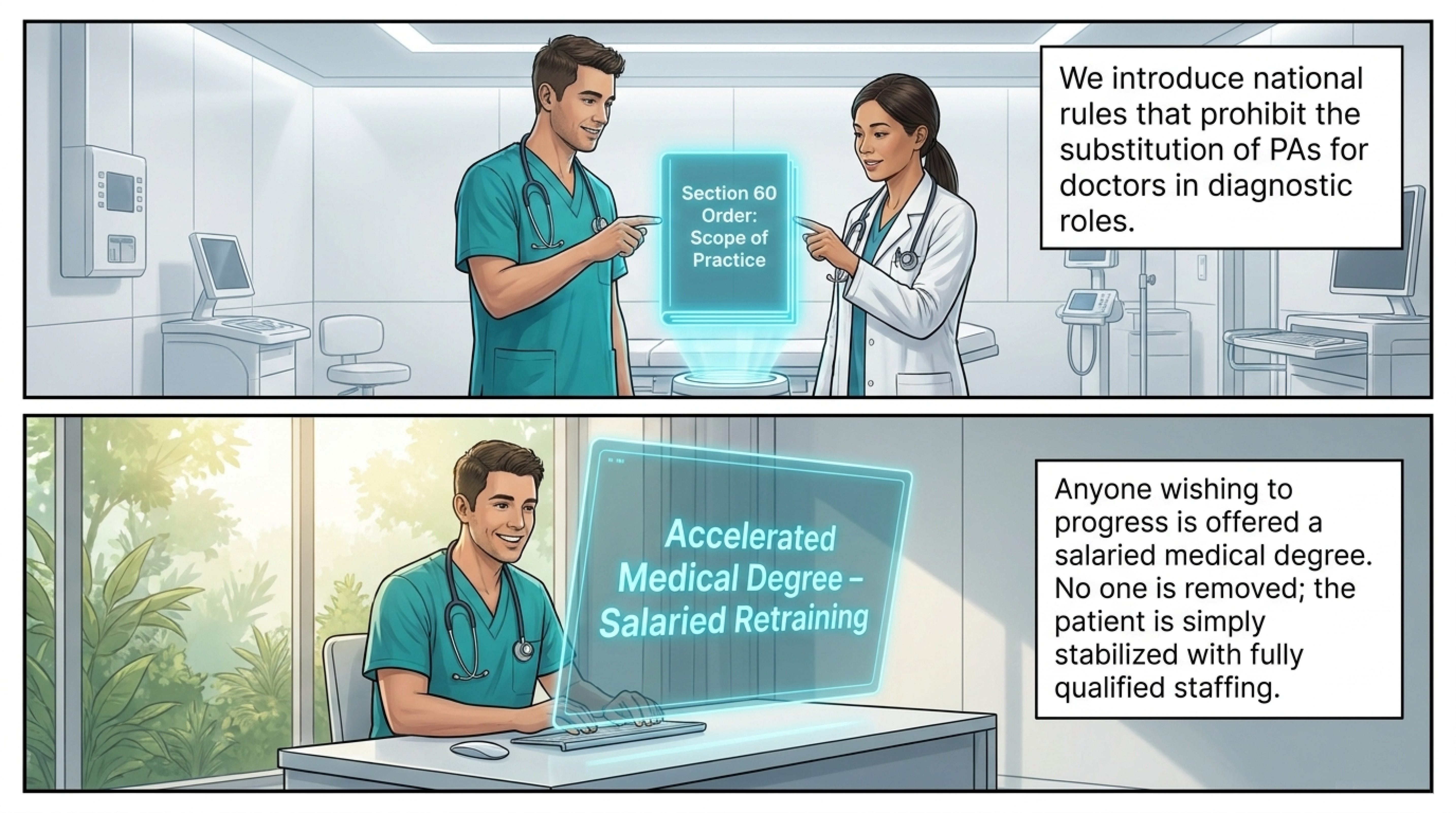
The General Medical Council would be instructed—via a Section 60 order under the Health Act 1999—to introduce enforceable, national scope-of-practice rules prohibiting the substitution of PAs for doctors in diagnostic or treatment decision-making roles. Simultaneously, Health Education England would be directed to fund a retraining pathway: any PA wishing to progress could enrol in a streamlined, salaried medical or nursing degree, with their prior experience credited toward accelerated completion. No one is excised from the workforce; rather, the patient is withdrawn from a dangerous drug and stabilised on a regimen of appropriate, fully qualified clinical staffing. The cost of this transition is trivial compared to the £33 million per month currently wasted on “validation exercises” that delete patients from waiting lists without treating them.
Monitoring the Treatment
How would we monitor efficacy? Not by deficit targets, but by clinical outcomes: waiting lists measured in days, not years; workforce vacancy rates below 5%; patient satisfaction scores that reflect care, not queue management. These are the vital signs of a recovering NHS. Anything less is not prudence—it is malpractice.

The Quackery of Mainstream Rebuttals
Any attempt to administer the cure will provoke a chorus of objection from the established medical-political priesthood. It is essential to understand that these rebuttals are not diagnostic second opinions offered in good faith. They are the defensive symptoms of the very pathology they claim to treat—the fevered hallucinations of a body politic that has been inoculated against fiscal reality.
The Inflation Delirium
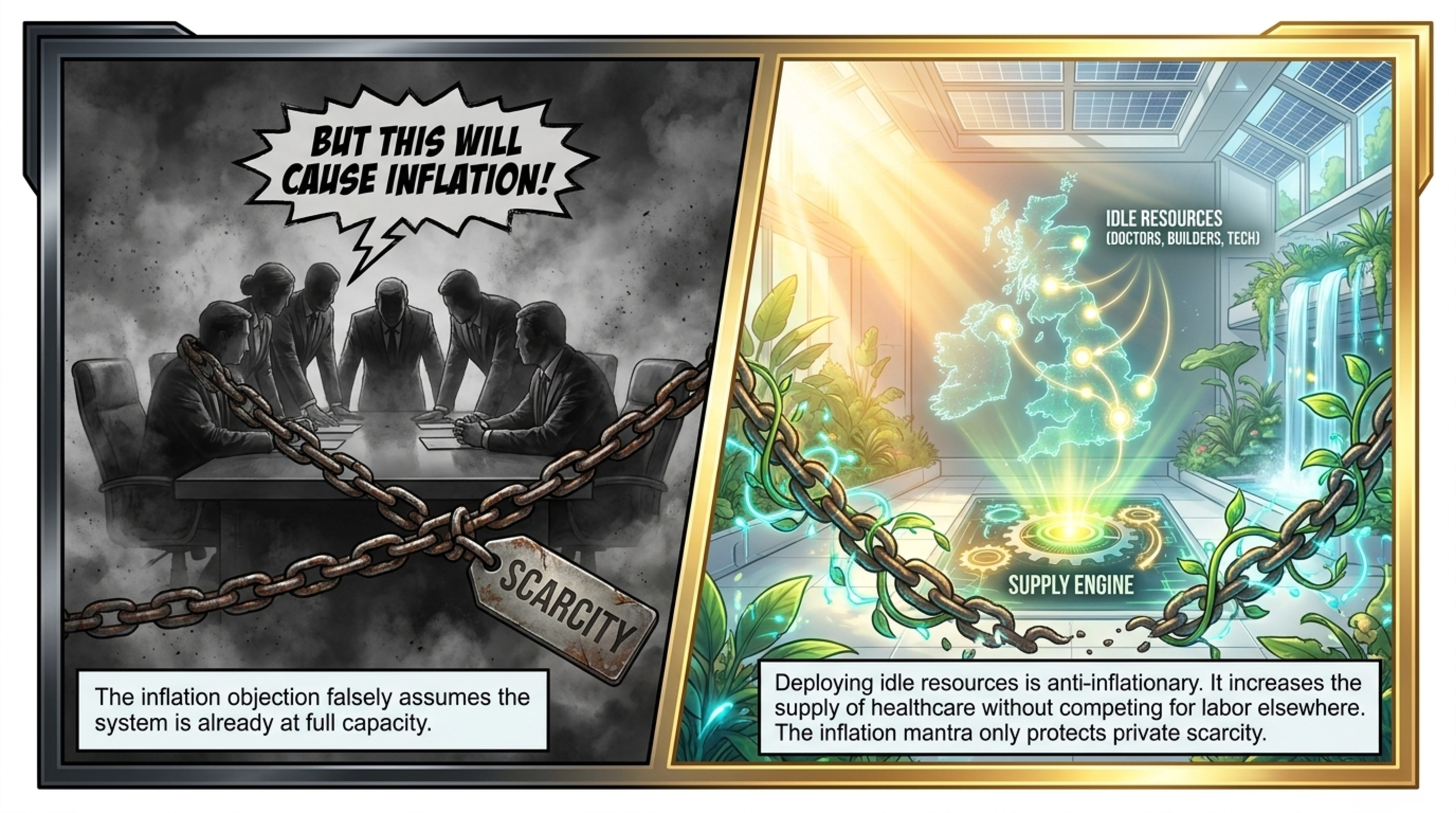
The first objection is that significant public spending on the NHS would generate runaway inflation, drawing resources out of the private economy and precipitating a cost-of-living fever. This argument imagines a body already running at full metabolic capacity, with no idle resources to draw upon. The clinical reality is the opposite: the UK health economy is riddled with slack. The fifty-two per cent of foundation year doctors without substantive posts, the unemployed international graduates, the construction sector that can readily scale to build new facilities—these are dormant metabolic reserves, not an overheated system. Deploying idle resources is anti-inflationary by definition, because it increases the production of genuine healthcare goods and services without bidding labour away from other sectors. Furthermore, reducing waiting lists at scale would directly alleviate the financial pressure on households currently forced into private, out-of-pocket care, a financial pain that is itself a form of inflation experienced by the patient. The inflation objection is not a warning of clinical risk; it is a shamanic chant designed to protect the lucrative scarcity upon which the private medical industry feeds.
The Debt Apoplexy
The second, emotionally charged objection is that increased spending will leave future generations with an unpayable debt, a morbid bequest of interest payments that will overwhelm the public finances. This narrative relies on the false analogy of the household budget, a diagnosis that is clinically inappropriate for a currency-issuing sovereign. The government’s so-called debt is, in reality, the accumulated net financial savings of the non-government sector, held in the safe asset of gilts. It is a liability of the state, but an asset of the pension funds, insurance companies, and citizens who own it. A currency-issuing government that borrows in its own currency never faces a solvency crisis; it can always make all payments as they fall due, mechanically and without drama. For a sovereign issuer, the deficit is not a scorecard of fiscal virtue but a record of net financial assets injected into the private sector. The real burden for our descendants is not a number on a balance sheet; it is the physical inheritance of a collapsed health service, a multimillion-patient waiting list, a chronic shortage of clinicians, and a privatised system that will charge them at the moment of their greatest vulnerability. The debt apoplexy is a politically induced panic attack, a tool of class power designed to maintain a permanent state of fiscal asphyxiation as the only conceivable policy.

The Efficiency Malingering
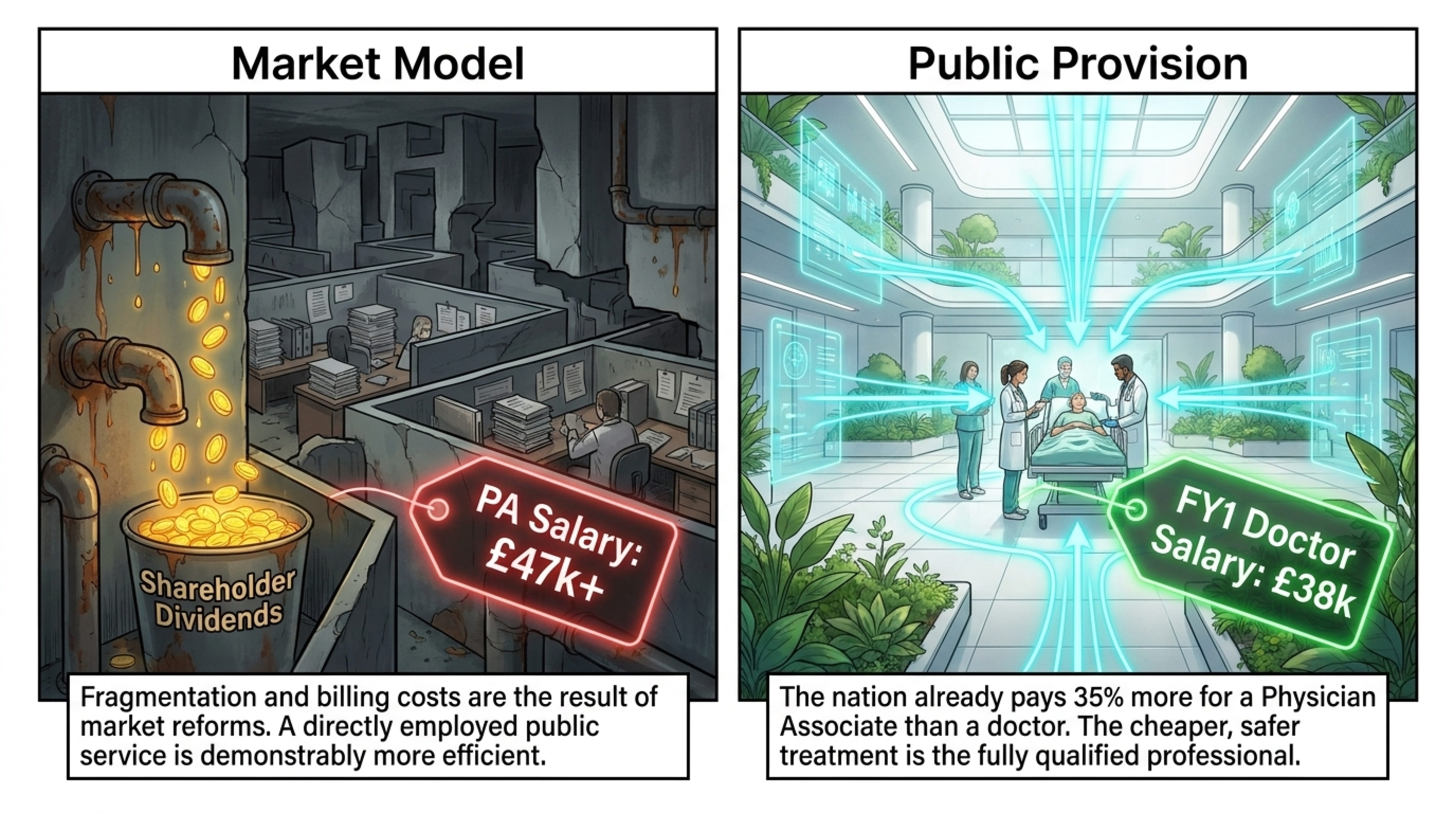
The third objection, delivered with the weary certainty of a quack prescribing bloodletting for every ailment, is that the private sector is inherently more efficient than a public monopoly, and that “throwing money” at the NHS would merely line the pockets of bureaucrats. This claim wilfully ignores the politikogenic origins of the NHS’s inefficiency. The fragmentation, billing costs, and commercial contracting complexities that currently plague the service are the direct consequence of the marketisation reforms that the private sector’s advocates have themselves imposed. A directly employed, publicly provided service, freed from the parasitic drag of shareholder dividends, the tendering industry, and the constant rectification of errors caused by a confused, PA-diluted workforce, would be demonstrably more efficient in real-resource terms. Moreover, the claim that the nation cannot afford doctors is contradicted by the straightforward cost comparison: the state is currently paying thirty-five per cent more for a PA’s starting salary than for a doctor’s. The cheaper, safer, and more effective treatment is the fully qualified medical professional. The efficiency objection is not a plea for sound administration; it is a cynical demand that profit extraction be surgically implanted into the heart of publicly funded care.
The Cure Requires Political Will, Not a Miracle
The fatal pathology of the NHS is, in the final analysis, not iatrogenic but politikogenic. It has been inflicted upon a blameless institution by an ideological programme that uses the language of fiscal necessity to disguise a deliberate dismantling. The metaphors of “tightening our belts”, “living within our means”, and “there is no magic money tree” are not economic truths; they are the toxic prescriptions of a medical establishment that serves the interests of private wealth. The counter-movement must be political in the deepest and most urgent sense. It must refuse to accept the diagnostic framing of the enemy. The question “How will you pay for it?” must be replaced, forthrightly and permanently, with the question “Whose side are you on?” On the one hand: the unemployed doctor, the dying patient on a waiting list, the nurse burned out by years of deliberate understaffing. On the other: the private shareholders, the corporate lobbyists, and the think-tank necromancers who conjure ever more sophisticated justifications for the status quo.

The United Kingdom is a wealthy, resource-rich, currency-issuing state. It possesses the clinicians, the physical capacity, and the technical knowledge to cure the National Health Service. The medicine is available. The clinicians are ready. The only organ that has failed is the collective political will to administer the treatment. The dismantling of the NHS will continue only so long as the public accepts the false prognosis of fiscal terminality. But the truth, established by a thorough clinical investigation, is that the condition is entirely reversible. The patient can be saved—not by miracles, not by magic money trees, but by the routine administration of policies that any currency-issuing state can implement tomorrow. The citizenry must now demand to see the real test results—and then, with the sardonic clarity this moment demands, dismiss the quacks who have been poisoning the well. The alternative is not austerity; it is acquiescence. And acquiescence, in clinical terms, is a death sentence.


Documents of particular relevance
Modern monetary theory for the post-pandemic NHS: why budget deficits do not matter
How We Can Staff the NHS Without Tax Rises
Bibliography
BBC News (2025) ‘Junior doctors strike over job security for first time’, BBC News, 27 October. Available at: https://www.bbc.co.uk/news
British Medical Association (2024) Safe Scope of Practice for Medical Associate Professions: BMA Survey Results. London: BMA.
British Medical Association (2025a) International Medical Graduates in the UK: Employment and Integration. London: BMA.
British Medical Association (2025b) Public Confusion over Medical Roles: Survey Findings. London: BMA.
British Medical Association (2025c) The State of Medical Training: Survey of Foundation Year Doctors. London: BMA.
Carvel, J. (2007) ‘Revealed: the spin guide to selling hospital closures’, The Guardian, 1 July.
Centre for Health and the Public Interest (2026) The Creeping Privatisation of the NHS: An Analysis of the Latest Data. London: CHPI.
Doctors’ Association UK (2024) Position Statement on the Substitution of Doctors with Non-Doctor Roles. London: DAUK.
Dropkin, J. (2023) Integrated Care Boards and the Private Sector. Keep Our NHS Public. Available at: https://www.keepournhspublic.com
Health and Care Act 2022 (c. 31). London: The Stationery Office.
Health and Social Care Act 2012 (c. 7). London: The Stationery Office.
Health Service Journal (2026) ‘Hospitals paid £3m a month to delete patients from waiting lists’, Health Service Journal, 12 February.
Kelton, S. (2020) The Deficit Myth: Modern Monetary Theory and the Birth of the People’s Economy. New York: PublicAffairs.
Leng, G. (2019) Physician Associates and Anaesthesia Associates in the NHS: A Review of the Evidence. London: Health Education England.
Mitchell, W., Wray, L.R. and Watts, M. (2019) Macroeconomics. London: Red Globe Press.
Murphy, R. (2025) ‘The NHS and the currency-issuing state: why affordability is not the issue’, Tax Research UK, 15 January. Available at: https://www.taxresearch.org.uk
Nersisyan, Y. and Wray, L.R. (2021) Can the UK Afford a Well-Funded NHS? A Modern Money Theory Perspective. Working Paper No. 987. Annandale-on-Hudson, NY: Levy Economics Institute.
Nuffield Trust (2024) The Public-Private Mix in the NHS: Evidence and Implications. London: Nuffield Trust.
The Guardian (2002) ‘NHS spending millions on public relations to manage reputation’, 5 March.
The Guardian (2026) ‘Labour candidate for Gorton revealed as former health lobbyist who backed NHS privatisation’, 14 March.
The King’s Fund (2023) NHS Funding: The Long-Term Gap. London: The King’s Fund.
The Sunday Times (2025) ‘Patients died after being misdiagnosed by physician associates, families claim’, 22 June.
Transparency International UK (2023) Revolving Doors in the Health Sector: Risks and Reform. London: Transparency International UK.
UK Foundation Programme Office (2025) 2025 Foundation Programme Allocation Statistics. London: UKFPO.
UK Parliament (2026) ‘Debate on NHS privatisation and independent sector involvement’, Hansard, 2 April, cols. 345–412. London: The Stationery Office.
Wray, L.R. (2015) Modern Money Theory: A Primer on Macroeconomics for Sovereign Monetary Systems. 2nd edn. Basingstoke: Palgrave Macmillan.
Wright, J. (2026) ‘Labour pays millions to make hospital stats more flattering’, The Times, 12 February.