
The Other GEMMs
Government Engineered Money Makers

A Graphic Novella

The mythology of Silicon Valley is one of the most enduring fables of modern capitalism. In this telling, visionary entrepreneurs tinkered in suburban garages, venture capitalists took bold bets, and the free market rewarded genius with untold riches. It is a seductive narrative—and almost entirely wrong.
The truth, documented by historians and economists alike, is that the modern technology and finance economy was not merely aided by the state; it was built by it, sustained by it, and continues to depend upon it. From the microchips in your iPhone to the rockets that reach orbit, from the financial centres of Singapore to the bailouts that saved global banking, the state is the silent, indispensable partner in every “free market” success story.
This article traces that history—and, in doing so, addresses the central critique levelled against those who point it out: the so-called “touch fallacy”.
The Touch Fallacy and Its Limits

The critic’s objection is methodologically sound: “the state touched it, therefore the state caused it” is a logical fallacy. Mere presence does not prove necessity. If the state funded a project that would have happened anyway, then the “touch” is incidental.
This is a legitimate epistemic point. It demands counterfactuals: “Would this have happened without the state?”
But here is the problem: the critic has not built a credible counterfactual for any of the cases we are about to examine. The assertion that private capital would have built the internet, GPS, SpaceX’s rockets, or the iPhone’s core technologies is not economics; it is wishful thinking—an untestable assertion dressed as rigorous scepticism.
The state did not just fund these technologies randomly—it acted as the de-risker of first resort and market maker. Private capital explicitly refused to fund things like the early internet because the time-horizon to profitability was decades away.
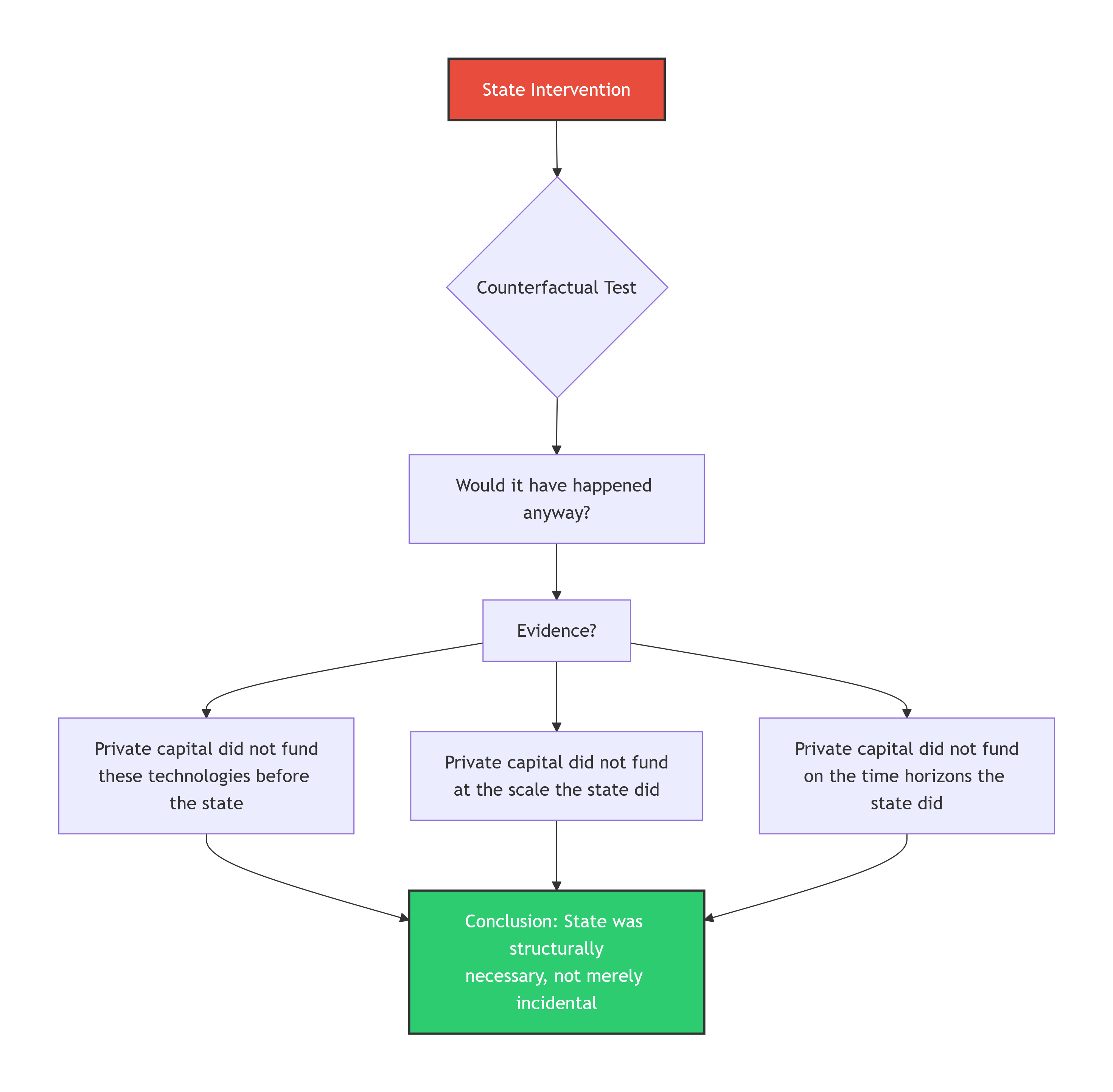
The pattern is the proof. When the state’s involvement is not a single touch but a systemic, sustained, and structural relationship, the “touch” ceases to be a fallacy. It becomes the structural condition of the market’s existence. The critic’s objection would be valid if we were pointing to a single, incidental grant. But we are pointing to the constitutive role of the state in building the very infrastructure upon which private enterprise depends.
Silicon Valley—A Military Creation
The Pentagon as First Venture Capitalist

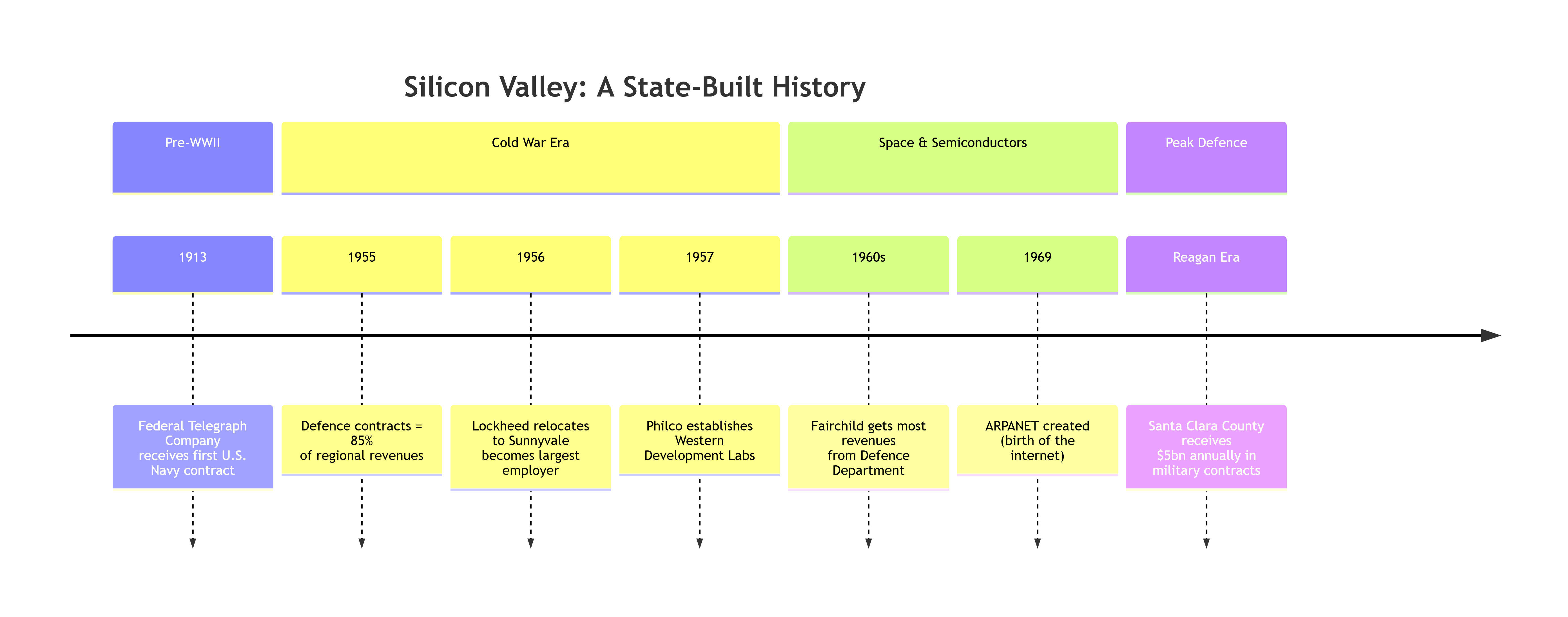
Silicon Valley’s origin story begins not with the personal computer, but with the Cold War. In the 1950s, the region surrounding Mountain View, California, was quiet agricultural land. That changed when the U.S. government, eager to establish technological dominance over the Soviet Union, began funnelling massive sums into research and development.
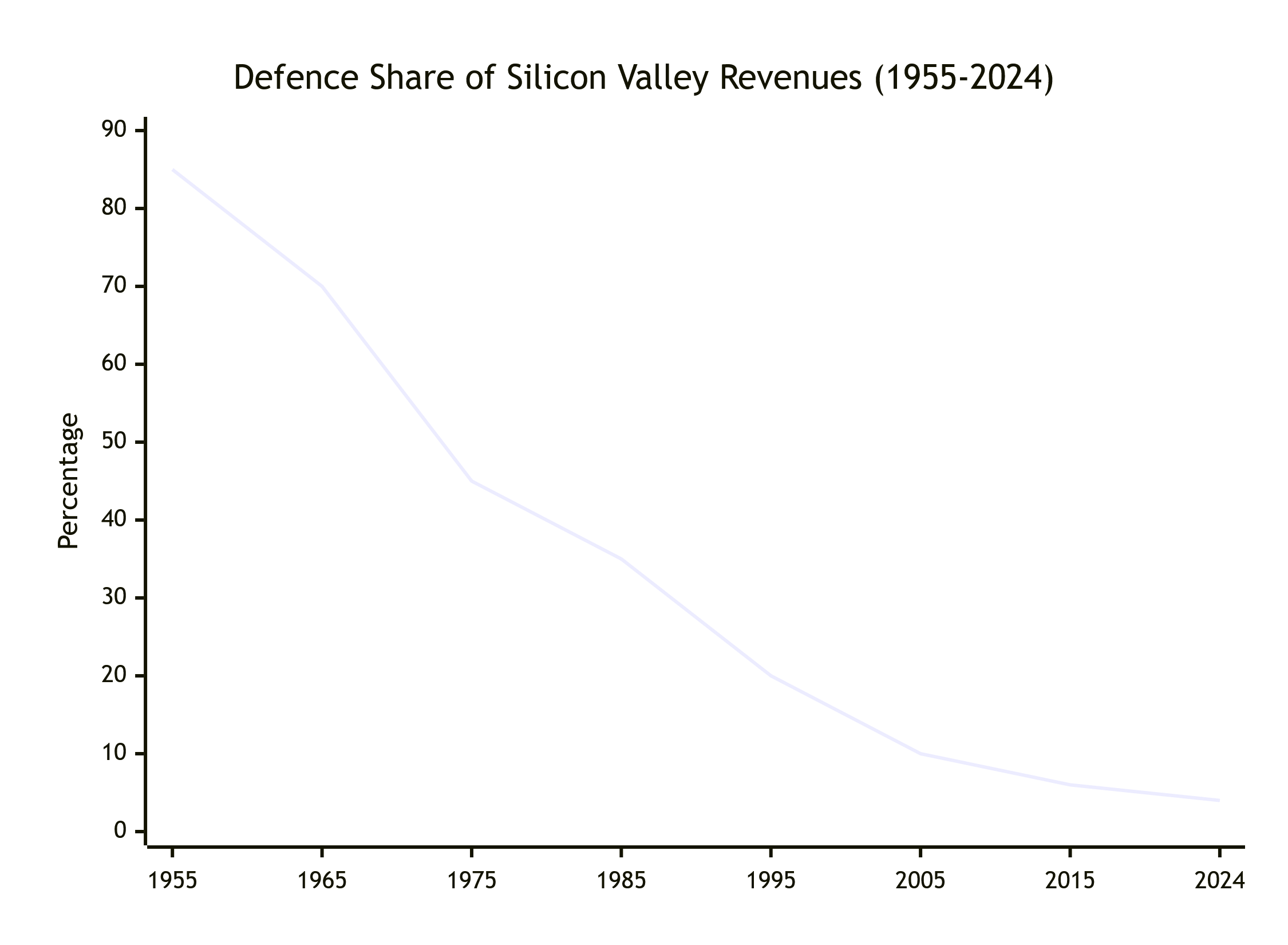
In 1955, defence-related contracts accounted for an estimated 85% of the region’s total revenues [1]. The integrated circuit itself was a military procurement project. Fairchild Semiconductor—the “proto-company” that seeded nearly every important Silicon Valley firm of the era—got most of its revenues from the Defence Department. Its very first customers were the Air Force and the Minuteman missile programme. Early on, NASA was buying 60% of the integrated circuits produced in the United States [2].
Defence’s share of Silicon Valley revenues fell from 85% in 1955 to roughly 6% by the mid-1990s, to under 3% by 2018. But the relationship never ended; it merely evolved. Today, the Pentagon is spending billions on Big Tech and Silicon Valley startups as it goes all-in on AI.
Silicon Valley: Defence Revenue Share Over Time
Key Milestones
The iPhone—The Ultimate State-Funded Product
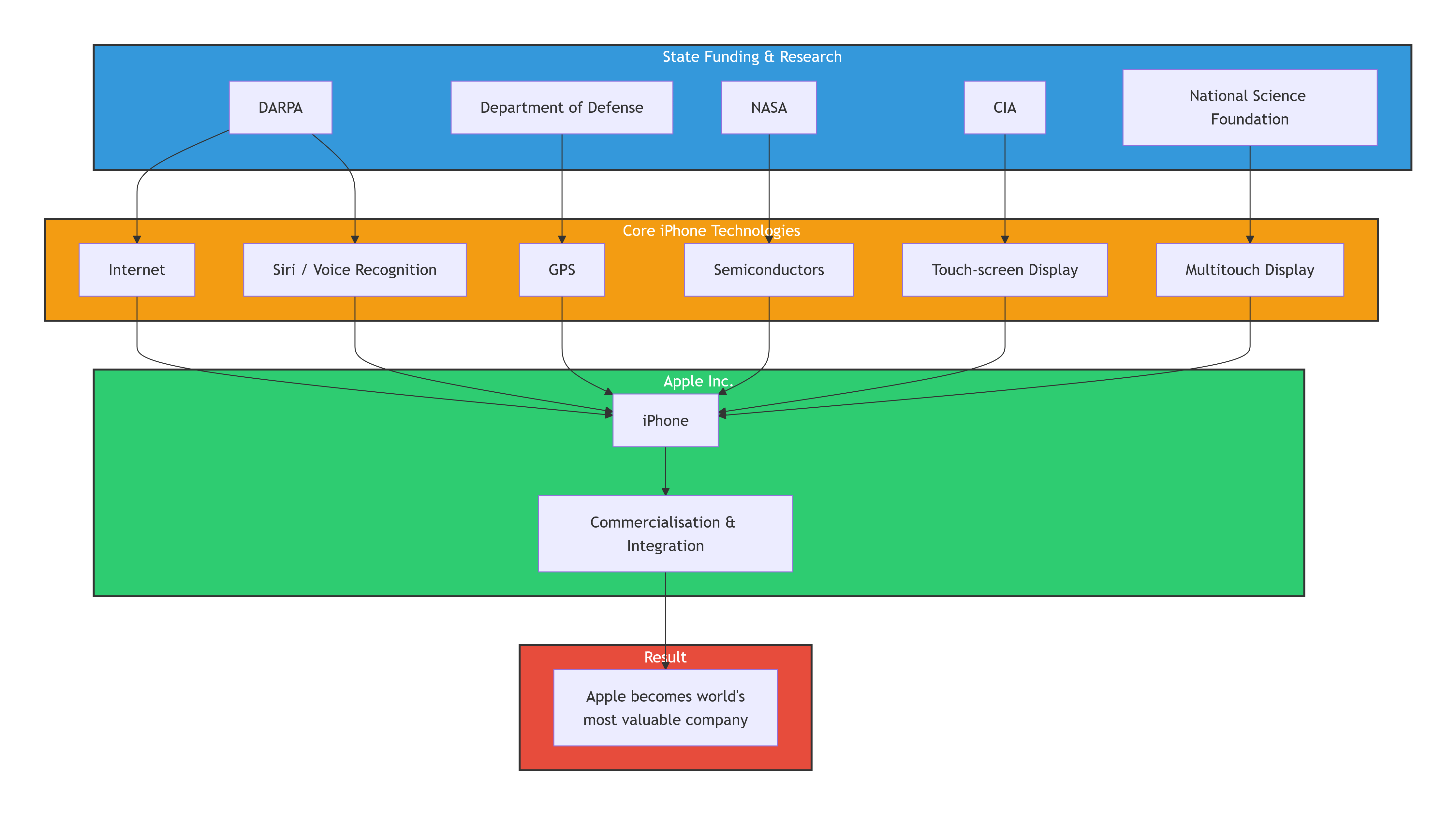
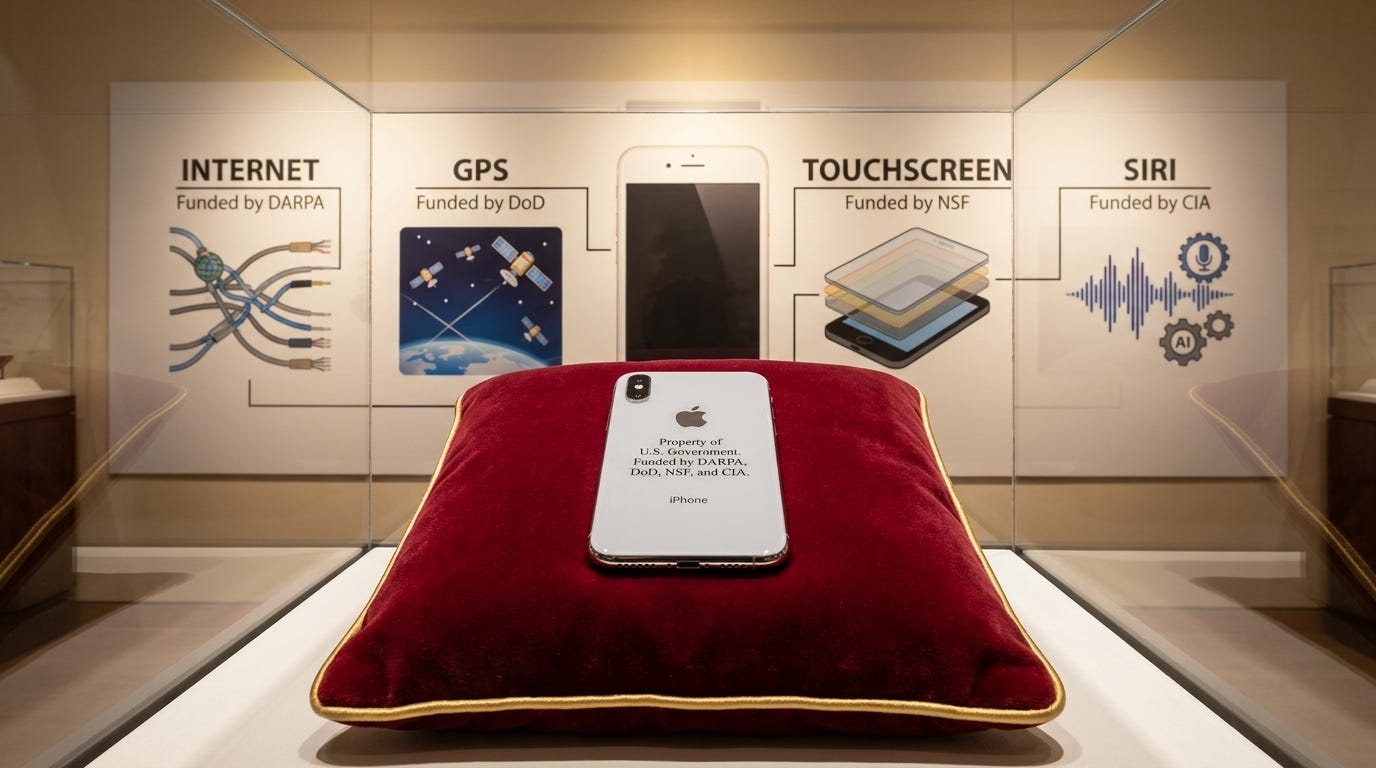
No example illustrates the state’s foundational role better than the iPhone—often seen as the ultimate symbol of private-sector genius. Yet almost every technology that makes the iPhone “smart” was funded by the U.S. government.
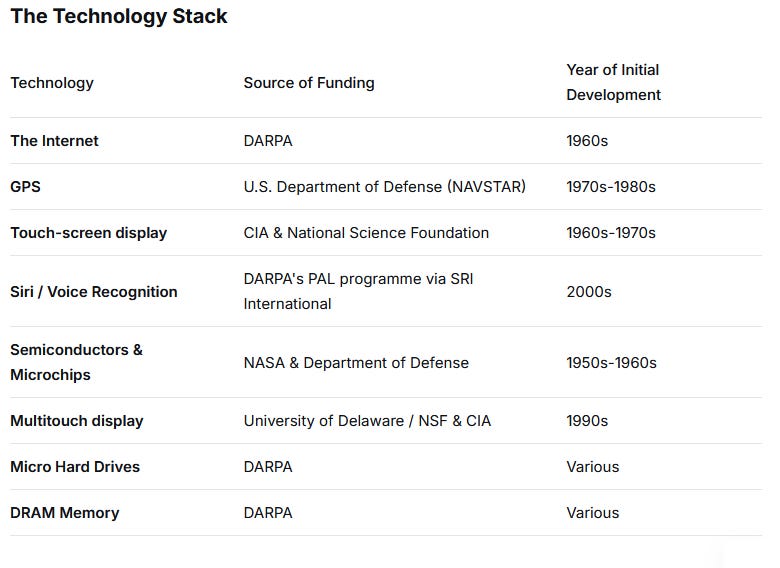
The iPhone’s Hidden State Footprint
Apple’s Early State Funding
Apple did not merely benefit from government-funded research; it also received its early-stage finance from the U.S. government’s Small Business Investment Company (SBIC) programme. In 1978, federal money was invested in Apple when the company had just 63 employees and was making less than $50,000 per year [3].
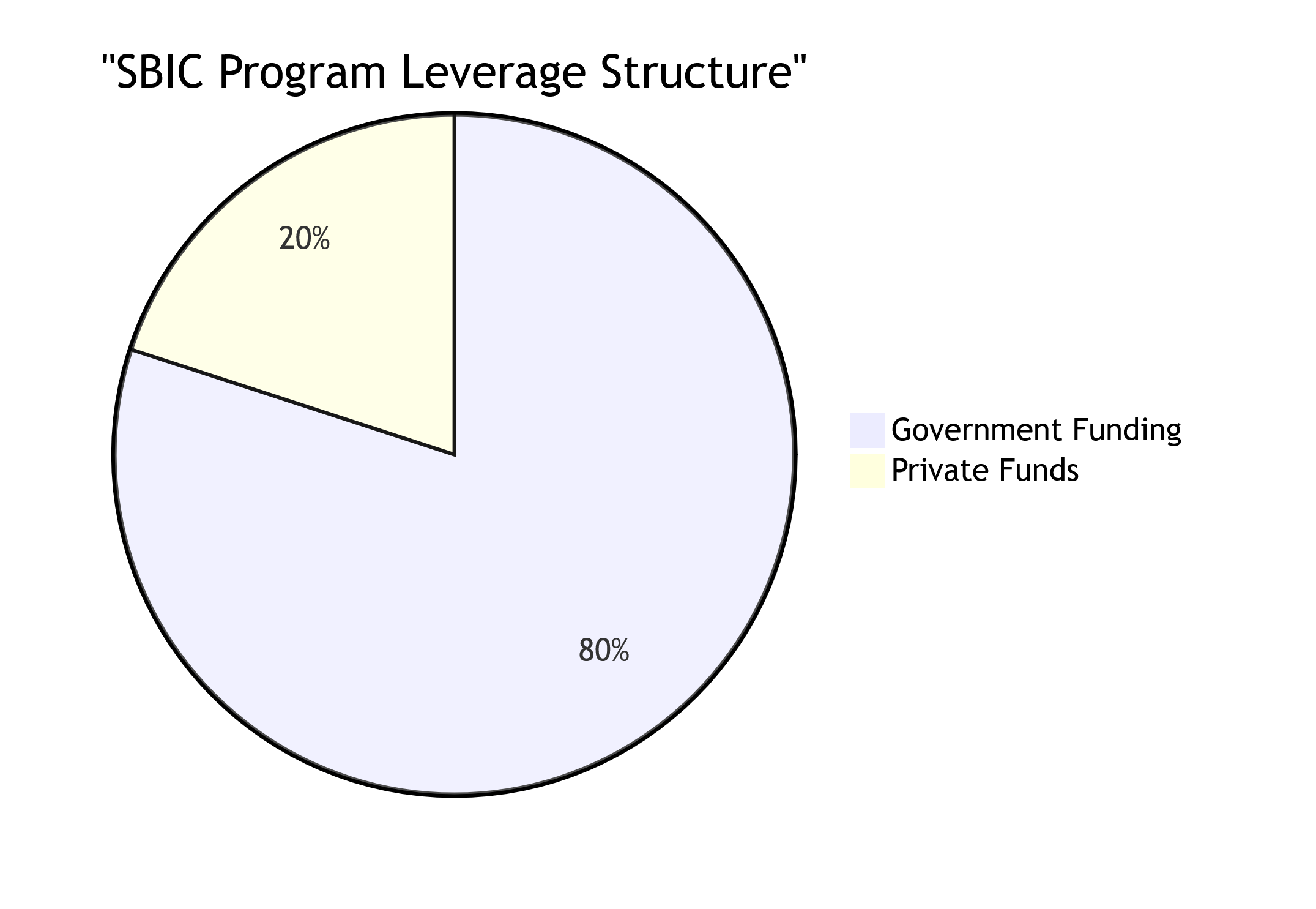
The government provided $4 of leverage for every $1 of private funds [4]. The government took the risk; the investors who held Apple stock reaped the benefits.
The Musk Empire—$38 Billion in State Support
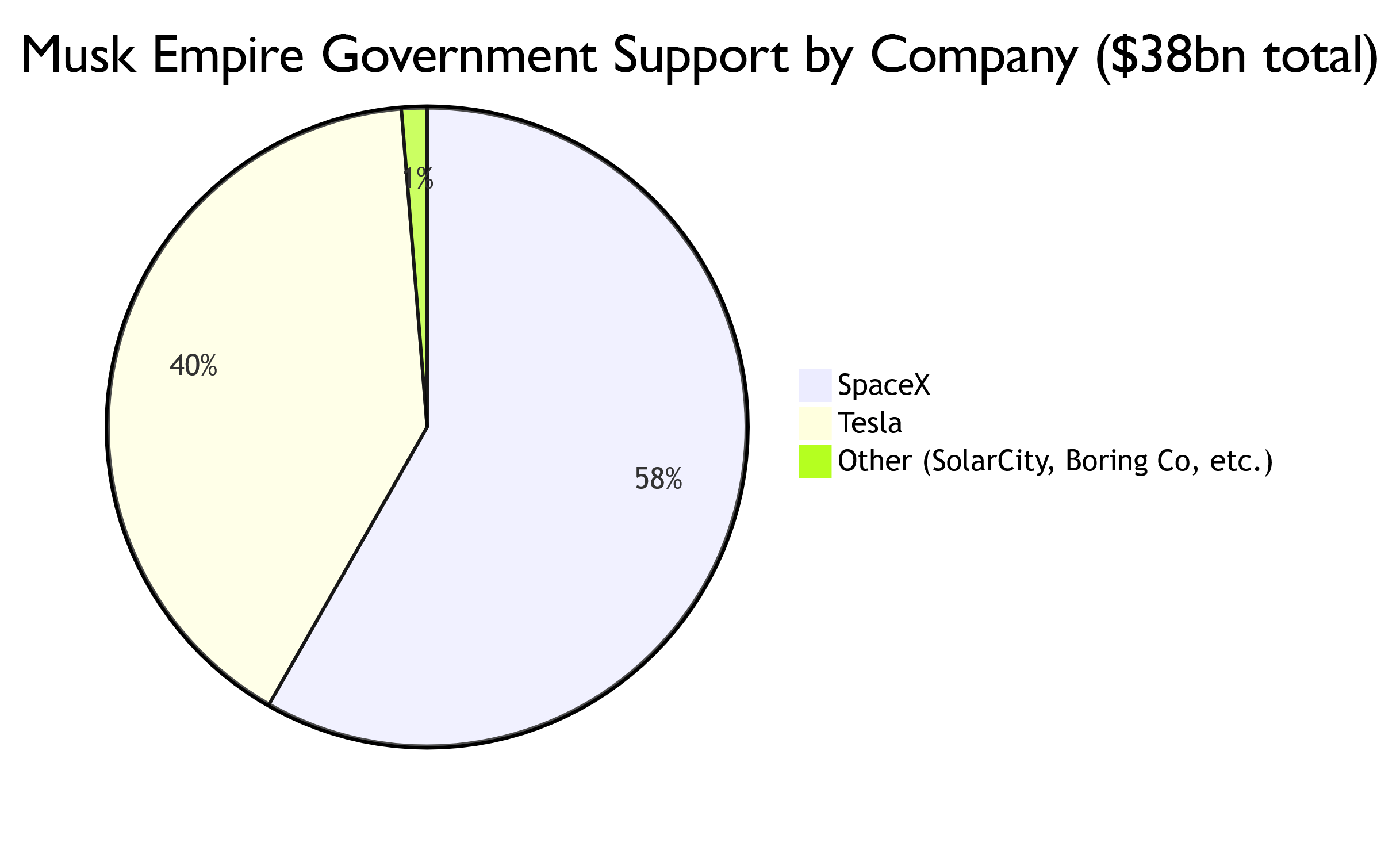
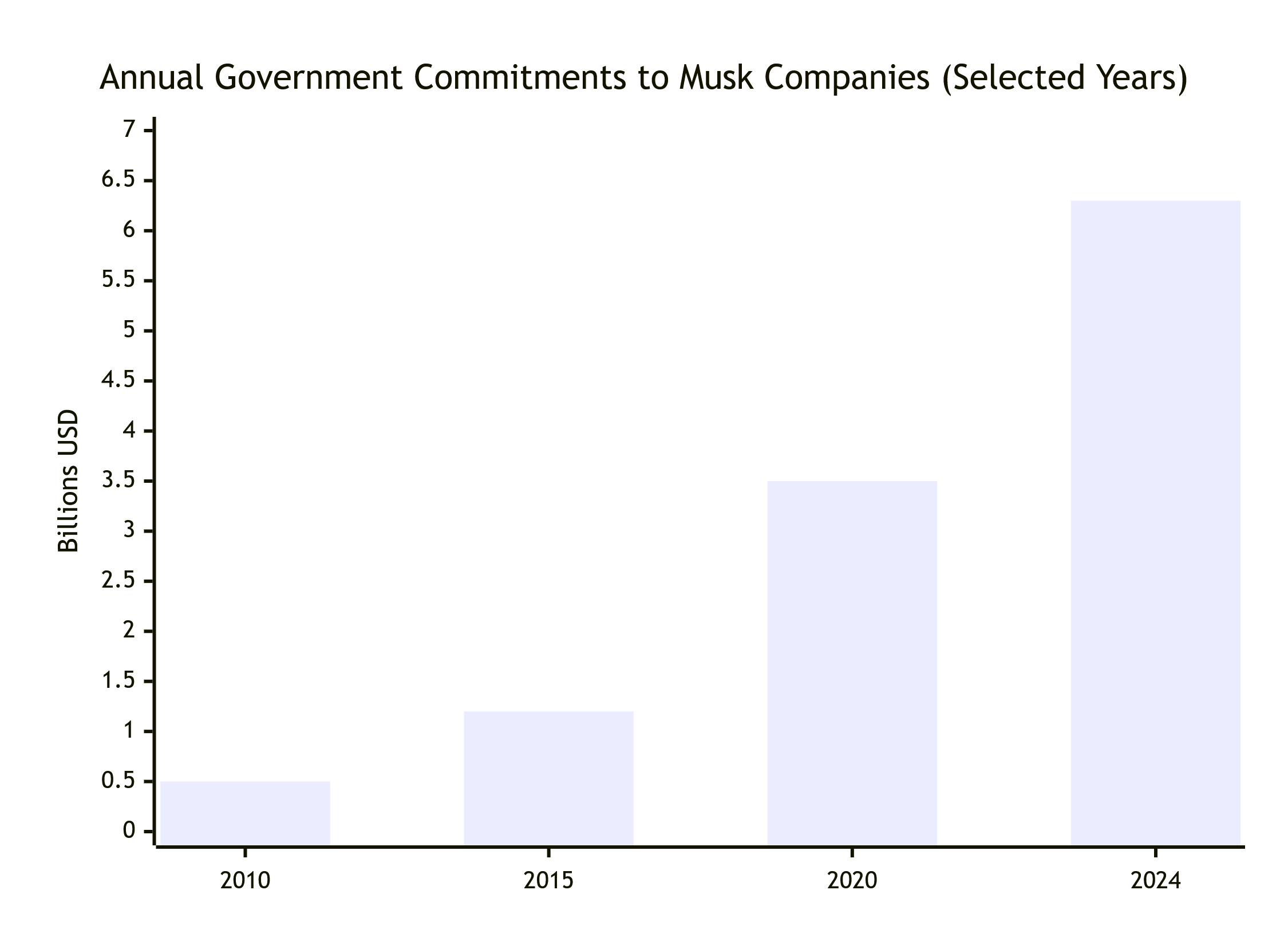
The Musk empire—Tesla, SpaceX, and their sister ventures—is perhaps the most vivid contemporary illustration of this pattern. A Washington Post analysis found that Musk and his businesses have received at least $38 billion in government contracts, loans, subsidies, and tax credits over more than 20 years. This includes $15.7 billion for Tesla and $22.6 billion for SpaceX, with two-thirds of that amount pledged in the last five years. In 2024 alone, commitments reached at least $6.3 billion [5].
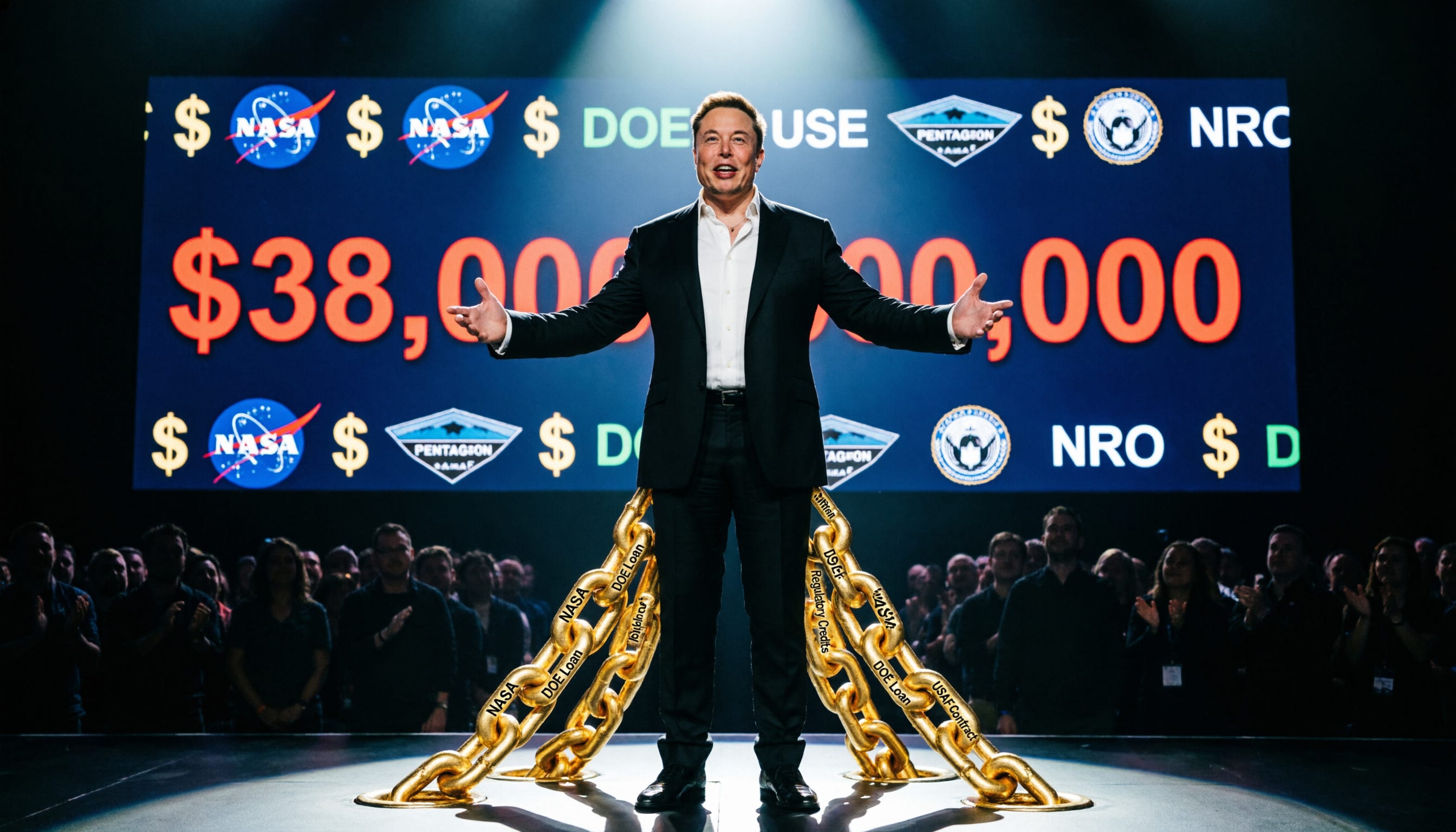
The Musk Empire: Government Support Breakdown
Musk Empire: Annual Government Commitments
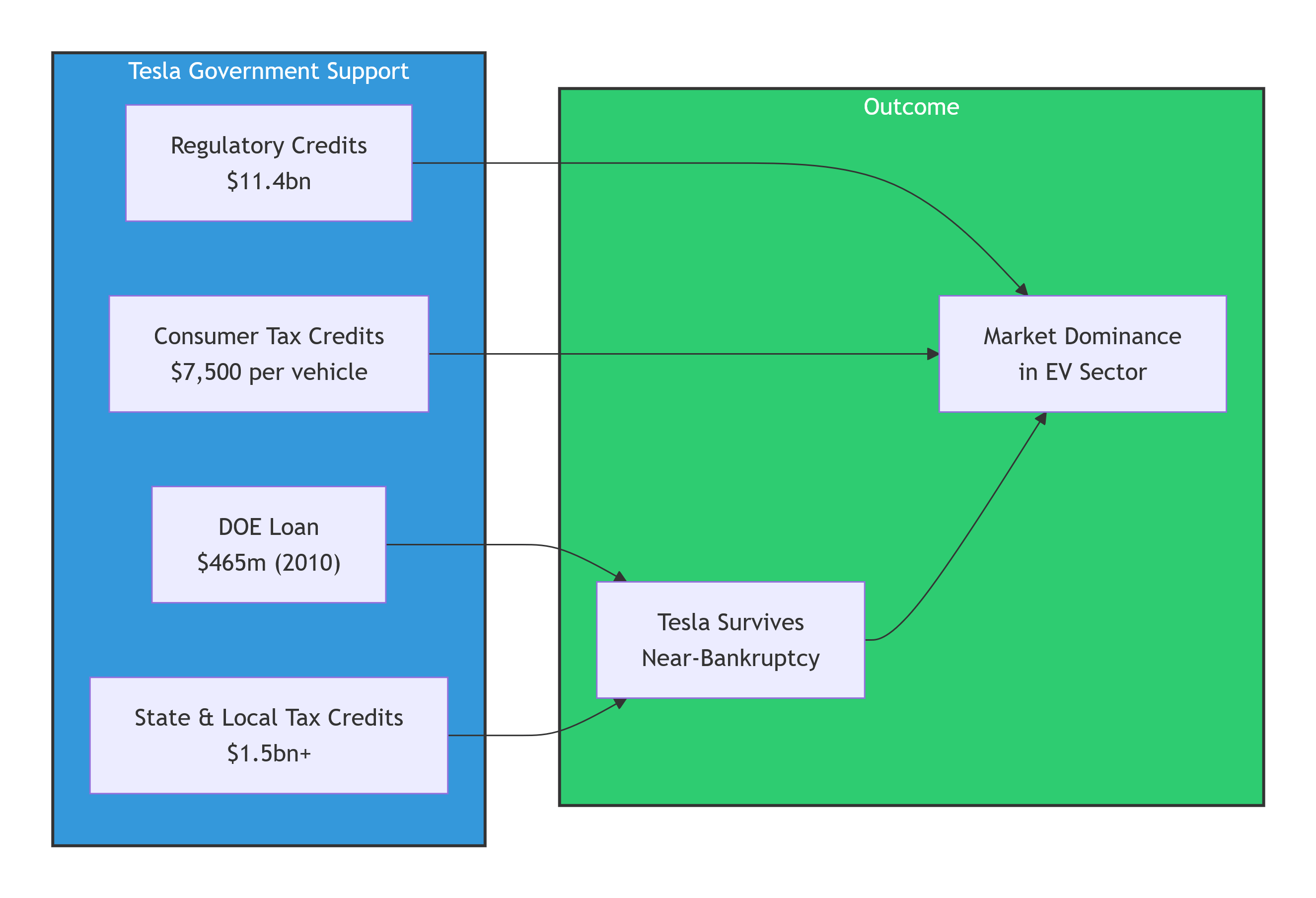
Tesla: Rescued by the State
In 2008, Tesla was cash-strapped and had sold fewer than 2,000 cars in its entire history. The company secured a $465 million low-interest loan from the Department of Energy’s Advanced Technology Vehicles Manufacturing programme—approved in January 2010 [6]. Beyond the loan, Tesla has earned $11.4 billion in regulatory credits from federal and state programmes [7]. Consumer tax credits—the $7,500 federal EV tax credit—have also bolstered sales [8]. State and local governments have contributed at least $1.5 billion in tax credits, grants, and reimbursements since 2007 [9].
Ross Gerber, CEO of an investment firm and an early Tesla investor, stated: “There would not be (Tesla and SpaceX) if it weren’t for the government” [10].
SpaceX: Born from NASA Contracts
SpaceX was founded in 2002, but its first major windfall came in August 2006: a $278 million grant from NASA [11]. This was followed by more than $500 million in early grants. At the end of 2008, when SpaceX was almost out of cash, it received a critical $1.6 billion contract from NASA [11]. Musk himself acknowledged this dependency: “The fact (is) that we could not have started SpaceX, nor could we have reached this point, without the help of NASA” [12].
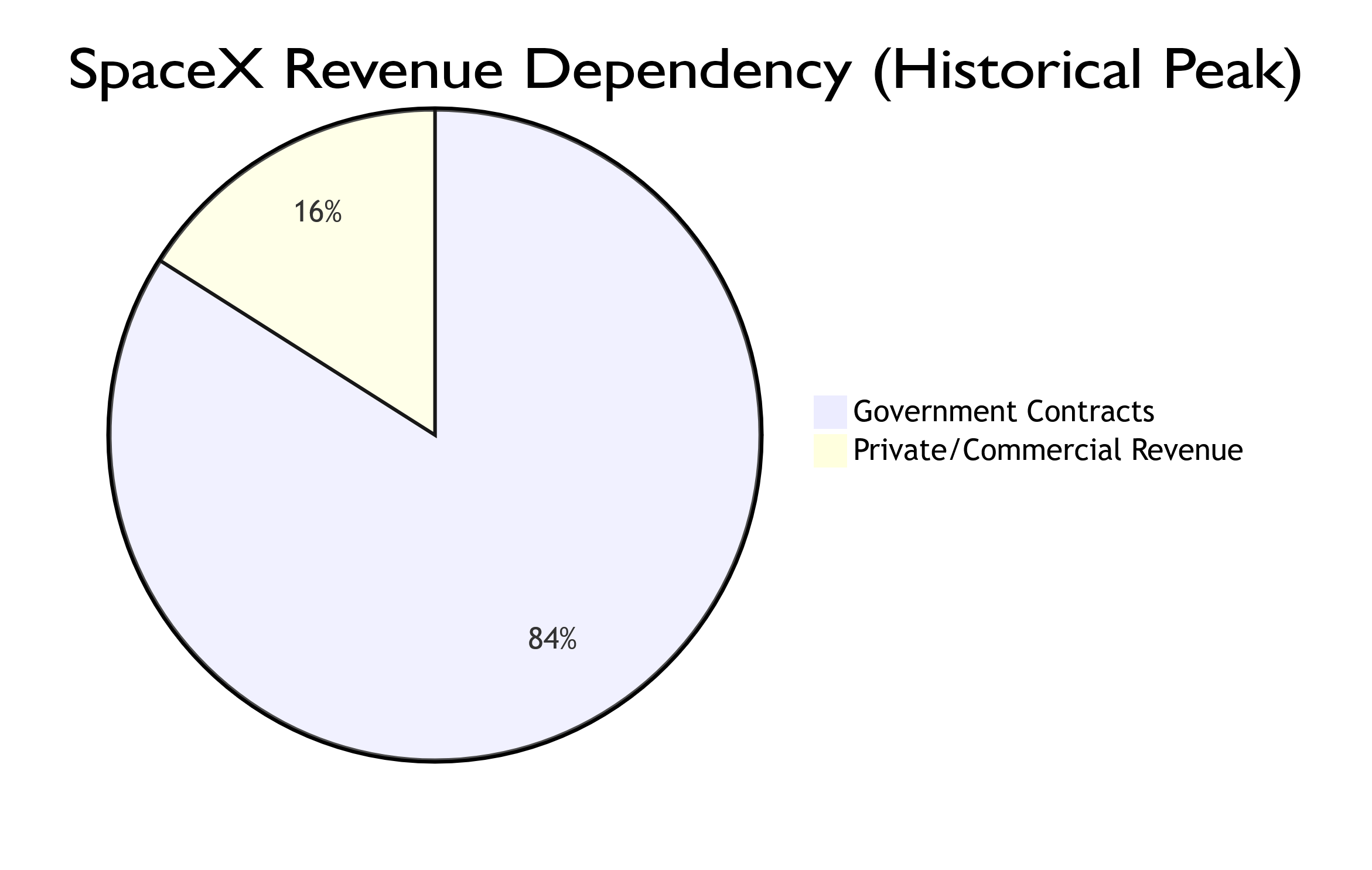
SpaceX has received more than $15 billion in funding from NASA, making it the agency’s largest private sector contractor [13]. Since 2015, it has accumulated more than $17 billion in federal contracts [14]. Government business has historically made up as much as 84% of SpaceX’s revenue [15].
The DOGE Footnote
Musk was appointed to lead the Department of Government Efficiency (DOGE) in January 2025, tasked with cutting government spending. The agency’s charter was set to expire on July 4, 2026 [16]. Musk left the organisation in May 2025, serving roughly a 130-day stint. By the time DOGE officially shut down, the agency was being led by Amy Gleason—and the central DOGE organisation had effectively been disbanded months earlier [17].
While DOGE claimed over $200 billion in lifetime savings upon its July 2026 closure, independent reviews showed a massive chunk came from improperly or retroactively trying to cancel legally binding contracts, resulting in extensive litigation that diminished actual net savings.
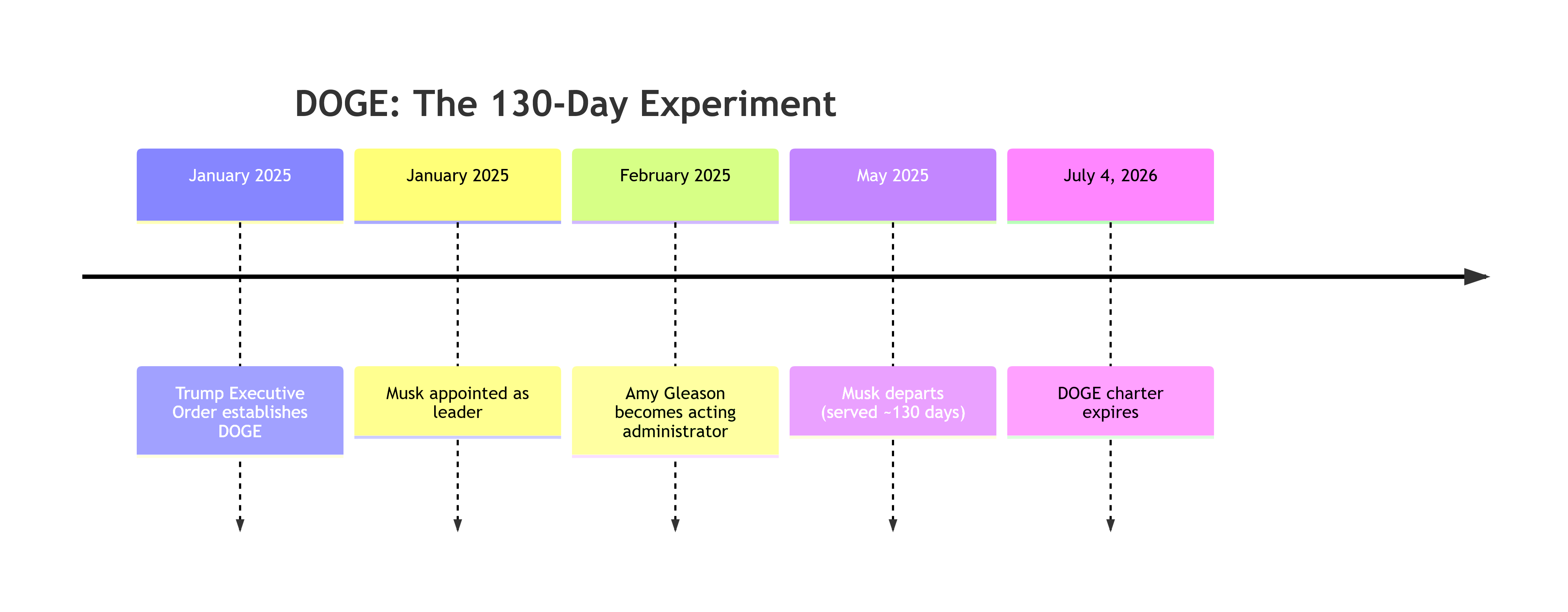
His departure does not alter the structural dependency. The subsidies were already secured. The contracts were already in place. The pattern persists: the state underwrites the risk; private capital reaps the reward. The irony—that he was tasked with cutting the very government spending that made his fortune possible—is a testament to the cognitive dissonance at the heart of the “free market” mythology.
Other State-Sponsored Technology Hubs
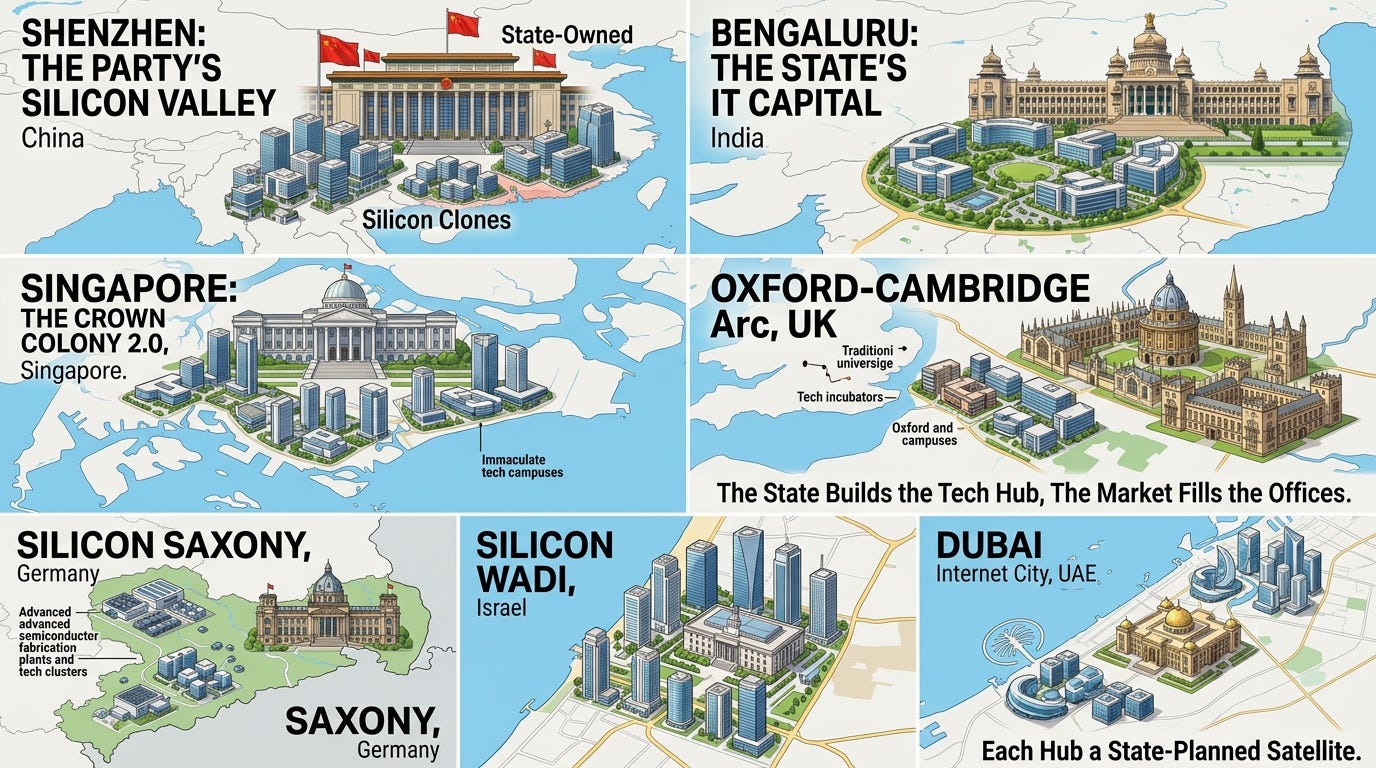
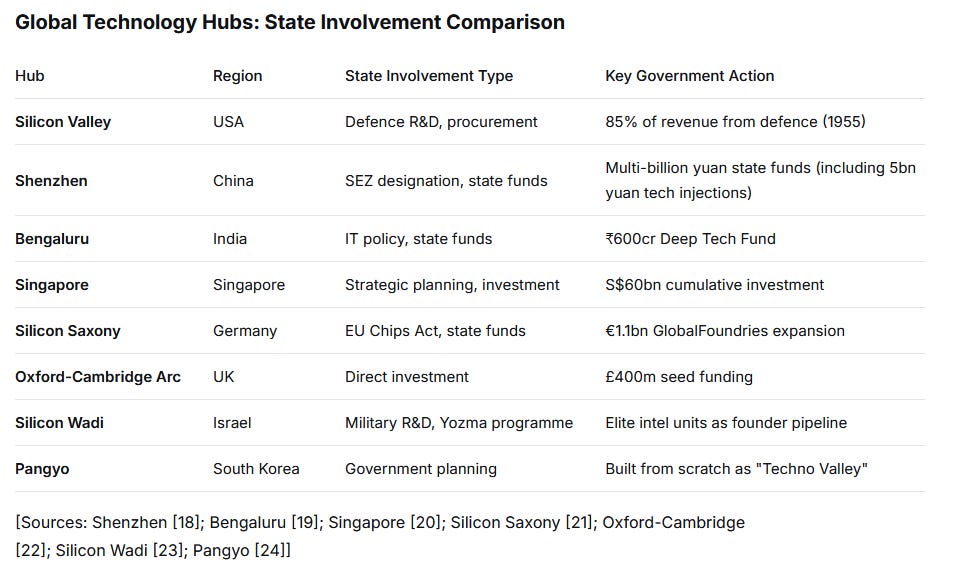
The pattern established in Silicon Valley has been replicated—consciously and deliberately—across the globe.
The Silicon Wadi Model: Military to Market Pipeline
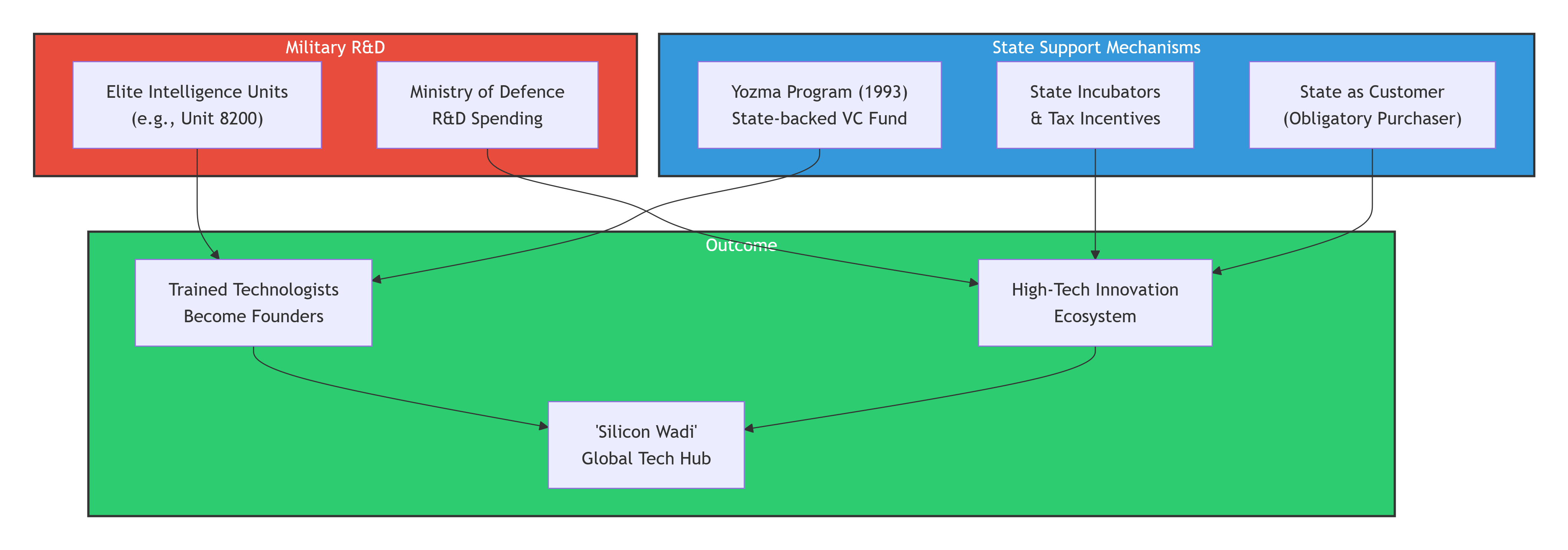
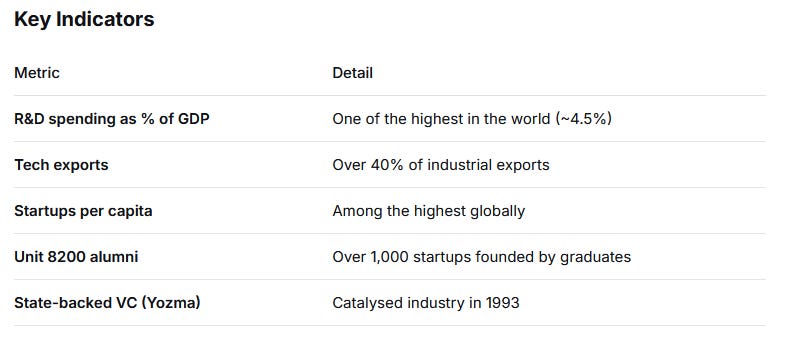
The Israeli government has historically supported tech innovation through funding, tax incentives, and incubators. Governmental initiatives like the Israel Innovation Authority offer grants and assistance to startups. State-owned arms companies—Rafael Advanced Defense Systems and Israel Aerospace Industries—serve as “obligatory customers” for new technologies.
The most distinctive feature of the Israeli model is the pipeline from elite military intelligence units—particularly Unit 8200—to commercial tech success. Soldiers trained in these units receive world-class cybersecurity and signal intelligence training, then leave to found startups. This is not a market phenomenon; it is a state-funded education and training programme that happens to produce entrepreneurs.
Yozma
The State as Venture Catalyst
In 1993, the Israeli government created a financing programme for high-tech developments called “Yozma” (Initiative) . This was a deliberate state strategy to crowd in private venture capital. The government provided matching funds and tax incentives to foreign VCs, effectively underwriting the risk of early-stage investment. The programme catalysed the creation of Israel’s venture capital industry and earned the country its nickname.
Multinational firms began opening R&D centres in Israel—Intel, Google, Microsoft, Apple—drawn by the trained workforce and the innovation ecosystem that the state had deliberately cultivated.
The State as Customer
Like Silicon Valley, Silicon Wadi benefits from the state as a guaranteed first customer. Israeli defence and intelligence agencies purchase domestic technology, providing revenue and credibility to young companies. This de-risking mechanism is identical to the U.S. model: the state absorbs the earliest, riskiest phase of development, allowing private capital to enter once the technology is proven.
UK Innovation
The Missing Link in the Myth
To truly understand state-led innovation, one must look at the UK’s recent track record, which perfectly mirrors the Silicon Valley model:
ARM Holdings: The chip architecture in almost every smartphone on Earth originated from Acorn Computers, which was heavily backed by the UK government’s BBC Computer Literacy Project and the Department of Trade and Industry [25].
ARIA (Advanced Research and Invention Agency): Established with a budget of £800m, ARIA acts as a prime contemporary example of state-led, high-risk innovation funding, explicitly modelled on DARPA to tackle high-reward scientific research [26].
The Oxford Vaccine (AstraZeneca): The UK government’s Vaccine Taskforce, chaired by Kate Bingham, didn’t just fund the science; it underwrote the commercial risk by securing multiple vaccine candidates through advance purchase agreements before they were even proven to work [27].
Offshore Wind & CfDs: The UK is a global leader in offshore wind entirely because the state de-risked the market through the Contracts for Difference (CfD) mechanism, guaranteeing strike prices and crowding in billions in private investment [28].
State-Backed Financial Centres
The “Singapores”
The Singapore model—a state creating a financial centre not by historical accident, but by legal fiat, tax incentives, and strategic vision—has become the definitive playbook for nations seeking a shortcut to global finance.
The Original
Singapore
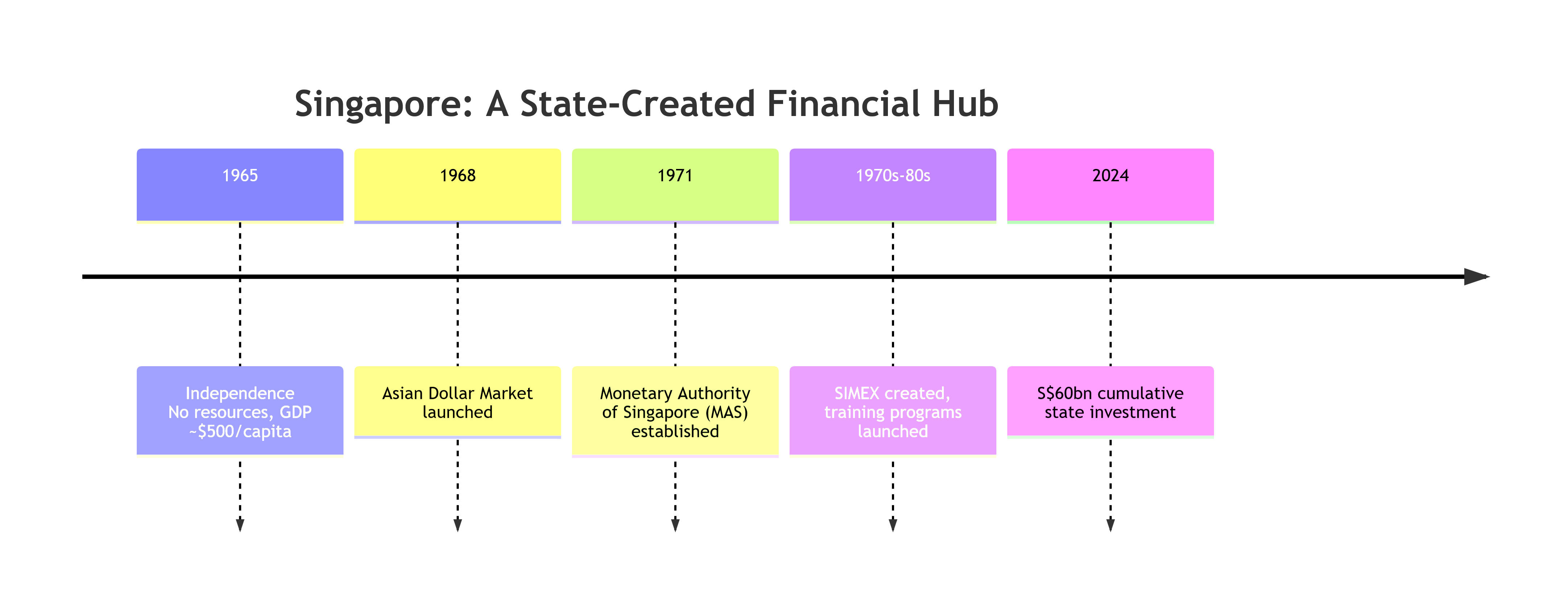
When Singapore gained independence in 1965, it had no natural resources and a per capita GDP of ~US$500 [29]. The government systematically built the financial centre from scratch: launching the Asian Dollar Market in 1968, establishing the Monetary Authority of Singapore in 1971, and investing heavily in financial sector training [30]. Every step was strategic. There was no “invisible hand”—only the very visible hand of the Singaporean state.
The Progeny
State-Built Financial Centres
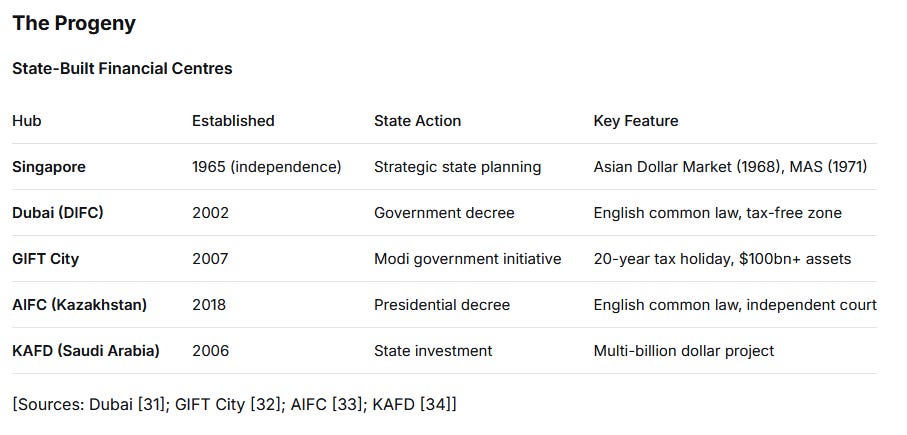
State-Built Financial Centres Comparison
The Two Models: Singapore vs. British Offshore
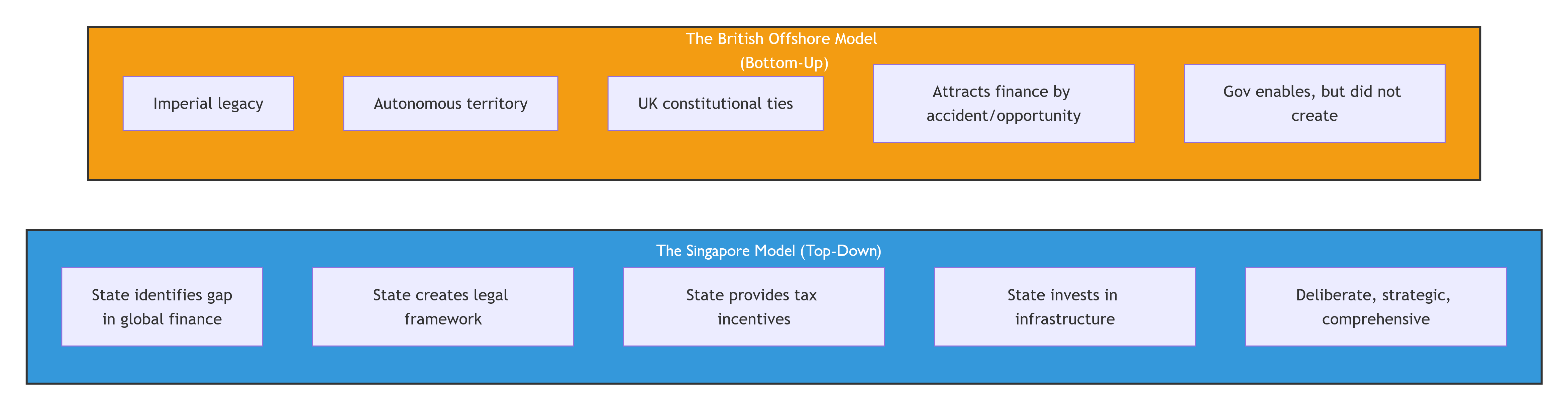
While Singapore represents state-directed strategic planning, British offshore centres historically relied on legal arbitrage and light-touch regulation. Both, however, required the sovereign backing of the state to enforce property rights and contracts.
Crisis Bailouts
The State as Firefighter
When the system itself is at risk, the “free market” is swiftly set aside.
The 2008 Financial Sector Bailout

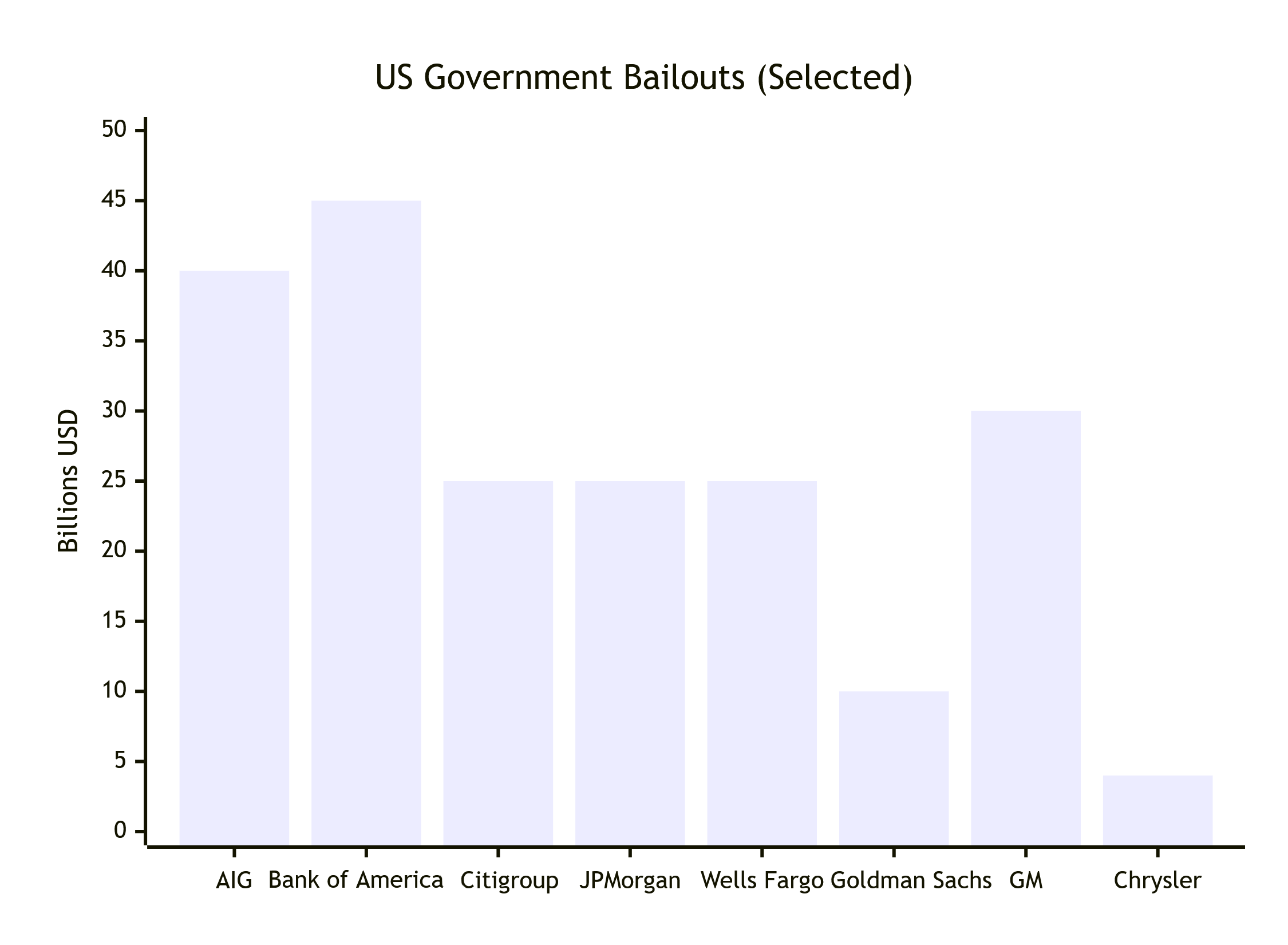
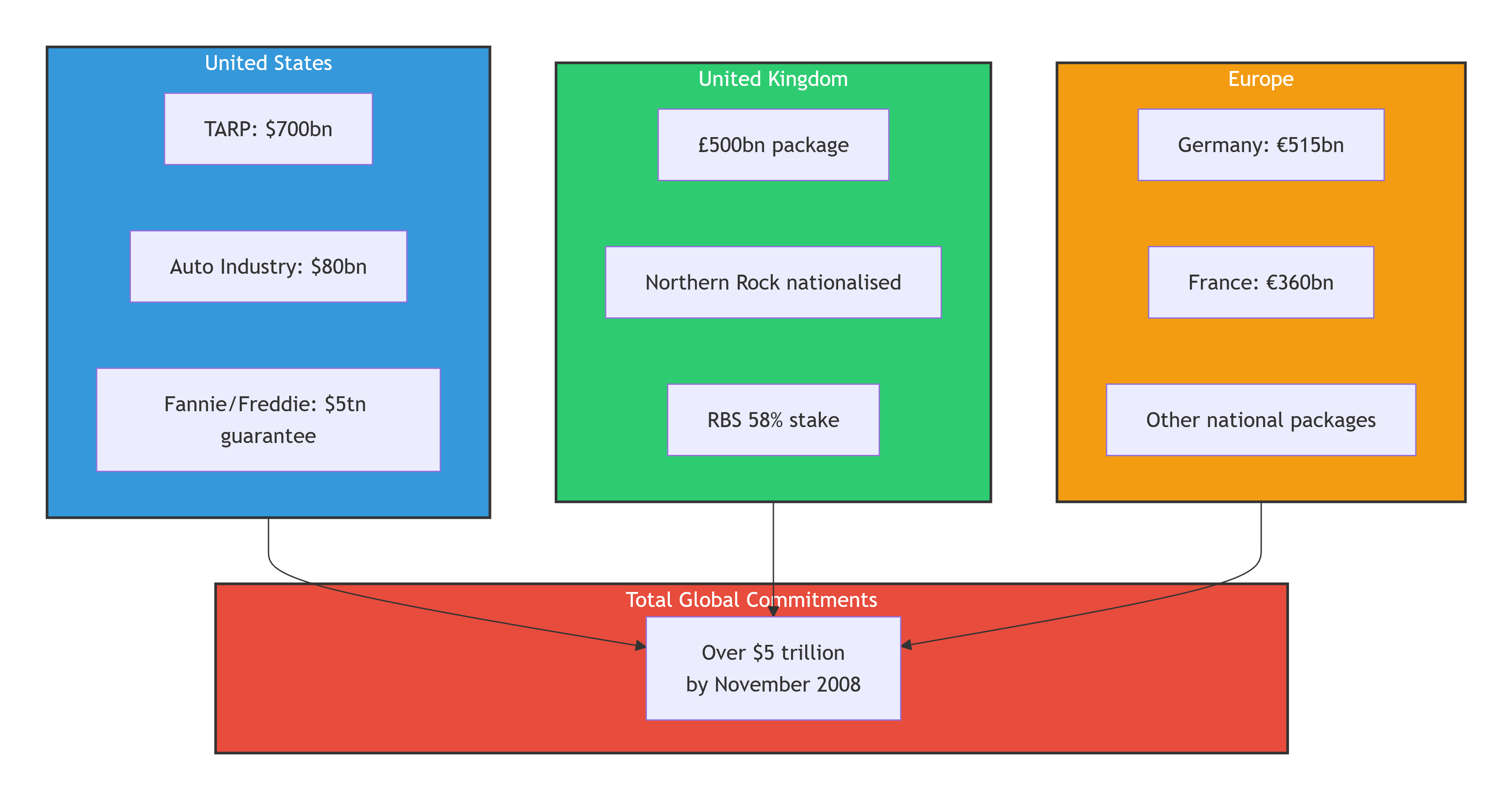
The Troubled Asset Relief Program (TARP) authorised $700 billion to purchase toxic assets and inject capital into financial institutions [35]. By November 2008, over $5 trillion had been committed globally to bailing out the financial sector [36].
Major US Bailouts Comparison
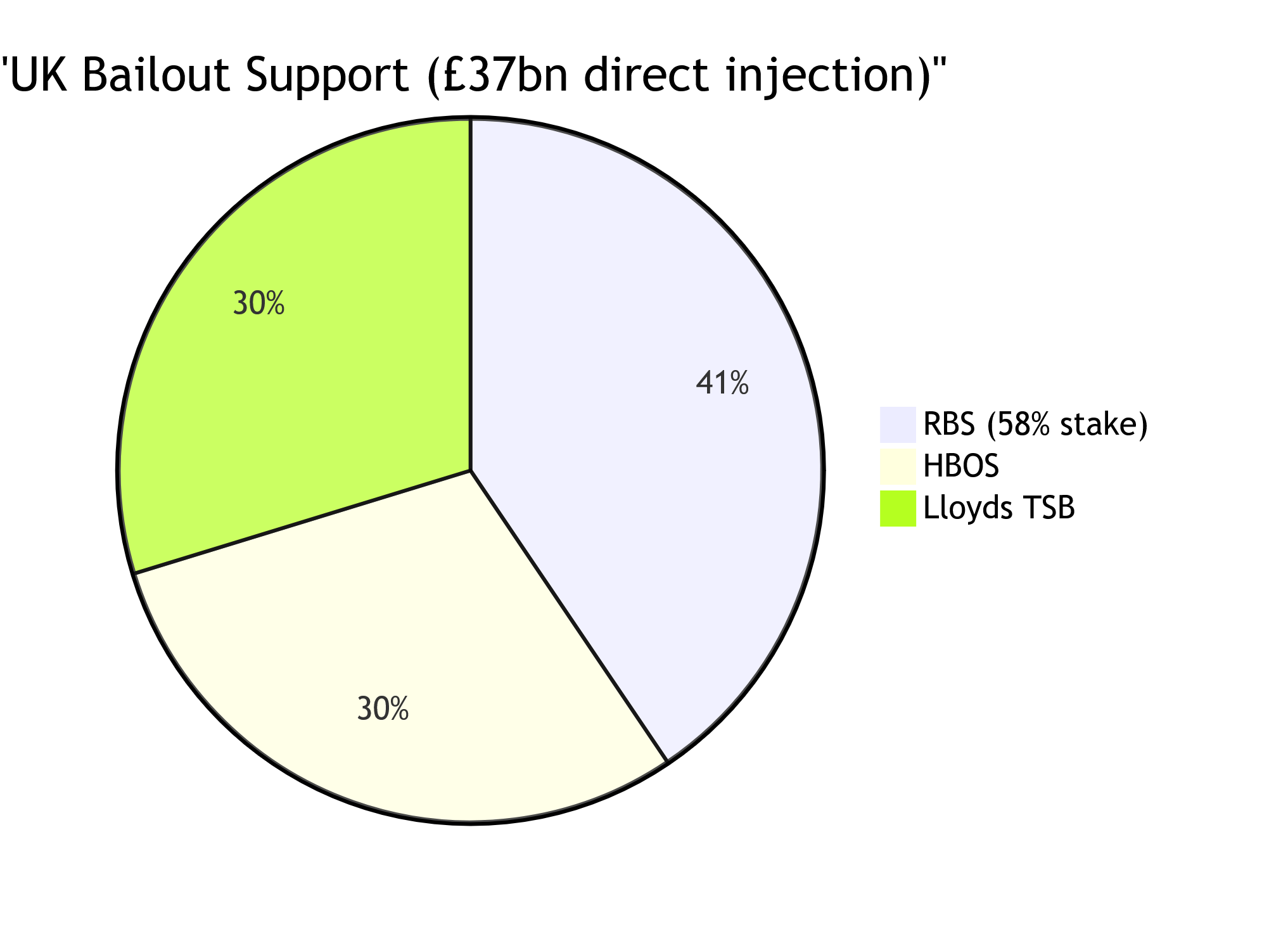
UK Bailouts (2008)
The UK government announced a rescue package worth £500 billion ($850 billion) on October 8, 2008 [37].
UK Bailout Programme Details
Global Scale: $5 Trillion Committed
Normal Course of Business—The State as Architect
The state is not merely a firefighter during crises. In normal economic times, it is a silent partner in countless daily transactions.

The State’s Permanent Presence: Key Institutions
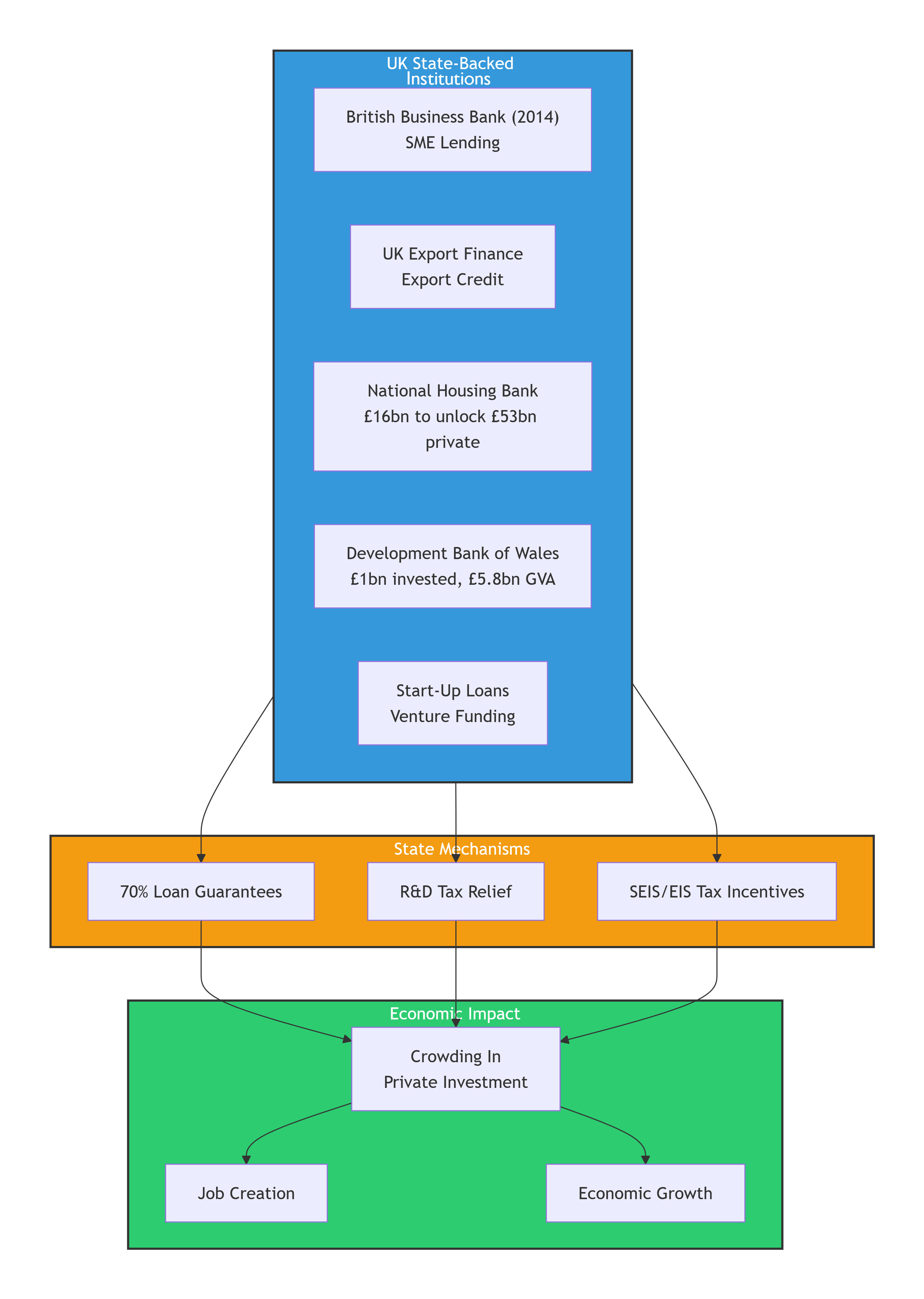
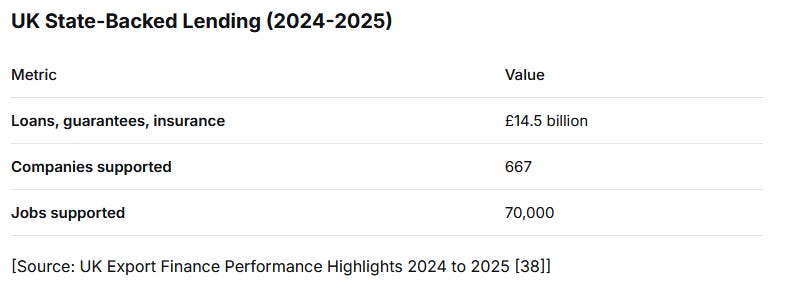
UK State-Backed Lending (2024-2025)
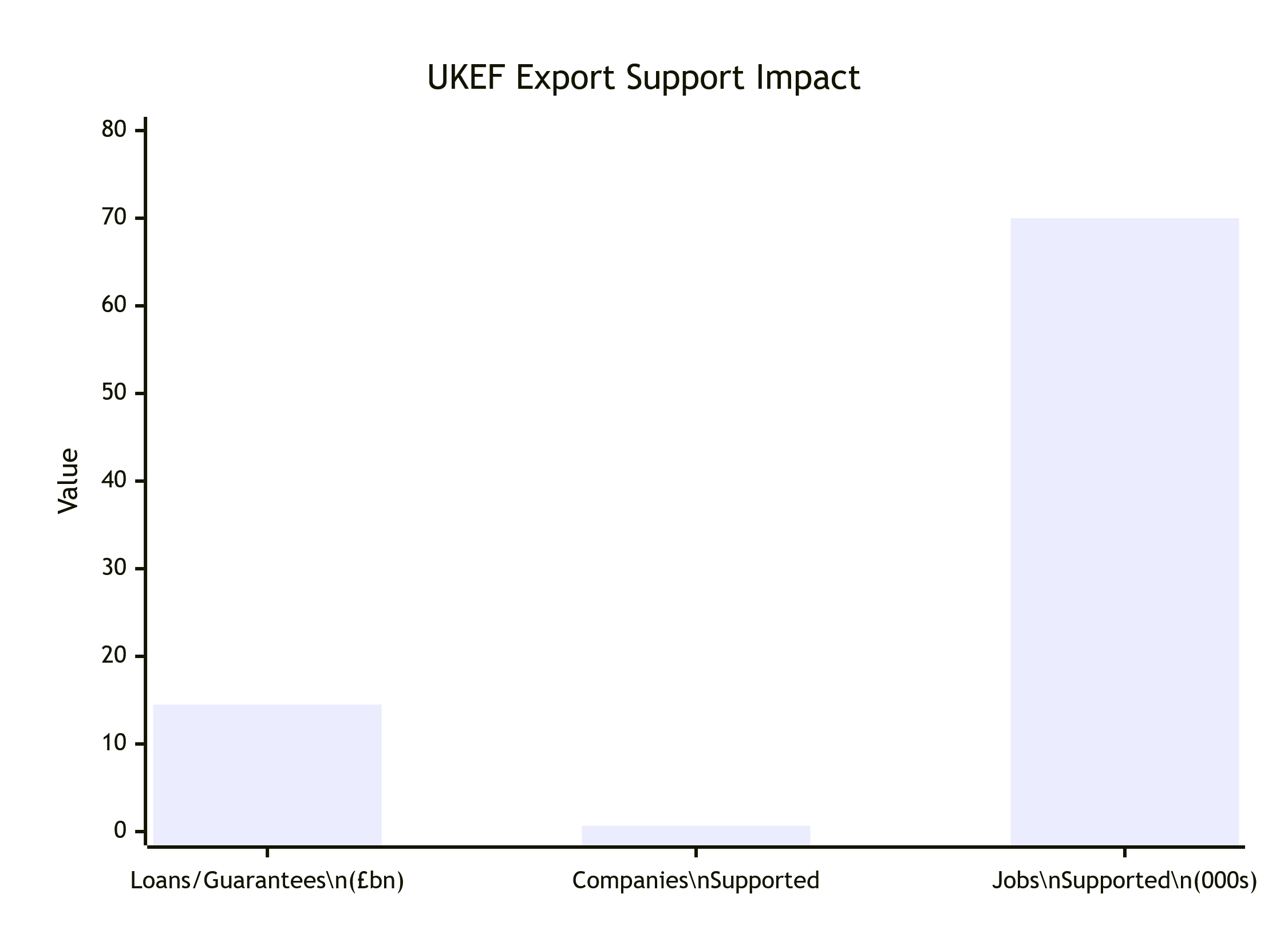
UKEF Export Support Impact
Public R&D Investment Multiplier
The UK government has recently committed to a record £55bn R&D boost to close the innovation gap [39].
UK R&D Investment Trends

The MMT Framework—Crowding In, Not Crowding Out
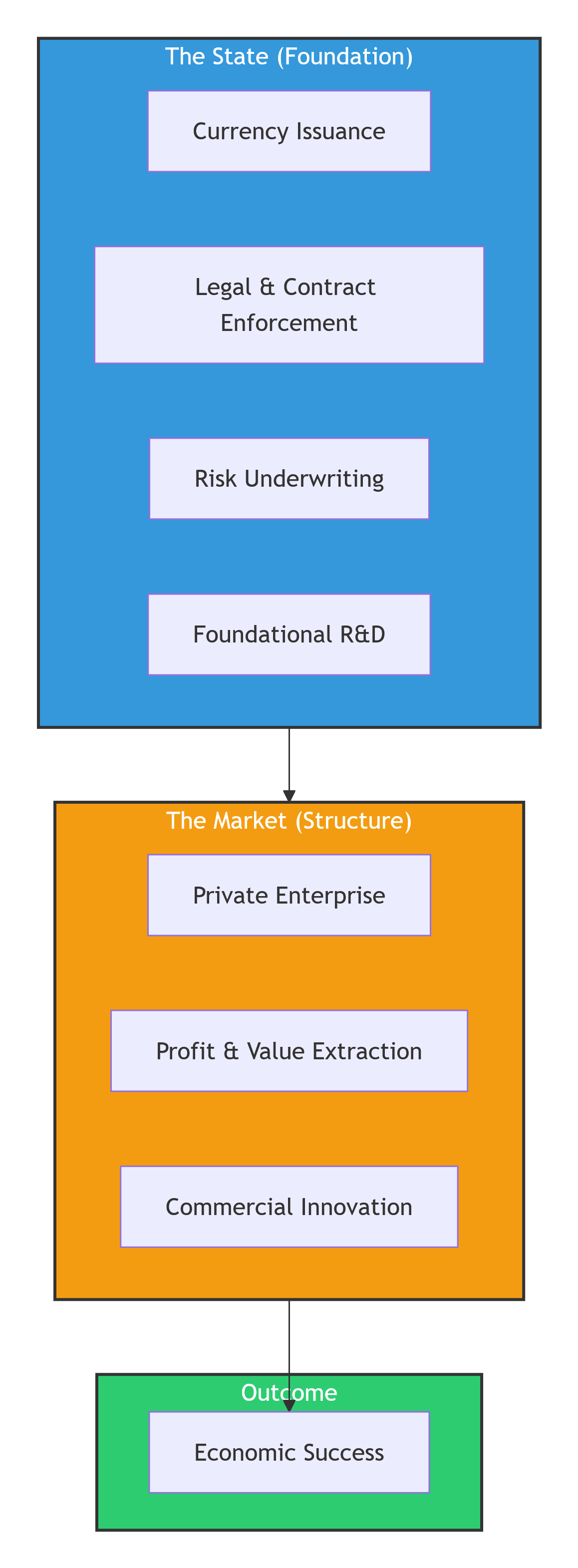
From a Modern Monetary Theory (MMT) perspective, the state’s role is not an exception to the market; it is the precondition for the market. The state issues the currency, enforces the contracts, underwrites the risk, and funds the foundational research upon which private profit is built.
The Mechanics of Sovereign Spending
Critics often argue that the government must “find” money through taxation or borrowing before it can spend. MMT clarifies that for a sovereign currency issuer, this is backwards. The government spends by keystroke, creating new money. As MMT economist Bill Mitchell notes, “The revenue is not to fund the spending but to create the real resource space that can absorb government spending in a non-inflationary manner” [40].
Furthermore, the issuance of gilts (government bonds) is not to “fund” the government. Because the state creates the currency, it cannot run out of it. Gilts are issued to manage interest rates and to provide a safe, yield-bearing asset for the private sector. This dismantles the household-budget analogy entirely: the state is not constrained by revenue; it is constrained only by real resources (labour, materials, technology) and inflation.
Crowding In vs. Crowding Out
When the state invests in foundational R&D or infrastructure, it does not “crowd out” private investment; it “crowds it in”. By absorbing the earliest, riskiest stages of development, the state creates the very platforms that private capital later monetises.
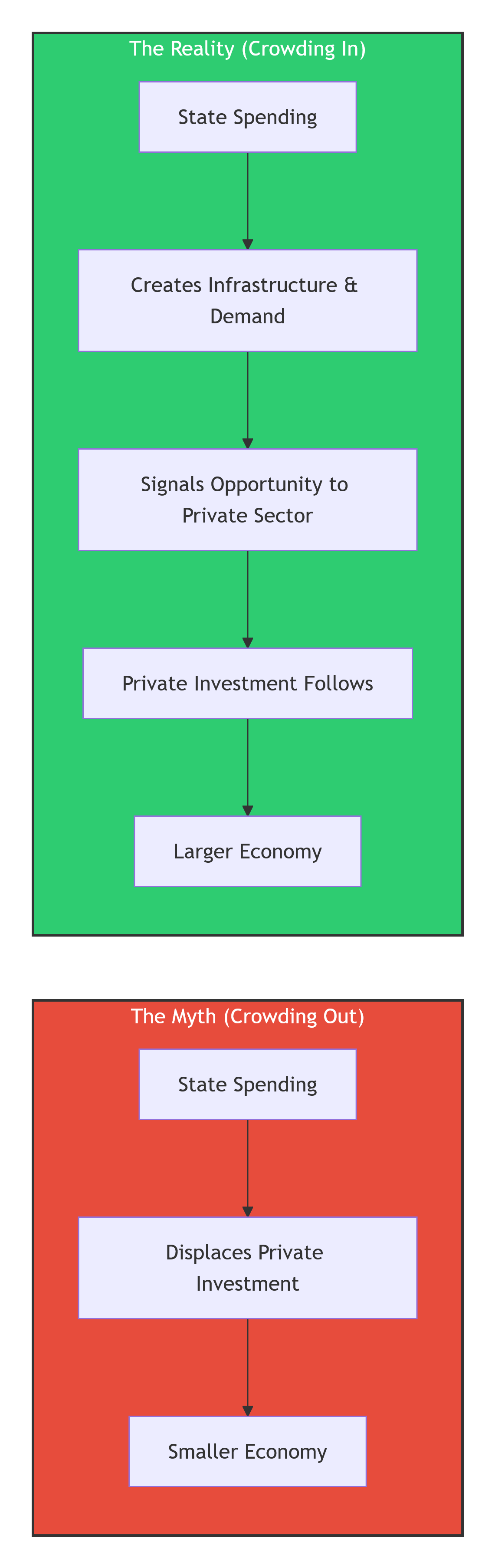
The State-Market Relationship: A Conceptual Model
Government Deficits = Private Sector Surpluses
In a fiat system, the government’s deficit is mathematically identical to the private sector’s surplus. When the state spends more than it taxes, it is injecting net financial assets into the private economy, allowing households and corporations to save and invest.
Government Deficits and Private Sector Surpluses

Conclusion
The free-market mythology of Silicon Valley serves a psychological function: it allows winners to believe their success is purely meritocratic. But the historical record is unambiguous. The integrated circuit was a military procurement project. The internet, GPS, touchscreens, and Siri were all born from public investment. Apple, Tesla, and SpaceX did not invent these technologies; they commercialised them, brilliantly and profitably.

This does not diminish the genius of the engineers and entrepreneurs involved. Design, integration, and marketing are real and valuable skills. But they stand on a multi-billion-dollar public scaffold they did not pay to erect. The state was the patient, high-risk underwriter of the foundational technologies upon which modern capitalism rests.
The Irony
From Foundation to Feast

The pattern is inescapable. From Silicon Valley to Shenzhen, from Bengaluru to Cambridge, from Silicon Saxony to Silicon Wadi, every serious technology and financial hub is the product of strategic state intervention. Whether through defence contracts, tax breaks, direct investment, or university grants, the state is always the invisible hand behind the “miracle”.
The question is not whether the state should intervene, but how effectively it does so. The state is not crowding out private enterprise; it is crowding it in, creating the demand, reducing the risk, and building the infrastructure that makes private profit possible.
The free market doesn’t build these places. The state lays the foundation, and another free market is engineered by the state.
Bibliography
1. Kedrosky, P. (2026). Silicon Valley Was Born a Defense Industry, and is Becoming One Again. Available at: https://paulkedrosky.com/silicon-valley-was-born-a-defense-industry-and-is-becoming-one-again/
2. FedTech Magazine. (2018). How Government Helped Spur the Microchip Industry. Available at: https://fedtechmagazine.com/article/2018/09/how-government-helped-spur-microchip-industry
3. American Progress Institute. (2023). Advancing Ownership in Cutting-Edge Industries. Available at: https://www.americanprogress.org/article/advancing-ownership-cutting-edge-industries/
4. U.S. Government Accountability Office. (1995). Specialized Small Business Investment Companies. RCED-95-146FS. Available at: https://www.govinfo.gov/content/pkg/GAOREPORTS-RCED-95-146FS/html/GAOREPORTS-RCED-95-146FS.htm
5. Good Jobs First. (2025). Our Data Fuels WAPO Reporting on Musk. Available at: https://goodjobsfirst.org/our-data-fuels-wapo-reporting-on-musk/
6. U.S. Department of Energy. (n.d.). Tesla. Available at: https://www.energy.gov/edf/tesla
7. Fortune. (2025). Elon Musk’s companies have received billions in government funding. Available at: https://fortune.com/2025/02/26/elon-musk-companies-billion-government-funding-tesla-spacex-doge/
8. Green Car Reports. (2021). Tesla nearing limit of $7,500 federal tax credits. Available at: https://www.greencarreports.com/news/1116938_tesla-nearing-limit-of-7500-federal-tax-credits-which-will-boost-effective-prices-this-fall
9. U.S. Congress. (2025). House Judiciary Committee Documents. Available at: https://www.congress.gov/119/meeting/house/117956/documents/HMKP-119-JU00-20250226-SD003.pdf
10. CP24. (2026). How much of Musk’s wealth comes from government help? Virtually all of it. Available at: https://www.cp24.com/news/world/2026/06/13/how-much-of-musks-wealth-comes-from-government-help-virtually-all-of-it/
11. NASA Office of Inspector General. (2013). NASA’s Support for Development of Commercial Space Transportation Capabilities. IG-13-016. Available at: https://oig.nasa.gov/docs/IG-13-016.pdf
12. NASA Watch. (2012). SpaceX Falcon 9 Launch Success. Available at: https://nasawatch.com/2012/05/22/spacex-falcon-9-launch-success-updated/
13. DC Report. (2026). Who really benefits when private space companies get public money? Available at: https://www.dcreport.org/2026/05/12/who-really-benefits-when-private-space-companies-get-public-money/
14. ABC News. (2025). Elon Musk works to slash federal spending as his firms received billions. Available at: https://abcnews.com/US/musk-works-slash-federal-spending-firms-received-billions/story?id=118589121
15. Chosun Biz. (2025). SpaceX’s Revenue Dependency on Government Contracts. Available at: https://biz.chosun.com/en/en-science/2025/08/17/57BWVLBOBVGRBFZ62WM4B7Q3BA/
16. The White House. (2025). Executive Order: Establishing and Implementing the President’s Department of Government Efficiency. Available at: https://www.whitehouse.gov/presidential-actions/2025/01/establishing-and-implementing-the-presidents-department-of-government-efficiency/
17. Nextgov. (2026). DOGE about making government services easier to access, its head says. Available at: https://www.nextgov.com/digital-government/2026/05/doge-about-making-government-services-easier-access-its-head-says/413680/
18. Yahoo Finance. (2025). Chinese startup Baichuan AI secures funding. Available at: https://finance.yahoo.com/news/chinese-startup-baichuan-ai-secures-083506038.html
19. The Hindu. (2025). Karnataka announces ₹600 crore fund to push deep tech decade. Available at: https://www.thehindu.com/news/national/karnataka/karnataka-announces-600-crore-fund-to-push-deep-tech-decade/article70237391.ece
20. Yahoo Finance Singapore. (2025). Top 4 sectors that benefit from Singapore’s. Available at: https://sg.finance.yahoo.com/news/top-4-sectors-benefit-singapores-064300016.html
21. Yahoo Finance. (2025). GlobalFoundries to invest $1.1 billion. Available at: https://finance.yahoo.com/news/globalfoundries-invest-1-1-billion-110456549.html
22. Cambridge Independent. (2025). £400m investment for Cambridge announced by Chancellor. Available at: https://www.cambridgeindependent.co.uk/news/400m-investment-for-cambridge-announced-by-chancellor-with-9438673/
23. Wikipedia. (n.d.). Silicon Wadi. Available at: https://en.wikipedia.org/wiki/Silicon_Wadi
24. Wikipedia. (n.d.). Pangyo Techno Valley. Available at: https://en.wikipedia.org/wiki/Pangyo_Techno_Valley
25. BBC Computer Literacy Project. (n.d.). History. Available at: https://clp.bbcrewind.co.uk/history
26. Red Knight Consultancy. (2024). Introducing the Advanced Research and Invention Agency. Available at: https://redknightconsultancy.co.uk/2024/12/02/introducing-the-advanced-research-and-invention-agency/
27. Grokipedia. (n.d.). Kate Bingham. Available at: https://grokipedia.com/page/Kate_Bingham
28. Renewable Energy Magazine. (2026). UK government secures 8.4 GW of offshore wind. Available at: https://www.renewableenergymagazine.com/wind/uk-government-secures-8-4-gw-of-20260114
29. Monetary Authority of Singapore. (2015). An Economic History of Singapore. Available at: https://www.mas.gov.sg/news/speeches/2015/an-economic-history-of-singapore
30. Bank for International Settlements. (2015). Review of Singapore’s Financial Centre Development. Available at: https://www.bis.org/review/r150807b.htm
31. Wikipedia. (n.d.). Dubai International Financial Centre. Available at: https://en.wikipedia.org/wiki/Dubai_International_Financial_Centre
32. The New Indian Express. (2025). GIFT City now manages $100 billion in assets. Available at: https://www.newindianexpress.com/business/2025/Dec/01/gift-city-now-manages-100-billion-in-assets
33. Astana Times. (2025). AIFC wraps up 2025 with strong investment growth. Available at: https://astanatimes.com/2025/12/aifc-wraps-up-2025-with-strong-investment-growth-market-expansion/
34. Saudipedia. (n.d.). King Abdullah Financial District (KAFD). Available at: https://saudipedia.com/en/king-abdullah-financial-district-kafd
35. U.S. Treasury Department. (n.d.). TARP: The Troubled Asset Relief Program. Available at: https://home.treasury.gov/data/troubled-asset-relief-program
36. Better Markets. (2021). Wall Street’s Six Biggest Bailed-Out Banks. Available at: https://bettermarkets.org/wp-content/uploads/2021/07/Better-Markets-Wall-Streets-Six-Biggest-Bailed-Out-Banks-FINAL.pdf
37. Risk.net. (2008). UK announces £500 billion bail-out plan. Available at: https://www.risk.net/foreign-exchange/1498806/uk-announces-ps500-billion-bail-out-plan
38. UK Export Finance. (2025). Performance Highlights 2024 to 2025. Available at: https://www.gov.uk/government/publications/uk-export-finance-performance-highlights-2024-to-2025/uk-export-finance-performance-highlights-2024-to-2025
39. CityAM. (2025). Labour’s Liz Kendall unveils record £55bn R&D boost for UK innovation. Available at: https://www.cityam.com/labours-liz-kendall-unveils-record-55bn-rd-boost-for-uk-innovation/
40. Mitchell, B. (2023). Bill Mitchell Blog: Modern Monetary Theory. Available at: https://billmitchell.org/blog/?p=50005
Nice piece. :)
<<Critics often argue that the government must “find” money through taxation or borrowing before it can spend. MMT clarifies that for a sovereign currency issuer, this is backwards. The government spends by keystroke, creating new money. As MMT economist Bill Mitchell notes, “The revenue is not to fund the spending but to create the real resource space that can absorb government spending in a non-inflationary manner” [40].>>
That is a superb quote by Bill Mitchell, regarding tax - so elegant.
<<Furthermore, the issuance of gilts (government bonds) is not to “fund” the government. Because the state creates the currency, it cannot run out of it. Gilts are issued to manage interest rates and to provide a safe, yield-bearing asset for the private sector. This dismantles the household-budget analogy entirely: the state is not constrained by revenue; it is constrained only by real resources (labour, materials, technology) and inflation.>>
"[...] to provide a safe, yield-bearing asset for the private sector."
This puzzles the hell out of me. It seems so mad I keep thinking I'm not understanding it correctly? Why is it the government's job to provide a safe, yield-bearing asset for the private sector, if it doesn't need the money? If so, why isn't it doing that for me as well? :D
Andrew