
They Look Down on Us
The Aetiology of Ideological Austerity

A Graphic Novella

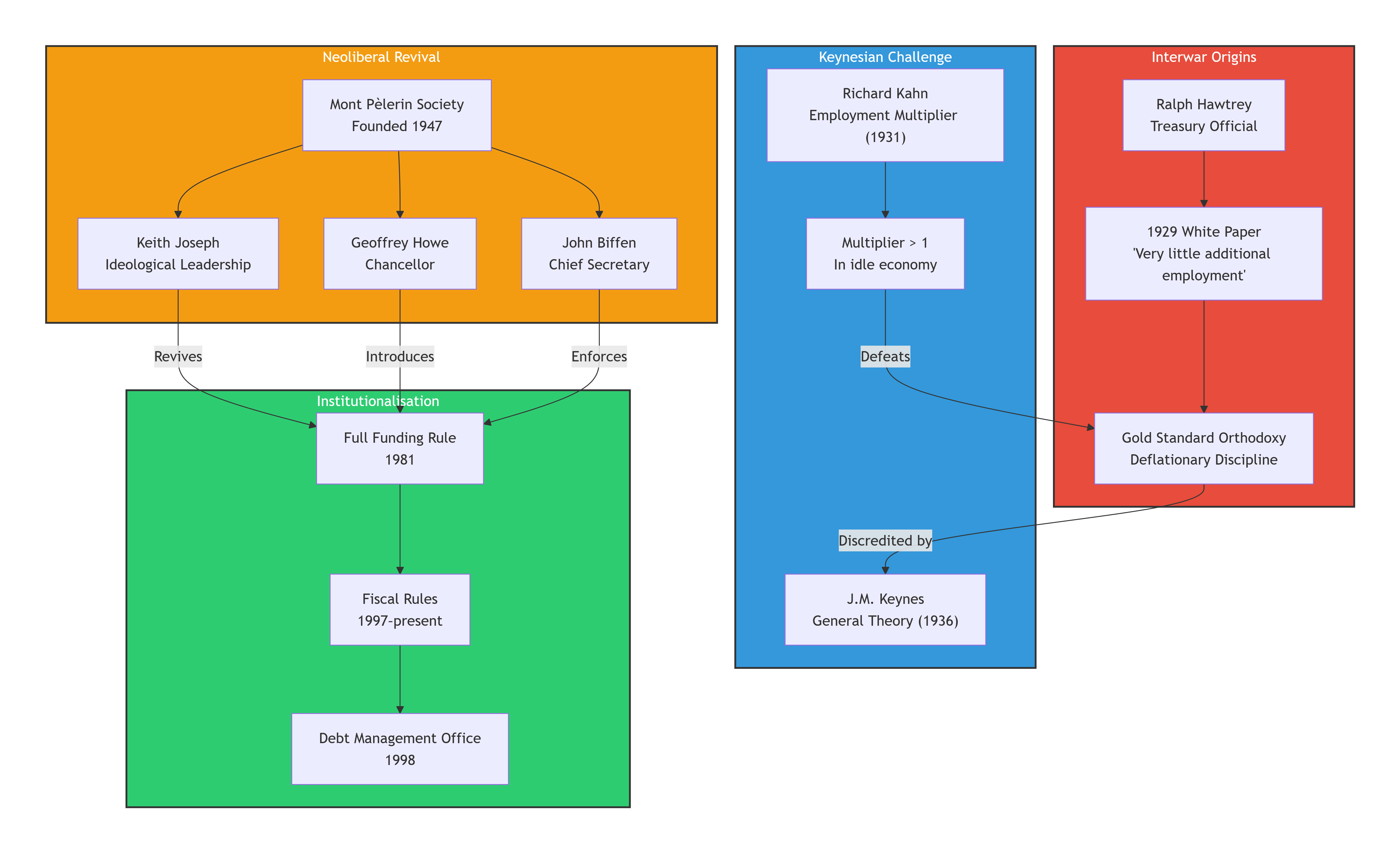
This article traces the intellectual and institutional history of the “Treasury View”—the doctrine that fiscal policy cannot affect aggregate economic activity—from its interwar origins through its contemporary manifestations in UK fiscal rules and the Full Funding Rule. It argues that what began as a technocratic theory of crowding-out, articulated by Treasury official Ralph Hawtrey in the 1920s, was revived and institutionalised in the 1970s and 1980s by a network of neoliberal intellectuals associated with the Mont Pèlerin Society. Through the appointments of Keith Joseph, Geoffrey Howe, and John Biffen, this network succeeded in transforming a discredited interwar doctrine into the permanent operating system of British economic governance.
The selective application of the Treasury View—permitting vast state expenditure on strategic technology while denying funds for public services—reveals the doctrine’s true function as an instrument of class power. Drawing on current operational reality critique of the Full Funding Rule and a counterfactual analysis of wartime mobilisation, it demonstrates that the Treasury View is not an economic law but a political choice: a doctrine of convenience deployed to constrain spending on the public and abandoned whenever the interests of the powerful require state intervention.
The Doctrine Defined
The “Treasury View” is the assertion that fiscal policy has no effect on the total amount of economic activity and unemployment, even during times of economic recession. As Winston Churchill articulated it during the 1929 election campaign:
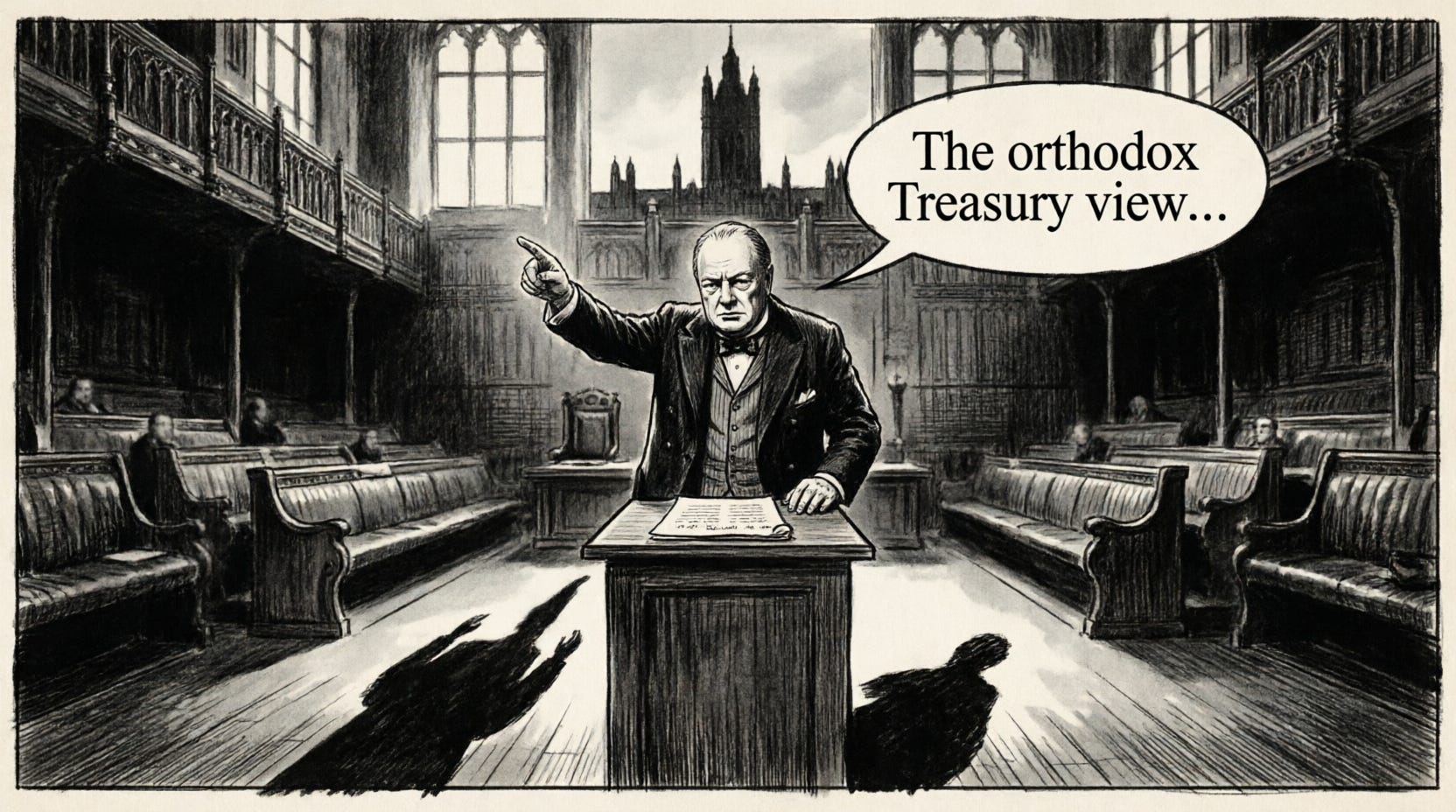
“The orthodox Treasury view ... is that when the Government borrow[s] in the money market it becomes a new competitor with industry and engrosses to itself resources which would otherwise have been employed by private enterprise, and in the process raises the rent of money to all who have need of it.”
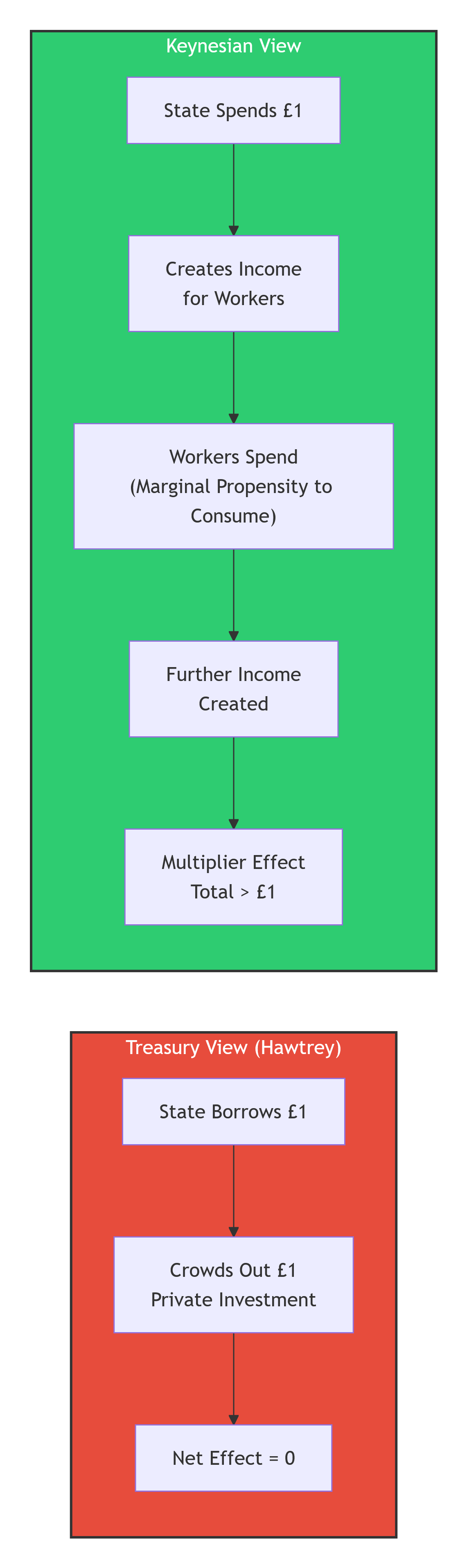
Any increase in government spending, according to this view, necessarily crowds out an equal amount of private spending or investment, producing no net impact on economic activity.
The intellectual bankruptcy of the Treasury View was recognised even by contemporaries. As the economic historian G. C. Peden noted in his definitive study of the doctrine: “Few economic doctrines have been apparently so fully discredited in the lifetime of those who held them as the Treasury view of 1929” (Peden, 1984). John Maynard Keynes subjected the doctrine to a devastating theoretical critique, demonstrating that in an economy with idle resources, public investment did not “crowd out” private enterprise but rather mobilised unused capacity.
The Treasury View is not merely an economic proposition but a political doctrine—one that has been repeatedly deployed to constrain democratic decision-making and privilege the interests of financial capital over those of labour and the public. The British Treasury View of the 1920s on the crowding-out effects of public expenditure is now recognised as a chief forerunner of contemporary austerity policies.
The Origins: Hawtrey and the Interwar Austerity Agenda
Ralph Hawtrey and the Birth of the Doctrine

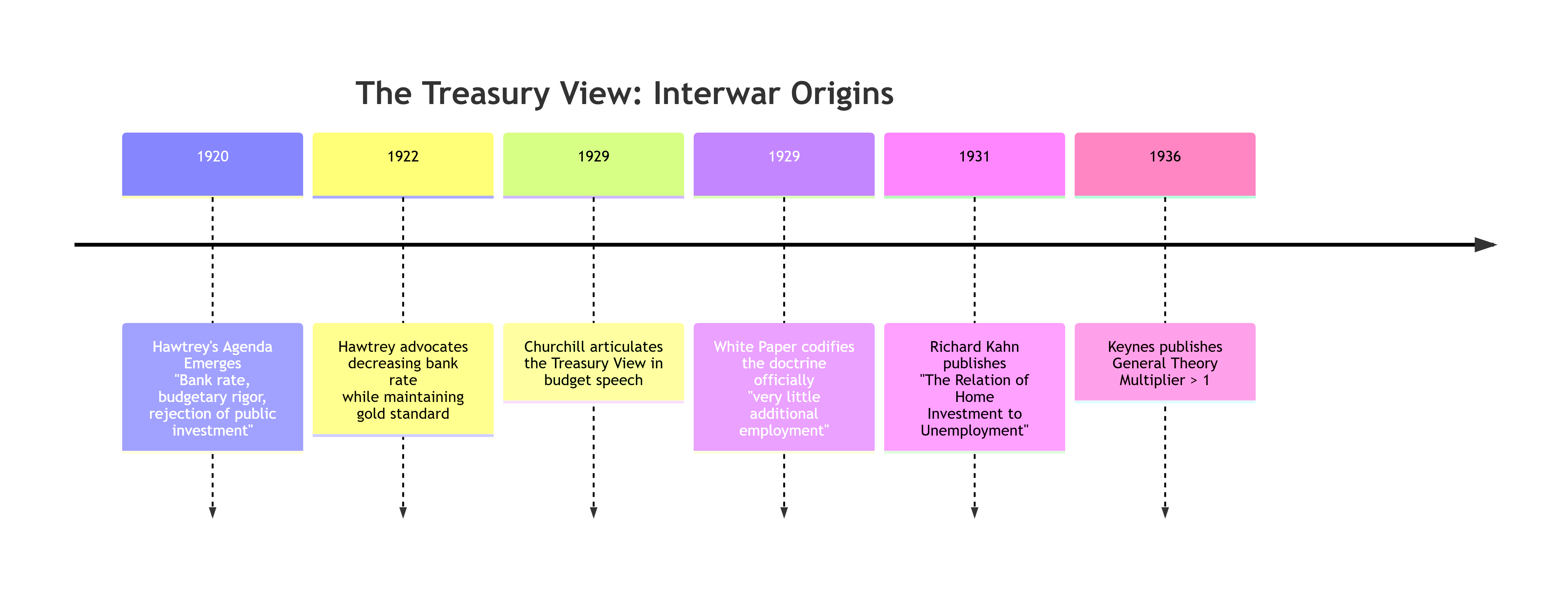
The Treasury View was most famously advanced in the 1920s and 1930s by staff of the Chancellor of the Exchequer, notably Ralph George Hawtrey.
Hawtrey was no marginal figure; he was a Treasury official of considerable influence whose policy prescriptions stemmed directly from his economic model. Through the parallel study of Treasury files and Hawtrey’s scholarly publications, his direct influence upon the most commanding minds of the Treasury and the Bank of England has been established—the two institutions that, after World War I, shared primary responsibility over the British austerity agenda.
Hawtrey’s implementation of the Treasury View was driven by both a fear of unsound money and a distinct, deliberate austerity agenda. These were not separate motivations but two sides of the same ideological coin, unified by his monetary theory. The historical evidence shows that his policies were consciously designed to enforce deflation and discipline the economy through rigorous austerity.
“Unsound Money” as a Path to Ruin
At the heart of Hawtrey’s thinking was a profound, almost moral, conviction that “sound currency” was the absolute aim of economic policy. This was not just a preference for low inflation; it was a belief that monetary stability was the essential precondition for a functioning economy and society. This fear manifested in two critical ways:
The Return to the Gold Standard:
Hawtrey was an “adamant supporter of the gold standard,” believing it was the ultimate guarantor of sound money. He advocated for “drastic budgetary and monetary rigor in the name of price stabilization” and was even willing to accept “further monetary revaluation” (meaning more deflation) to maintain the gold standard.
The Fear of Inflation:
His focus was not on unemployment but on the threat of inflation. At the Bretton Woods conference, he famously questioned: “What’s all this talk about the dangers of deflation? Inflation, not deflation, is the postwar problem.” This shows his fear was squarely directed at the perceived threat of unsound, inflationary money.
The Austere Aspect
Rejecting Public Works
Hawtrey’s fear of unsound money was not passive; it was an aggressive doctrine that actively rejected any policy that might be inflationary, including government spending to create jobs. He argued that public works were not only useless but positively harmful. In a 1925 article, he wrote that “the original contention that public works give employment themselves is radically fallacious.” In his view, the only “true remedy for unemployment is to be found in the direct regulation of credit on sound lines.”
The “crowding-out argument” was his key theoretical weapon. He believed that government borrowing for public works would just compete with private industry for a fixed pool of savings, raising interest rates and stifling the private investment that was the “true” source of jobs.
The Unifying Theory
The Zero Multiplier
The link between Hawtrey’s fear of unsound money and his austerity agenda was his economic model. He believed that an increase in government spending would be completely offset by a decrease in private spending, resulting in no net increase in economic activity—a multiplier of zero. From this perspective, any state spending was a dangerous illusion: it didn’t create real prosperity, it just risked unbalancing the monetary system. Therefore, the only sound policy was monetary stabilization through the management of the bank rate, budgetary rigor, and rejection of public investment.
The historical scholarship is unequivocal on this point: Hawtrey’s original economic theory provided solid theoretical justifications for the austerity policies that defined British economic life after WWI. The doctrine was formally codified in a 1929 White Paper, which explicitly argued that public works would simply divert an equal amount of private spending, providing a parliamentary imprimatur to Hawtrey’s theoretical rigour. For Hawtrey, the “Treasury View” was a comprehensive doctrine where severe budget cuts and deflation appeared not as a political choice, but as a scientific and moral necessity.
The Interregnum
Keynesianism and the Eclipse of the Treasury View
The Keynesian Challenge
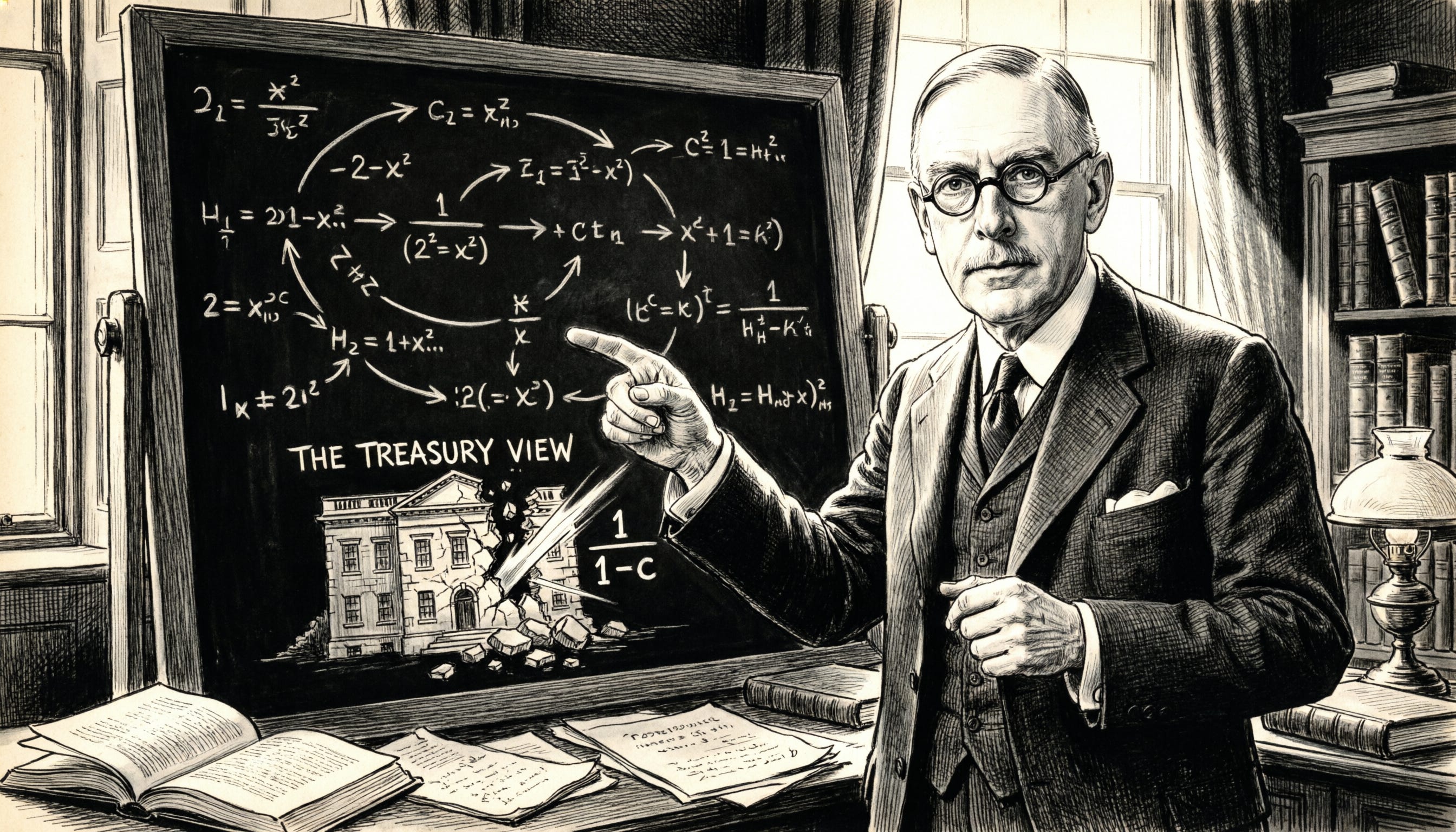
The Treasury View was subjected to devastating theoretical and empirical critique by John Maynard Keynes. In his General Theory of Employment, Interest and Money, Keynes provided a theoretical foundation for how fiscal stimulus could increase economic activity during recessions. The doctrine that government spending merely crowds out private investment seemed absurd in the light of mass unemployment—as Keynes famously observed, when resources were idle, there was no “crowding out” to occur.
Hawtrey’s model inherently assumed a multiplier of zero because he believed money velocity was fixed by banking habits. Keynes proved that the multiplier is greater than one when an economy is in a deep underemployment equilibrium (Skidelsky, 1981). The formulation of the multiplier was a collaborative breakthrough within the “Cambridge Circus.” While Keynes had intuitive notions of cumulative effects, it was his close student and colleague Richard Kahn who formally introduced the “employment multiplier” in his seminal 1931 paper, The Relation of Home Investment to Unemployment. Skidelsky maps out how Keynes took Kahn’s employment multiplier and transformed it into the investment/income multiplier that became the mathematical centrepiece of The General Theory in 1936.
Skidelsky shows how Keynes used the multiplier to prove that when an economy has idle capacity and mass unemployment, an injection of state spending creates a chain reaction of consumption. Because one person’s spending becomes another person’s income, the final increase in national income is a multiple of the original state injection.
Crucially, the multiplier fundamentally changed how economists viewed savings. The old Treasury View argued that the government “engrossed to itself resources” and drove up the price of money (interest rates). By using the multiplier framework, Keynes inverted this: public investment creates its own savings by raising total aggregate income. As national income rises through successive rounds of the multiplier, the total pool of savings expands to naturally match the initial investment.
The Post-War Consensus
For roughly three decades following the Second World War, the Treasury View was in retreat. The post-war settlement—sometimes called the “Keynesian consensus”—accepted that the state had a responsibility to manage aggregate demand to maintain full employment. Fiscal policy was the primary tool of macroeconomic management. The Treasury View survived as an institutional instinct within the Treasury, but it was subordinated to the prevailing orthodoxy.
The Revival
The Mont Pèlerin Society and the Neoliberal Counter-Revolution
The Intellectual Network and Austerity as a Weapon
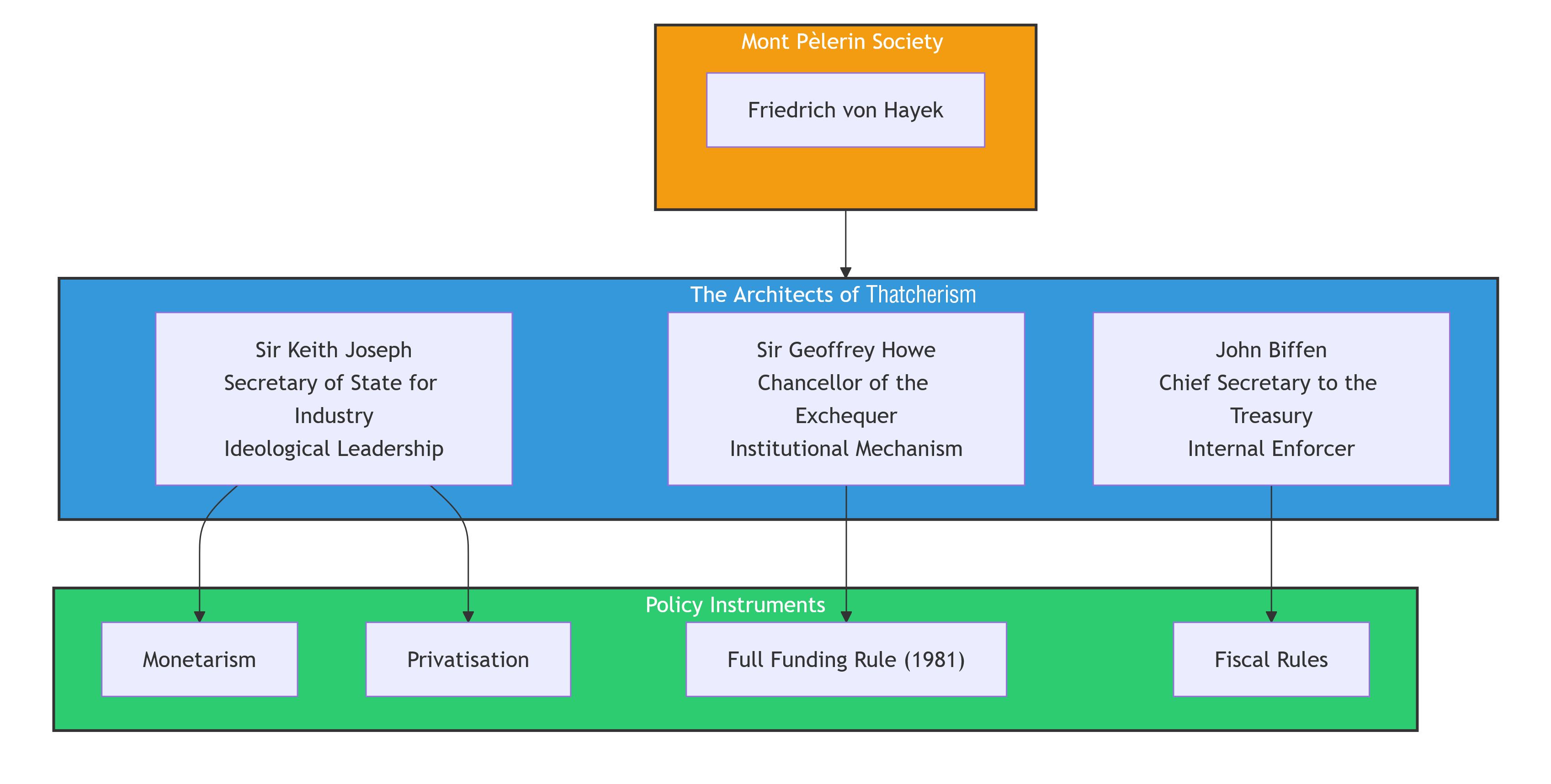
The revival of the Treasury View in the 1970s was not an accident of history; it was the product of an organised intellectual and political campaign. The Mont Pèlerin Society (MPS), founded in 1947 by economist Friedrich von Hayek, served as the institutional vehicle for this revival. By the turn of the 1970s, the society commanded influence at the highest levels of policy-making.
As recent research by Clara Mattei (2018) has demonstrated, the doctrine’s persistence was not due to its economic validity, but its utility as a political weapon. The Treasury View served as the theoretical justification for austerity—a deliberate mechanism to enforce deflation, discipline labour, and protect the interests of the creditor class at the expense of full employment. Evidence strongly suggests that MPS members were not only aware of this outcome but actively pursued it. For them, austerity was not an unforeseen consequence but a necessary and deliberate mechanism to achieve their ideological goals.
The primary driver was the monetarist theory promoted by key MPS figures like Milton Friedman. This theory argued that government attempts to manage the economy and maintain full employment were not only futile but also the primary cause of inflation. From this perspective, austerity was the essential policy to “starve the beast” of government:
The Core Belief
They believed governments could not create real jobs or growth through spending; they could only cause inflation.
The Prescription
To stop inflation, you had to limit the money supply, which inevitably meant cutting public spending and accepting higher unemployment as a necessary “shock.”
Austerity was thus a key tool in the MPS’s broader strategy to dismantle the post-war consensus and roll back the state. They viewed the welfare state, strong unions, and government regulation as threats to liberty. The desired outcome was a world where a “minimum of government, taxation and regulation” allowed market forces to dominate. The MPS developed a “deliberate strategy” to make this ideology central to Western policy, viewing austerity not as a hardship but as a necessary purge to break the power of the state and organised labour.
The Architects of Thatcherism
From Theory to Practice
The connection was fully realized in the 1970s, a decade of economic crisis that discredited Keynesianism and created an opening for MPS ideas. Three figures from this network were central to the implementation of the revived Treasury View in Britain, translating this ideology directly into policy:
Sir Keith Joseph: Joseph was deeply influenced by the ideas circulating within the MPS. Monetarism appealed to Joseph because of its moral force; it provided him with the certainty he had always craved. His conversion to monetarism in the mid-1970s was the catalyst for the Conservative Party’s shift away from the post-war consensus. As Secretary of State for Industry, he provided the ideological leadership and intellectual justification for the new direction, even as he paradoxically managed the state’s largest industrial interventions.
Geoffrey Howe: Howe was an MPS supporter and member. As Chancellor of the Exchequer in the first Thatcher government, he was the institutional mechanism for implementing the monetarist programme from within the Treasury. In his seminal 1979 Budget speech, Howe set out the new government’s guiding principle: “Finance must determine expenditure, not expenditure finance.”
John Biffen: Biffen joined the Mont Pèlerin Society in the 1960s. Appointed Chief Secretary to the Treasury after the 1979 election, he was tasked with controlling public expenditure from inside HMT. Biffen championed tight fiscal policy and opposed state intervention in economic management, acting as the Treasury’s internal enforcer for the new orthodoxy.
The appointment of Howe and Biffen to the Treasury, alongside Joseph’s ideological leadership from the Department of Industry, represented a decisive break with the post-war consensus. In effect, Britain had returned to the gold standard mentality of the interwar period, utilizing the core tenets of the Treasury View to justify strict fiscal limitations.
The British Institutional Infrastructure of the MPS
The profound influence of the United Kingdom within the global neoliberal network is illustrated by the prominent British figures who have served as president of the Mont Pèlerin Society:

A few notes on this list:
Friedrich Hayek, the society’s founder and first president, was born in Austria but became a British citizen in 1938 and is therefore listed as representing the United Kingdom.
Max Hartwell was born in Australia but is listed as a British president.
Linda Whetstone is the most recent British president, serving a shortened term from 2020 to 2021.
These figures represent the British intellectual and political current within the MPS that was so influential in shaping the Thatcherite policies.
The Institutionalisation
The Full Funding Rule and the Critique
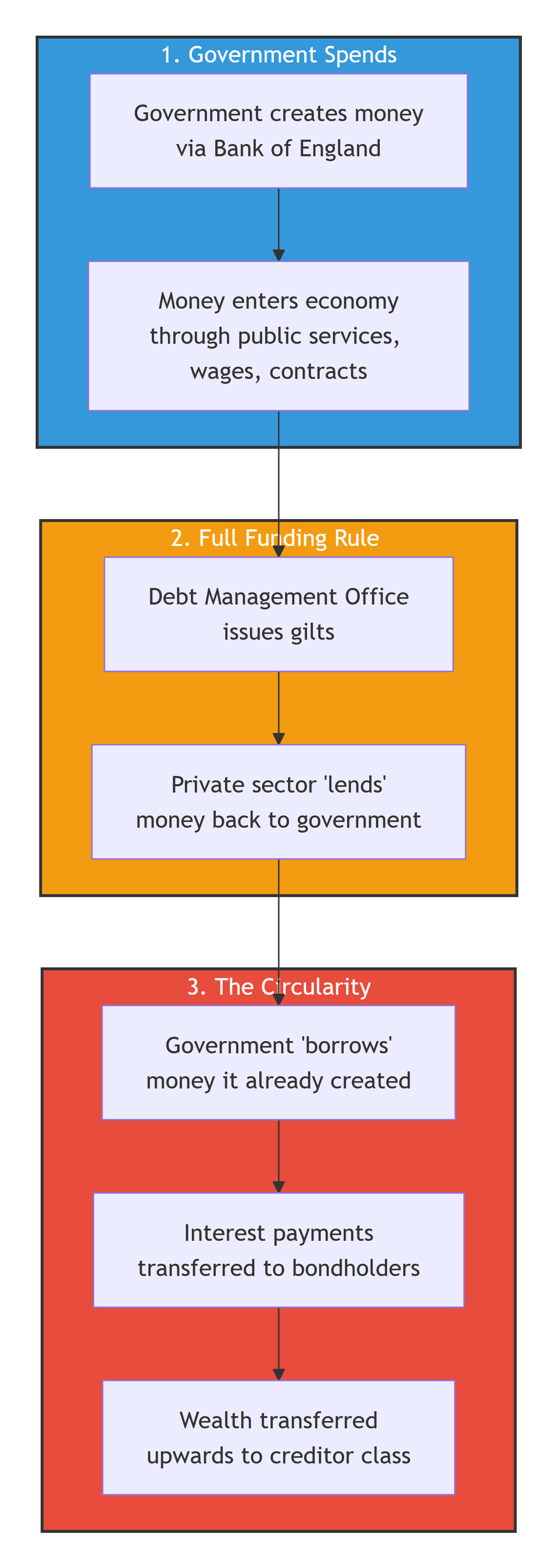
The Full Funding Rule is a self-imposed Treasury convention requiring the UK government to “fully fund” any fiscal deficit by issuing an equivalent amount of government bonds (gilts and Treasury Bills) to the private sector. If the government spends more than it receives in taxes, this rule requires that the government must “borrow” the difference by selling debt instruments to investors.
The rule was introduced in 1981 by Chancellor Geoffrey Howe, formalising the monetarist turn and ending the routine financing of deficits by selling Treasury bills directly to the Bank of England.
The Orthodox Illusion vs. The Operational Reality
The orthodox perspective relies on the “household budget constraint”—the false analogy that a sovereign currency issuer must “fund” its spending via taxation or borrowing before it can spend. This is the intellectual bedrock of the Full Funding Rule.
The operational reality is that of a “self-financing state.” The UK government spends by crediting the reserve accounts of commercial banks, thereby creating new money. Taxation does not “fund” spending; it deletes money from the system to manage aggregate demand and prevent inflation.
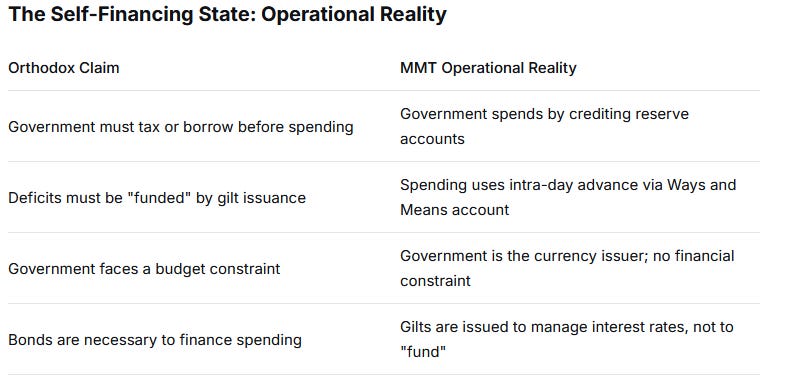
Institutional analysis of the UK’s self-financing state reveals the mechanics of this process. The government relies on the Bank of England’s “intra-day advance”—facilitated through the Ways and Means account, the government’s account at the central bank (the Exchequer)—to spend during the day. The Full Funding Rule merely requires the Debt Management Office (DMO) to issue gilts at the end of the day to “discharge” this intra-day advance.
In other words, the government creates the money to spend, then issues interest-bearing gilts to the private sector to “borrow back” the money it has already created. The acquirers of these gilts make settlement from their central bank reserve accounts. The entire operation is a circular exercise in financial theatre. By framing this as “prudence,” the state creates a fictional financial constraint to justify austerity on the public, while effortlessly bypassing those same constraints to fund strategic capital projects. Furthermore, this mechanism ensures that government deficits are financed through gilt issuance, transferring interest payments from the state to bondholders—a massive upwards redistribution of wealth that orthodox economics conveniently ignores.
Fiscal Rules
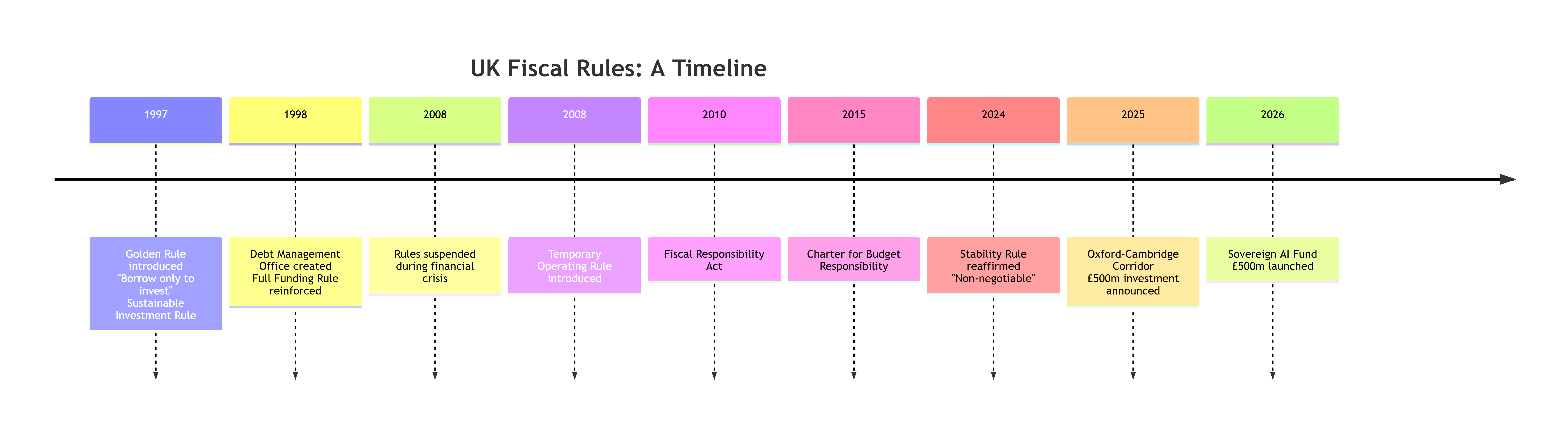
The Golden Rule and the Sustainable Investment Rule
The fiscal rules framework inaugurated by New Labour in 1997 represented the consolidation of the Treasury View into the permanent architecture of British governance. The first fiscal rule was the “golden rule”—that over the economic cycle the Government would borrow only to invest and not to fund current spending. The second was the “sustainable investment rule”—that public sector net debt as a proportion of GDP would be held at a stable and prudent level.
The Contemporary Framework
The current fiscal rules represent a continuation of this framework. The “Stability Rule” states that current spending—spending on public services—should only be financed through taxation, whereas public investment can be financed through borrowing. The government cannot borrow to fund day-to-day spending. While the 2008 financial crisis led to a temporary suspension of these rules, the framework was subsequently reinstated and has remained the anchor of UK fiscal policy.
Funding “Silicon Valley” Projects
The Contradiction Exposed
The contradiction at the heart of the Treasury View is exposed by the willingness of the same governments that preached fiscal restraint to write cheques for technology billionaires. The Treasury View was never a blanket prohibition on state spending; it was a class-based prohibition. It forbade spending that would empower labour, raise wages, or provide public goods. But it enthusiastically permitted—indeed, actively encouraged—spending that would enhance the competitive position of the British state and its corporate allies.
The Thatcherite Precedent
Inmos and Alvey
The pattern was set in the 1980s. Thatcher’s government was simultaneously the author of one of the most interventionist industrial policies in British history. Regarding Inmos, the state-backed semiconductor company, Hansard records from 1984 show the government debating the company’s valuation at £200 million, having invested heavily to establish a British chip industry.
Similarly, the Alvey Programme—a joint government-industry initiative launched in 1983—engaged more than 2,000 researchers on around 200 projects over five years. In total, the programme cost £350 million, of which £200 million came directly from the government. The programme was a direct response to Japan’s Fifth Generation Computer project. Thatcher’s government funded it because it was about competition, not compassion.
The Contemporary Continuity
Sovereign AI
The pattern has only intensified under contemporary administrations:
The Oxford-Cambridge Corridor
The government has announced a £500 million investment package to turn the corridor into “Europe’s Silicon Valley,” funding new homes, infrastructure, and business space. Chancellor Rachel Reeves described the investment as “choosing investment and renewal over chaos and decline.”
The Sovereign AI Fund
Launched in 2026, this is a £500 million sovereign venture fund tasked with co-investing alongside private backers in companies the Treasury views as “strategically important to Britain’s long-term competitiveness.”
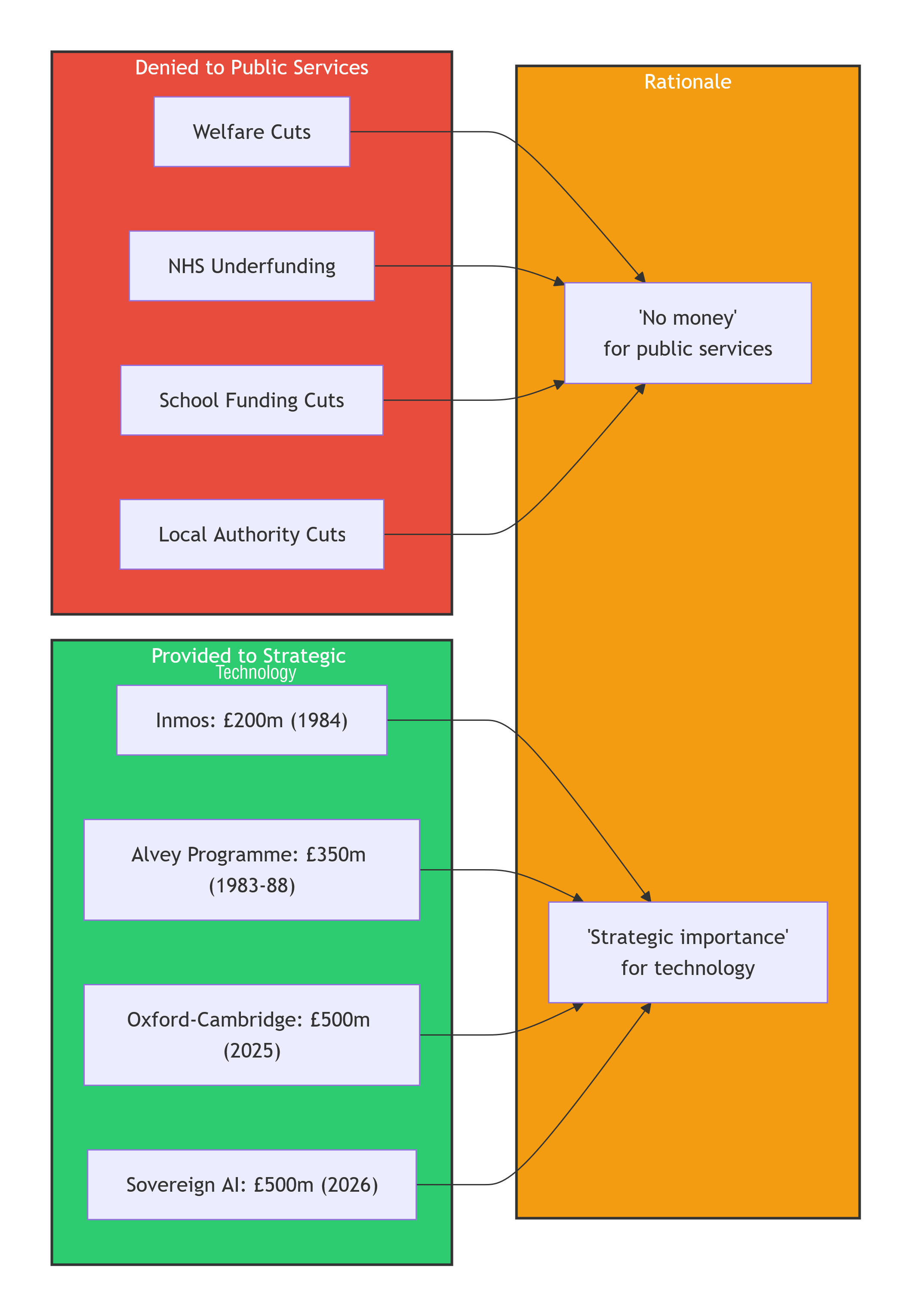
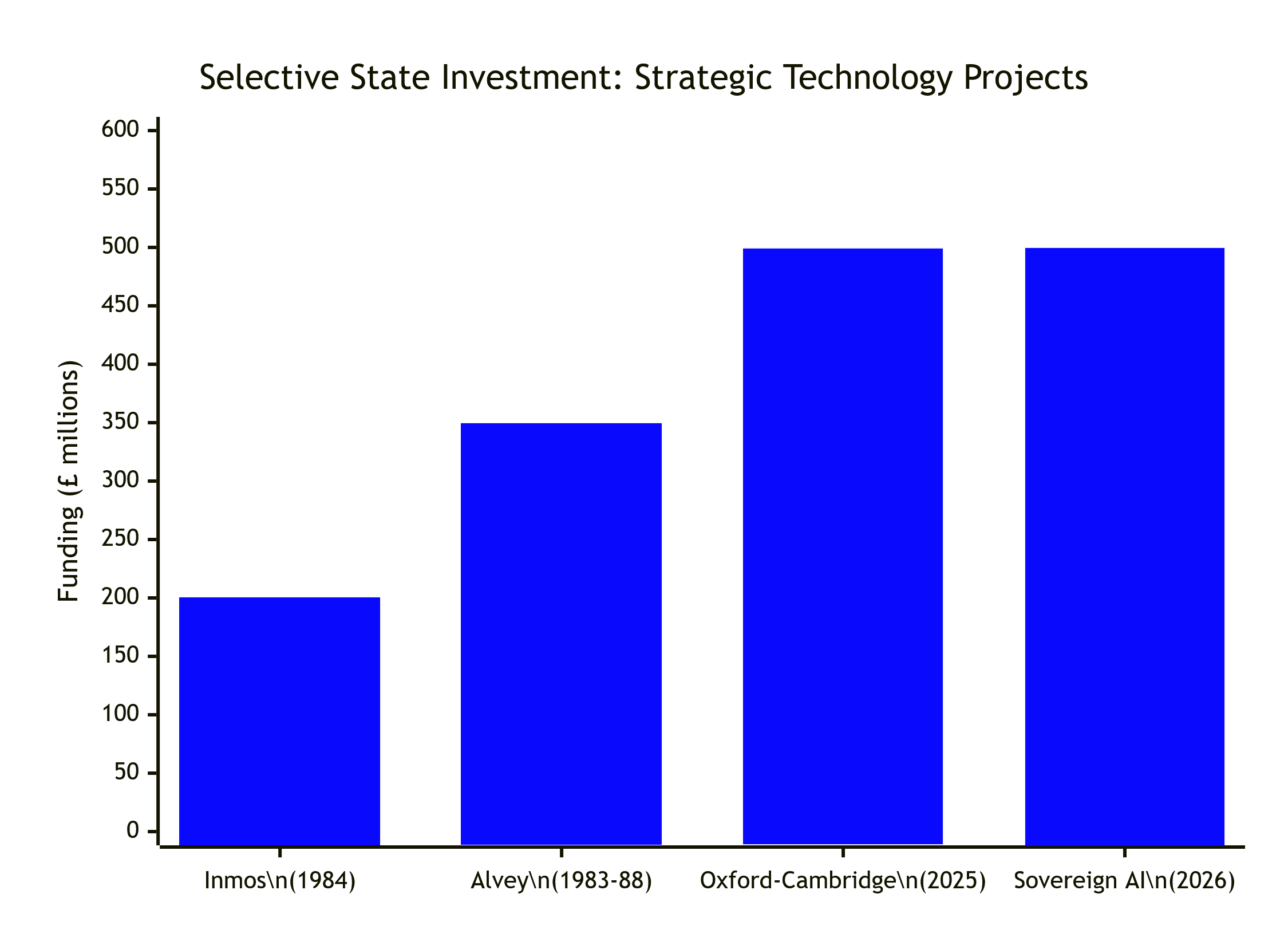
The funding for “Silicon Valley” projects is not philanthropy; it is statecraft. The Sovereign AI fund is tasked with backing companies “strategically important to Britain’s long-term competitiveness.” This is not about “sound money” or “fiscal responsibility”; it is about power. The Treasury View was never a doctrine of state abstinence; it was a doctrine of state selection.
The Counterfactual
The Treasury View Applied to WWII
Had the Treasury View been rigorously enforced during the Second World War, the outcome would have been catastrophic—quite possibly fatal to the Allied war effort. The doctrine’s core propositions would have systematically undermined every aspect of wartime mobilisation.
The “Crowding Out” Fallacy in Wartime
The Treasury View dictates that government borrowing “crowds out” private investment, and that any increase in state spending merely diverts resources from the private sector. Applied to WWII, the government would have been required to believe that massive state expenditure on munitions, ships, aircraft, and conscription was merely displacing an equivalent amount of private investment—that building a Spitfire factory somehow “crowded out” the production of civilian consumer goods.
In a wartime economy, private investment in consumer goods was deliberately suppressed. The state did not “crowd out” private activity; it mobilised idle capacity, redirected resources from civilian to military production, and created an unprecedented expansion of industrial output. The multiplier was not zero; it was transformative. Had the Treasury View been applied, the government would have been paralysed by the belief that its own spending was ineffective.
The Full Funding Rule in Wartime
The Full Funding Rule requires that government deficits must be “fully funded” by issuing an equivalent amount of gilts to the private sector. Applied to WWII, the government would have been forced to raise every penny of war expenditure through upfront gilt sales to private investors. This would have resulted in massive interest payments diverting resources to bondholders, the rapid exhaustion of private savings, and an inability to act quickly due to the slow velocity of gilt issuance.
In historical reality, the UK government financed a significant portion of the war effort through direct money creation. The Ways and Means account at the Bank of England was used extensively to provide immediate funds, with gilt issuance following after the spending had occurred—exactly the operational reality the Full Funding Rule was designed to prevent. The government spent first, created the money, and issued gilts later to manage the financial system’s liquidity.
The “Sound Money” Orthodoxy and Historical Irony
The Treasury View insists that price stability and sound money must take precedence over employment, output, or other objectives. Applied to WWII, the government would have been required to maintain price stability at all costs—even if that meant restricting the money supply, limiting state expenditure, and failing to mobilise the economy for war. In reality, the UK experienced significant inflation during WWII, managing it through rationing, price controls, and wage restraint rather than monetary contraction. The priority was national survival, not “sound money.”
There is a profound historical irony here: Ralph Hawtrey himself served as a Treasury official throughout the war and did oppose the government’s wartime financial policies on precisely the grounds the Treasury View dictated. Concerned about inflation, Hawtrey argued continuously for tighter monetary policy. He was, in effect, applying his own Treasury View to the war economy—and he was entirely ignored. The government understood that national survival required abandoning the very doctrines Hawtrey had spent his career building. The Full Funding Rule was treated as an afterthought, not a constraint.
The Class Character of the Doctrine Exposed
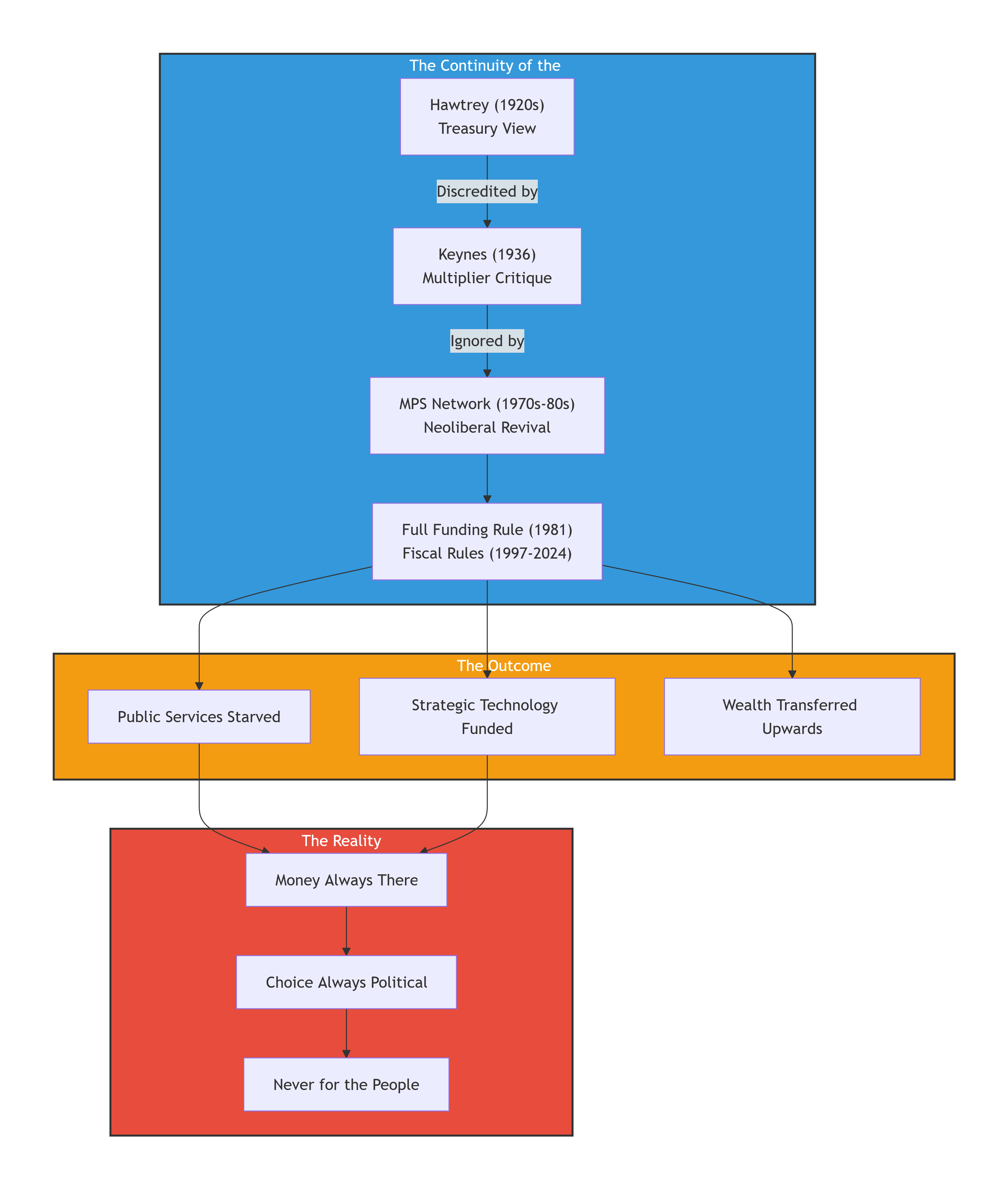
The counterfactual demonstrates that the Treasury View is not a universal economic principle; it is a class-based doctrine of convenience. It is deployed when it serves the interests of the creditor class—to constrain spending on wages, welfare, and public services—and abandoned whenever the interests of the state or its corporate allies require intervention.
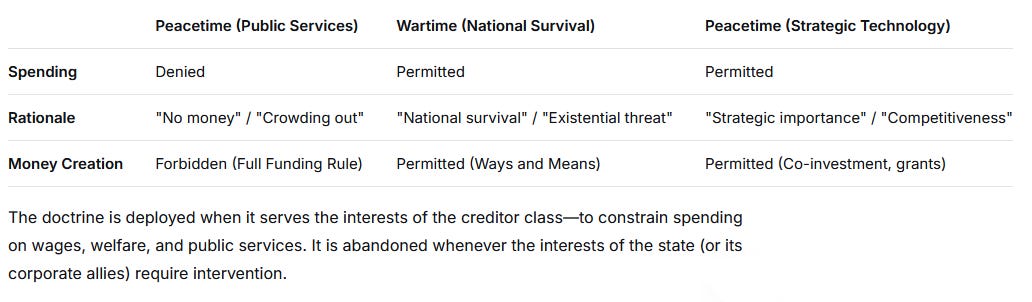
The Treasury View, the Full Funding Rule, and modern fiscal rules were never about neutral economic prudence; they were about class power. They were designed to constrain spending on the public while liberating spending for the powerful. The same Treasury that insists there is “no money” for public services somehow finds billions for tech billionaires. The funding of “Silicon Valley” projects is not a contradiction of the Treasury View; it is its ultimate fulfilment: directing state power toward the interests of capital. The idolatry of sound money was always a mask for the rapacity of the creditor class, and the mask slips the moment the interests of that class require state intervention.
The Persistence of the Doctrine
There is no single date when the Treasury View “ceased” to exist. It was thoroughly discredited as a formal doctrine in the 1930s, but it never truly died. Instead, it transformed into a persistent institutional mindset—an institutional reflex affecting politicians of all parties and civil servants alike, changing with the times and ebbing in response to the political context, but always present to a degree.
Three Historic Phases of the Doctrine
Articulation (1920s–1930s)
Formally articulated by Treasury officials like Ralph Hawtrey and famously encapsulated in Winston Churchill’s 1929 budget speech.
Theoretical Defeat (1936)
Discredited by Keynes’s General Theory, which demonstrated the logical and mathematical fallacy at its core. Modern Monetary Theory economist William Mitchell notes that the Treasury View “was thoroughly discredited in the immediate period after it was articulated” and that modern proponents are “peddling their nonsense oblivious that their ‘knowledge’ ceased to be such 80 odd years ago.”
Revival & Persistence (1979–Present)
Consciously revived in 1979 by the Thatcher government via the MPS network. As William Mitchell observes: “Macroeconomics has returned to the discredited Treasury view with some modern embellishments.”
A stark contemporary application of this persistence occurred during the 2010 UK austerity programme. The newly-elected coalition government explicitly “bought this argument,” which, as Mitchell notes, was “why Britain had an emergency budget within six weeks of the election and [experienced] the deepest cuts in public spending since the 1920s.” This represented a conscious, institutional return to the interwar doctrine.
Austerity and the Long Arc of Institutional Power
Austerity as a policy long predates both the classical Gold Standard and the Treasury View. Its history spans centuries, evolving from an ad-hoc imperial tool into a highly institutionalised weapon of class governance:
The 18th Century (Pre-Gold Standard)
Long before the Gold Standard, austerity drove major historical crises. Following the Seven Years’ War, the British government implemented a severe fiscal program in the 1760s to address its debt crisis, cutting colonial infrastructure spending, restricting trade, and banning the American colonies from printing their own money. This colonial “austerity program” acted as a primary structural grievance that pushed the colonies toward the American Revolution.
The 18th–19th Century (Classical Economics)
Early classical economists debated state debt management in the shadow of war. While David Ricardo and John Stuart Mill argued for strictly paying down debt, Thomas Malthus offered a notable counterpoint, warning that paying down war debt too quickly would stifle aggregate demand and harm the working classes. Despite these debates, the baseline orthodoxy remained that budgets must be balanced outside of exceptional wartime circumstances.
Post-WWI (The Birth of “Modern” Austerity)
The modern concept of austerity—as a deliberate policy to deflate an economy and enforce social “order”—crystallized after WWI. Historian Clara E. Mattei argues that “austerity as we know it today” emerged in this period as a direct structural reaction to post-war revolutionary upheaval. Governments in Britain and Italy utilized austerity—specifically returning to the Gold Standard and slashing social budgets—to intentionally rein in workers and restore the pre-war capitalist order.
The Treasury View (1920s)
The Treasury View was the intellectual formalisation of these earlier, ad-hoc austerity impulses. It provided a specific economic rationale for why government spending was inherently harmful, emerging directly out of post-WWI debt concerns.
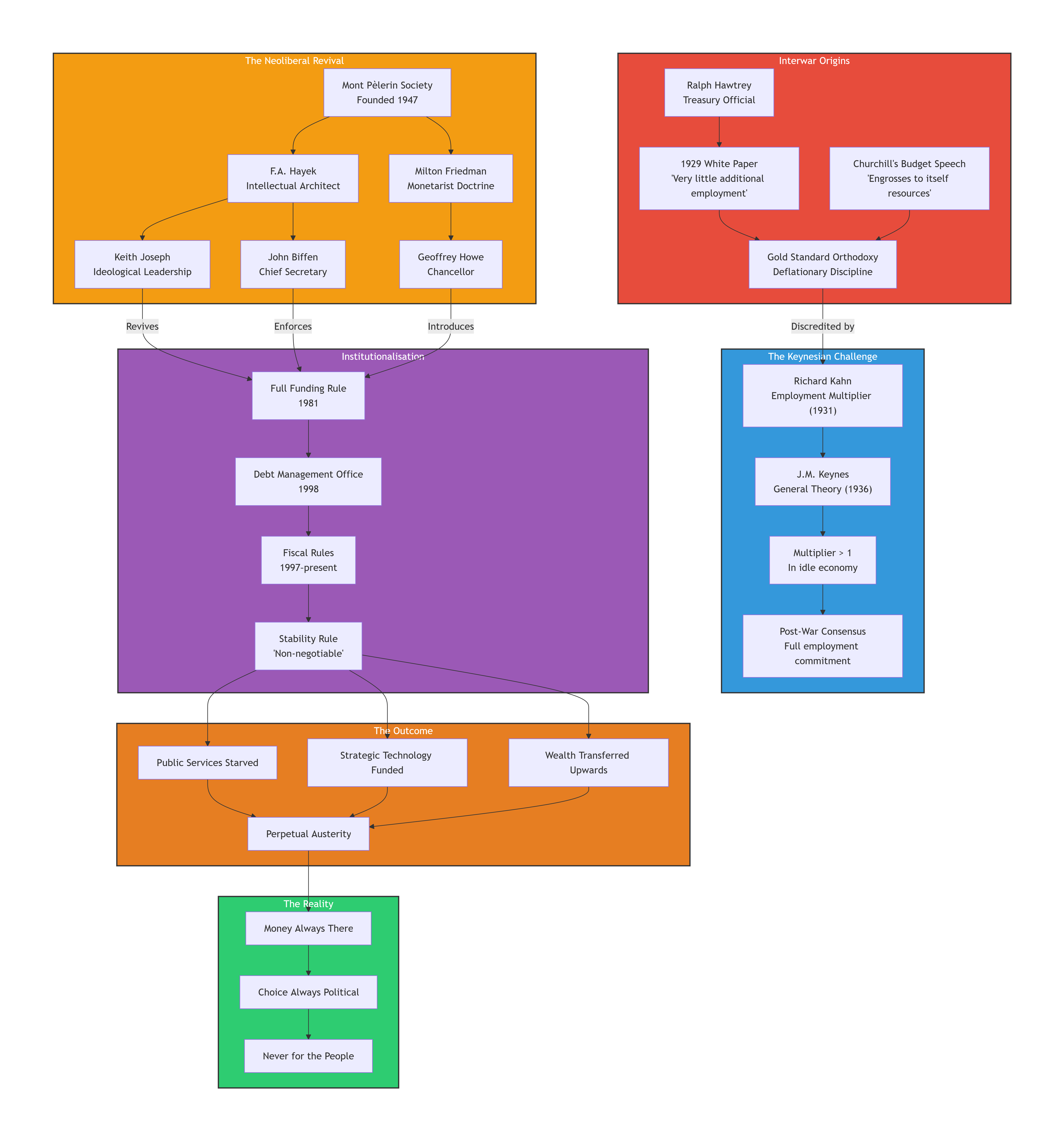
While austerity policies existed long before Ralph Hawtrey, the Treasury View gave them an enduring, technocratic academic justification. It transformed a raw political tool for managing state finances into a pseudo-scientific economic law. The lesson of this history is clear: the money was always there. The rules were always a choice. And the choice was always political.
References
Primary Sources
Churchill, Winston. Hansard (Commons), 5th series, vol. CCXXVII, 15 April 1929, col. 54.
HM Treasury. Financial Statement and Budget Report. July 1997.
HM Treasury. Fiscal Responsibility Bill: Explanatory Notes. 2010.
HM Treasury. Charter for Budget Responsibility. 2025.
Howe, Geoffrey. Budget Speech. 10 March 1981.
Secondary Sources
Blyth, Mark. Austerity: The History of a Dangerous Idea. Oxford University Press, 2013.
Campbell, John. Margaret Thatcher: The Iron Lady. Jonathan Cape, 2003.
Hartwell, Ronald Max. A History of the Mont Pelerin Society. Indianapolis: Liberty Fund, 1995.
Hartwell, Ronald Max. “The Rising Standard of Living in England, 1800–1850.” Economic History Review, vol. 13, no. 3, 1961, pp. 397-416.
Kahn, Richard F. “The Relation of Home Investment to Unemployment.” Economic Journal, vol. 41, no. 162, 1931, pp. 173–198.
Keynes, John Maynard. The General Theory of Employment, Interest and Money. Macmillan, 1936.
Mattei, Clara E. “Treasury view and post-WWI British austerity: Basil Blackett, Otto Niemeyer and Ralph Hawtrey.” Cambridge Journal of Economics, vol. 42, no. 4, 2018, pp. 1123–1144.
Mattei, Clara E. The Capital Order: How Economists Invented Austerity and Paved the Way to Fascism. University of Chicago Press, 2022.
Mitchell, William. Bill Mitchell Blog: Modern Monetary Theory.
Murphy, Richard. “New glossary entry: the Full Funding Rule.” Tax Research UK, 9 November 2025.
Peden, G.C. “The ‘Treasury View’ on Public Works and Employment in the Interwar Period.” Economic History Review, 2nd series, vol. 37, no. 2, 1984, pp. 167–181.
Ramsden, John, editor. The Oxford Companion to 20th-Century British Politics. Oxford University Press, 2002.
Robinson, Joan. Economic Philosophy. Watts, 1962.
Skidelsky, Robert. Politicians and the Slump: The Labour Government of 1929–1931. Macmillan, 1981.
UCL Institute for Innovation and Public Purpose. The Self-Financing State: An Institutional Analysis of Government Expenditure, Revenue Collection and Debt Issuance Operations in the United Kingdom. University College London, 2025.
Whetstone, Linda, editor. Islamic Foundations of a Free Society. Institute of Economic Affairs, 2016.
Young, Hugo. One of Us. Pan, 1990.
Youngson, A.J. The British Economy, 1920–1957. Allen & Unwin, 1960.
Very good indeed! 😀
You don't give Thatcher any intellectual credit in 'Thatcherism'. Is that intentional, do you think she was just the figurehead, rather than having much weight in the substance of it?
Great post!