

A Graphic Novella
This article is the second in a series that will look at events, not necessarily economic in nature, that had a profound effect on economics, or on how people perceive it. The first in the series is…

Introduction
From May to November 1970, the Republic of Ireland experienced a complete shutdown of its Associated Banks, four institutions holding approximately 82 per cent of Irish current and deposit accounts (Murphy 1978), following an industrial dispute. The public was deprived of direct access to its dominant means of payment and credit. While effects were surprisingly limited (Central Bank of Ireland 1971; Fogarty 1971), this observation requires substantial qualification. The substitution of trade credit for bank deposits, principally through public houses acting as informal clearing houses, raises questions about the necessity of formal banking architecture. However, this informal system was not indefinitely viable; it rested on a fragile equilibrium. Had the strike continued, the system would have progressively deteriorated, a fact both orthodox economists and Modern Monetary Theory (MMT) analysts must acknowledge.
Industrial Dispute
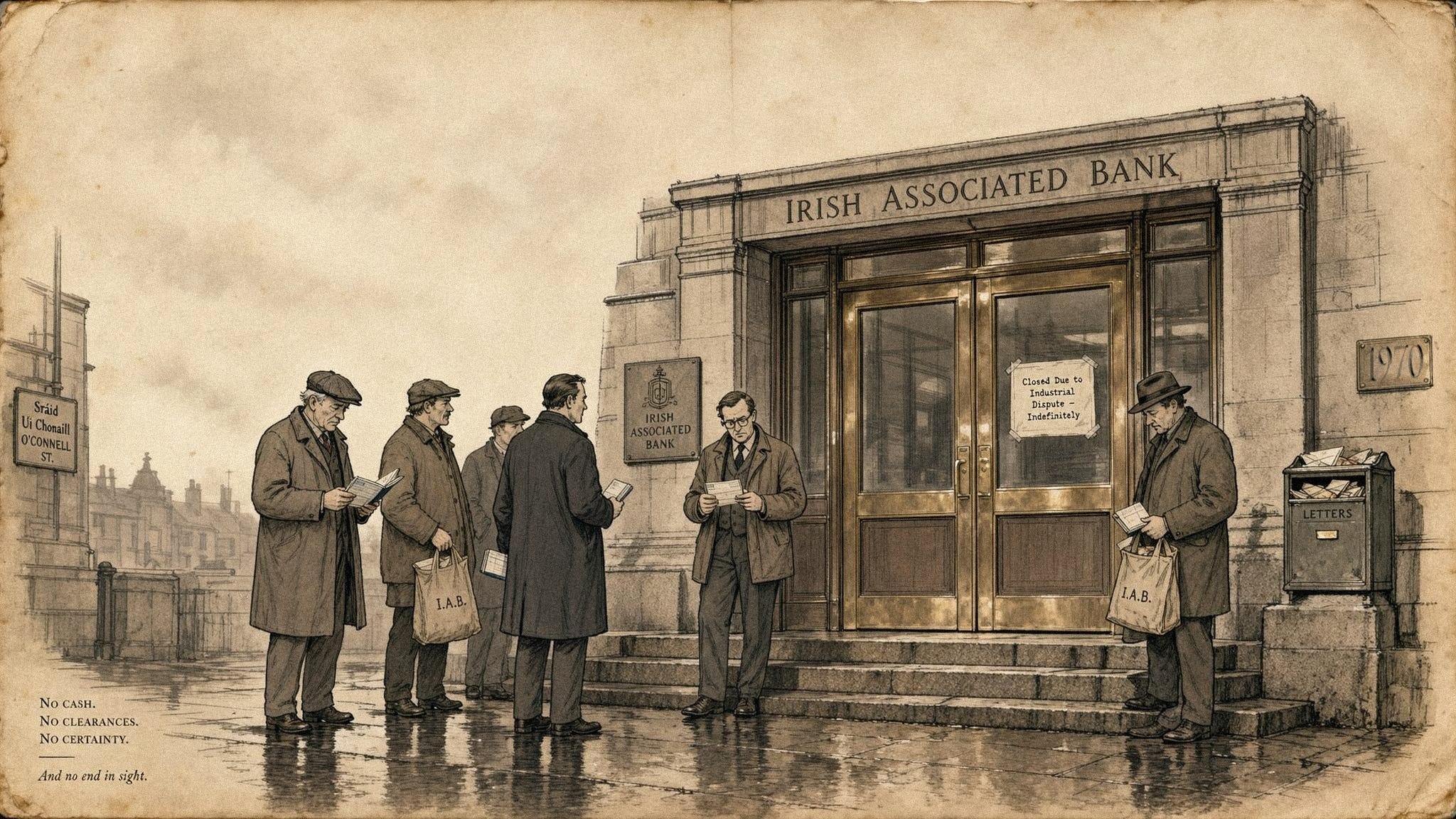
The strike originated from a pay claim by the Irish Bank Officials’ Association. A resulting go-slow in March 1970 accumulated two million unprocessed transactions by April (Dublin Port and Docks Board v Bank of Ireland [1976]). On 30 April 1970, the banks completely shut down, reopening on 21 October behind closed doors to clear arrears. The event’s legal characterisation remains contested; one Dáil Éireann member argued it was a “bank lock-out” rather than a strike, implying banks deliberately ceased operations to pressure the union (Dáil Éireann Debates, 17 February 1971). This orthodox free-market stance meant the burden of economic function fell entirely on the informal sector. Crucially, this was a shutdown of clearing banks, not a total financial collapse; institutions remained legally extant, holding deposits and accounts (Bank of England 2016).
The Legality of Cheques and the Dublin Port Litigation
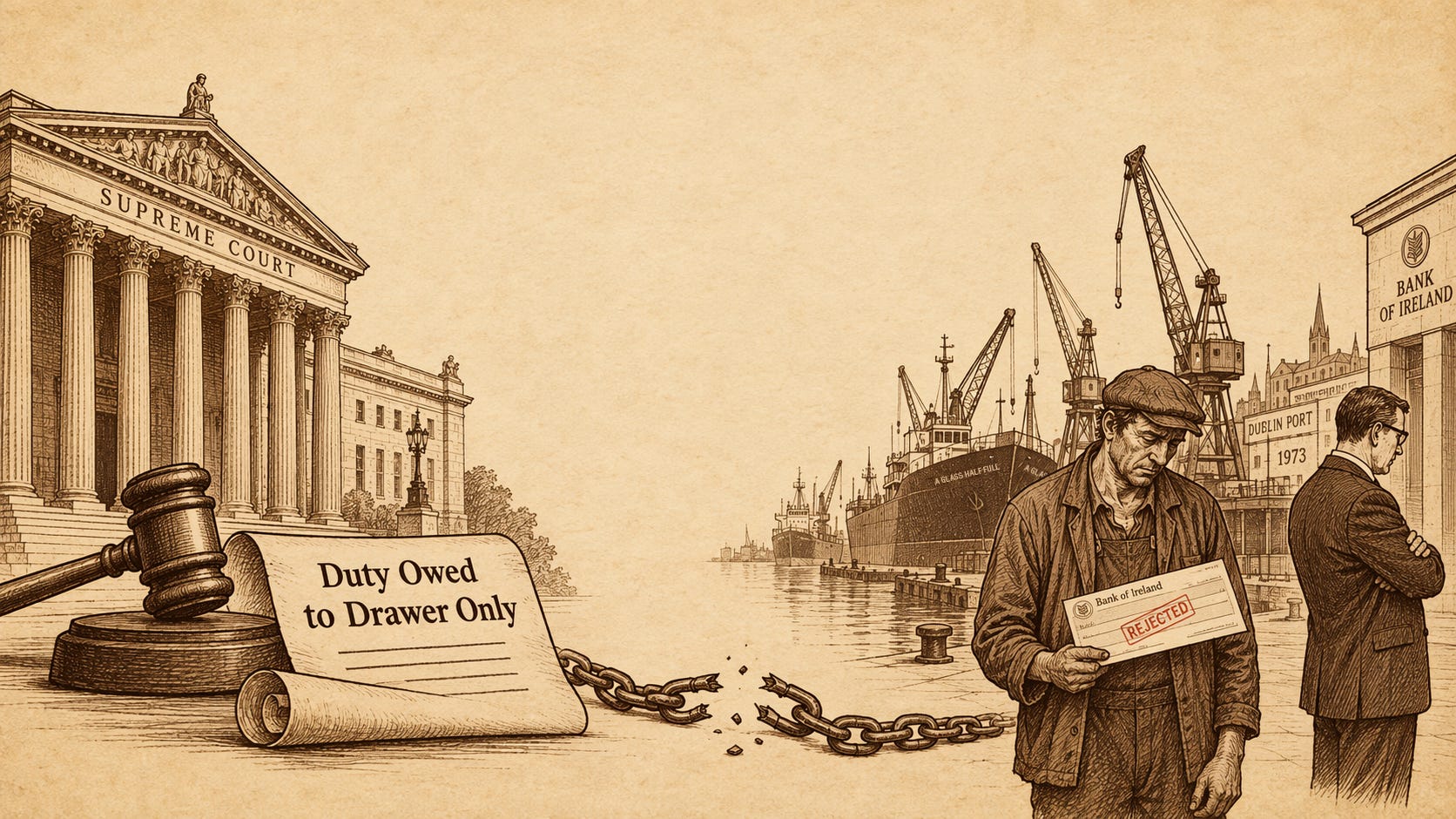
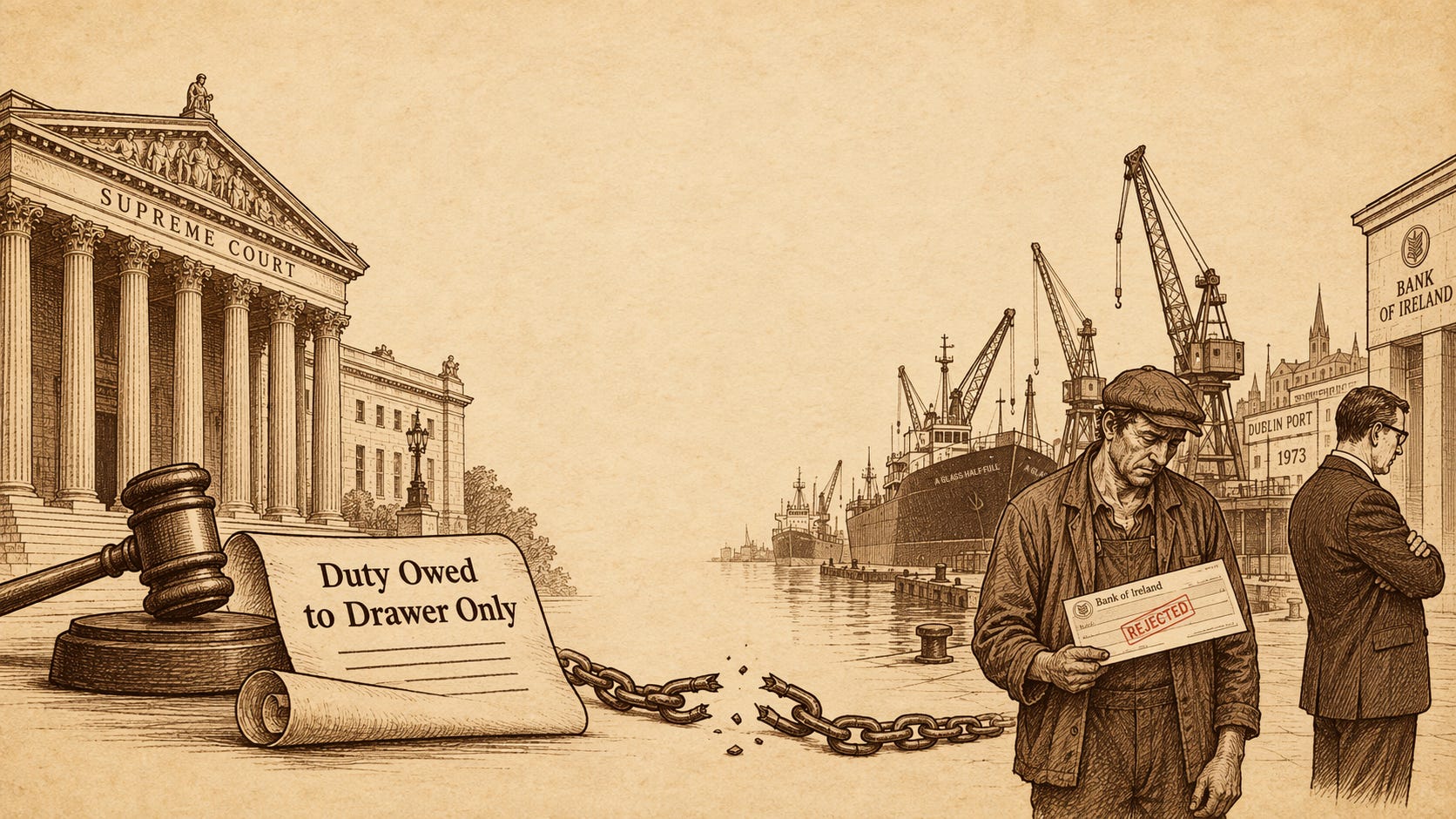
The strike exposed a legal grey area regarding bank obligations to cheque payees, clarified in Dublin Port and Docks Board v The Governor and Company of the Bank of Ireland [1976] IESC 1. A cheque lodged pre-strike was processed during the October 1970 special clearing, but the drawer’s account was overdrawn, prompting the bank to refuse payment. The Supreme Court held that a bank’s contractual duty to process a cheque is owed exclusively to its customer (the drawer), not the payee. This redefined the cheque from a near-certain promise of payment to an instrument dependent on trust.
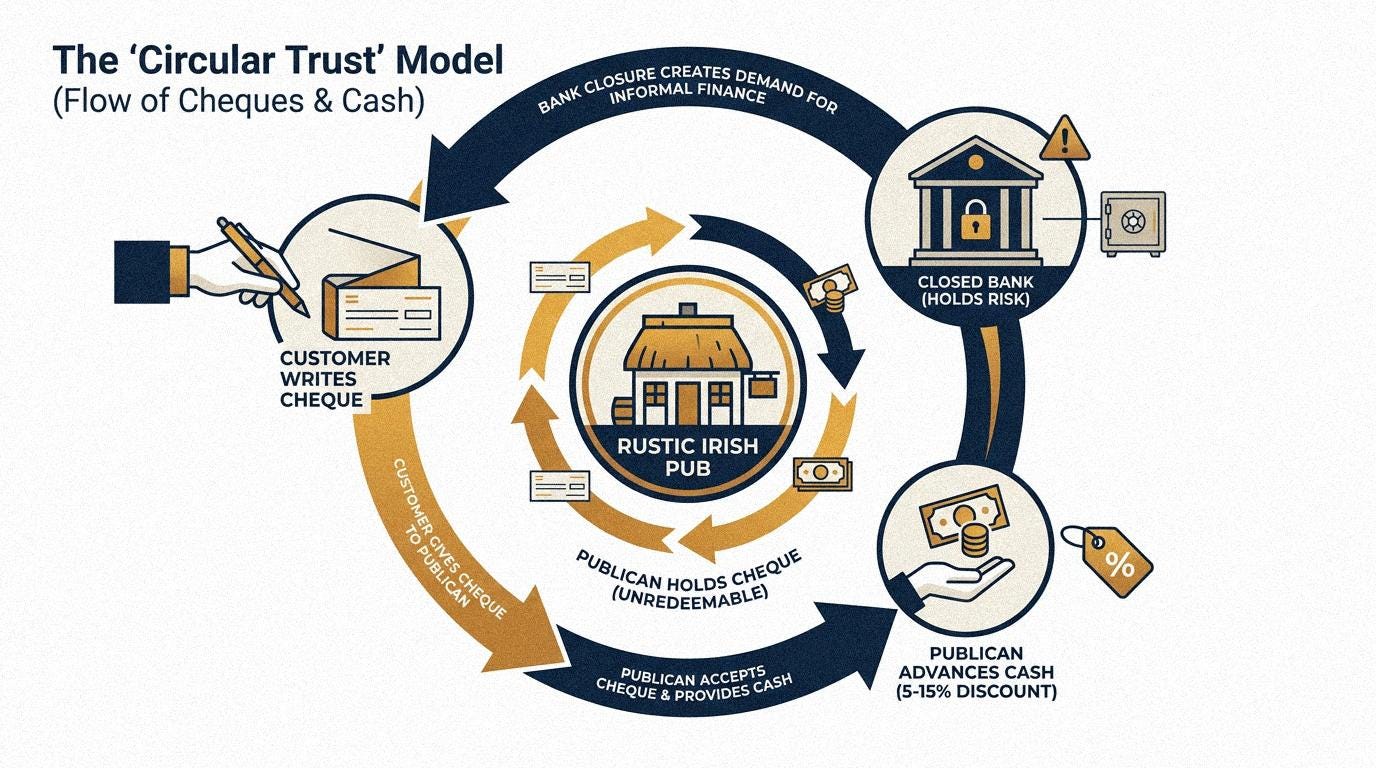
Consequently, the risk of non-payment during systemic disruption falls on the payee, not the bank. This had profound implications for the informal economy: publicans accepting cheques bore the risk of default, and the 5 to 15 per cent discount they applied represented, in part, compensation for this legal risk.
An Informal Financial Architecture
Pubs as Clearing Houses
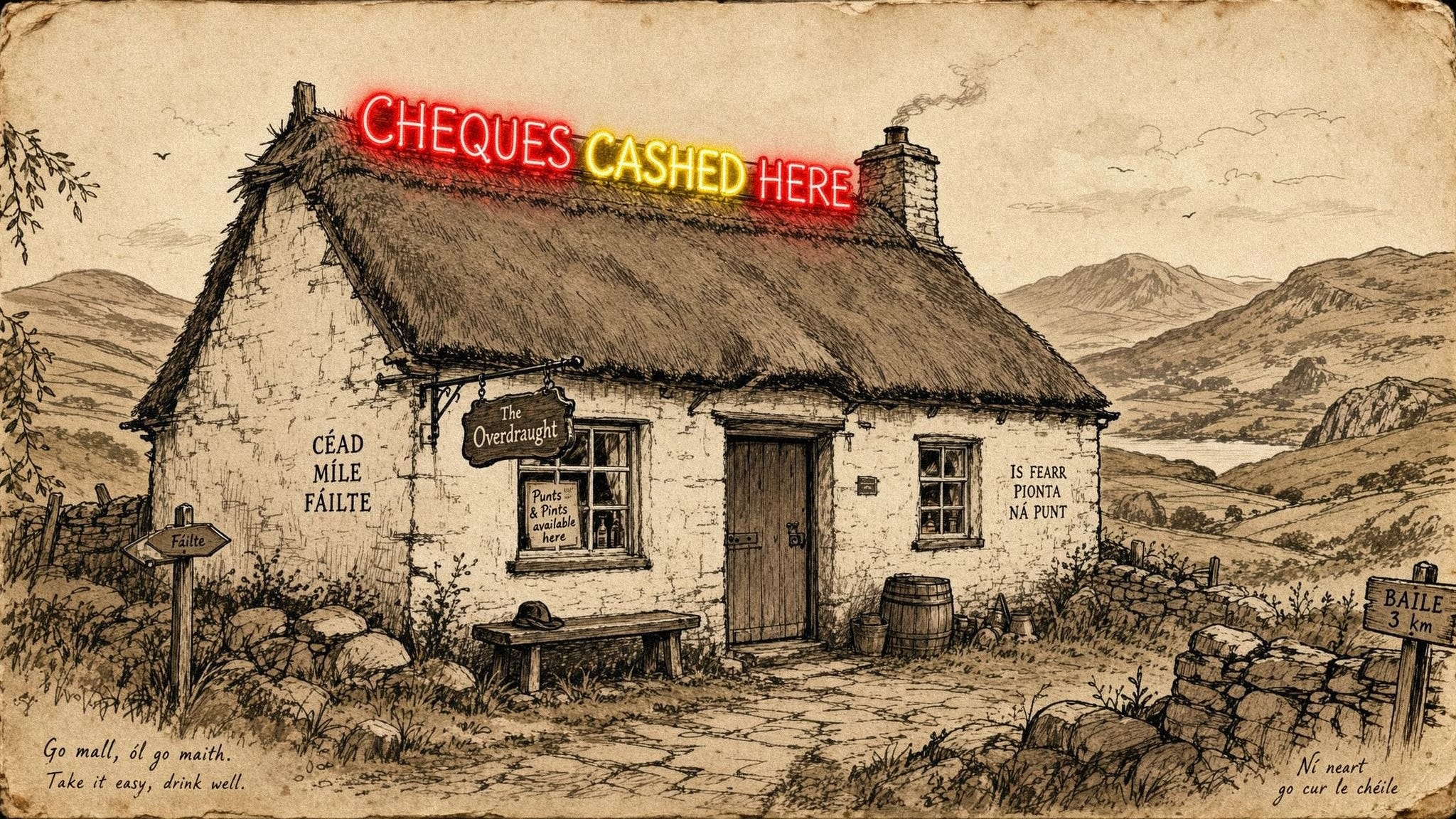
With banks inoperative, approximately 11,000 public houses, grocery shops, and retailers assumed banking functions (Murphy, cited in BBC 2017). The Irish pub’s geographic distribution, cash safes, steady daily takings, and intimate local knowledge made this possible. Publicans advanced cash to customers in exchange for cheques, holding them until banks reopened. This trade credit system operated almost entirely without inter-pub lending; each pub was an independent node relying on personal trust. As publican John Dempsey noted, his refusal of strangers and reliance on regulars allowed him to “keep a few local factories going” (cited in Business Insider 2016).
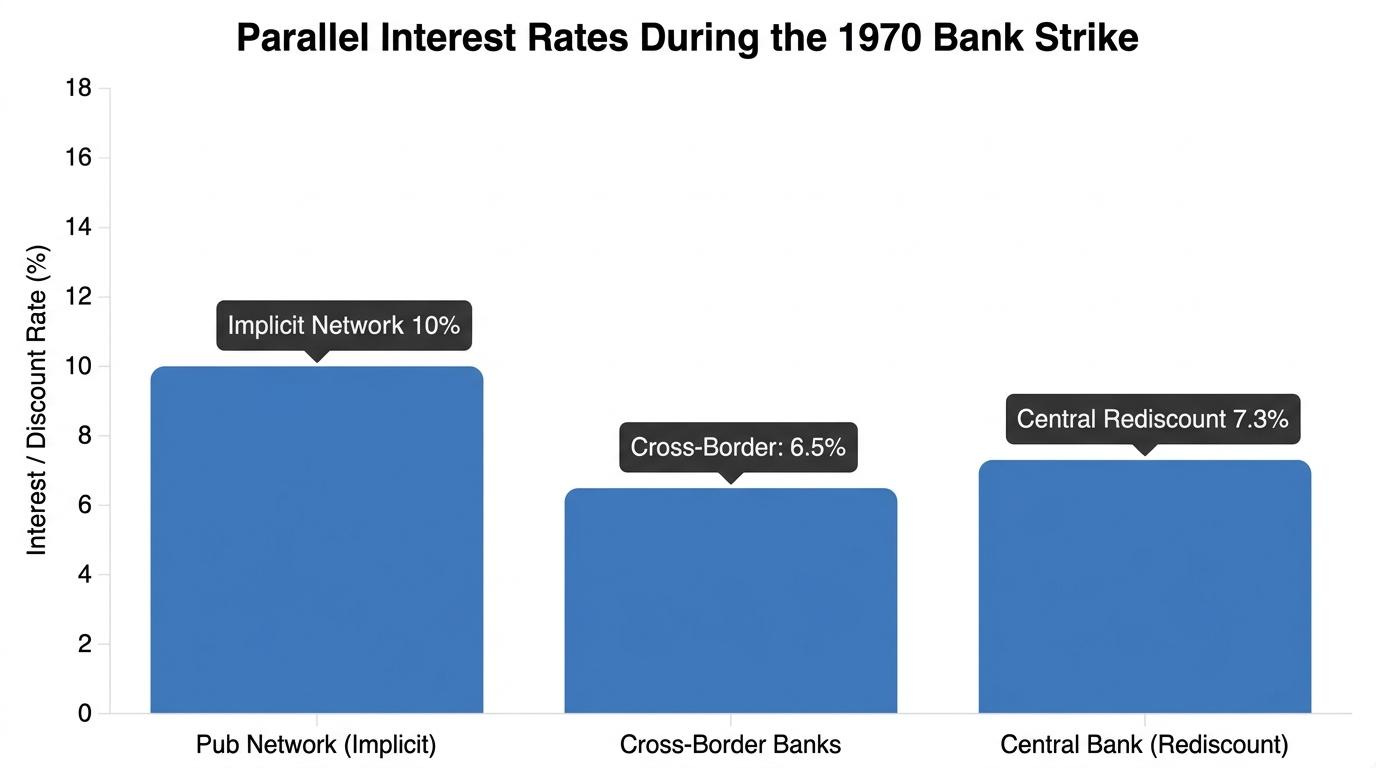
The 5 to 15 per cent discount on cheques functioned as the informal system’s implicit interest rate. Meanwhile, individuals moving funds across the border or to the American Bank earned 6 or 7 per cent (Dáil Éireann Debates, 23 February 1971),
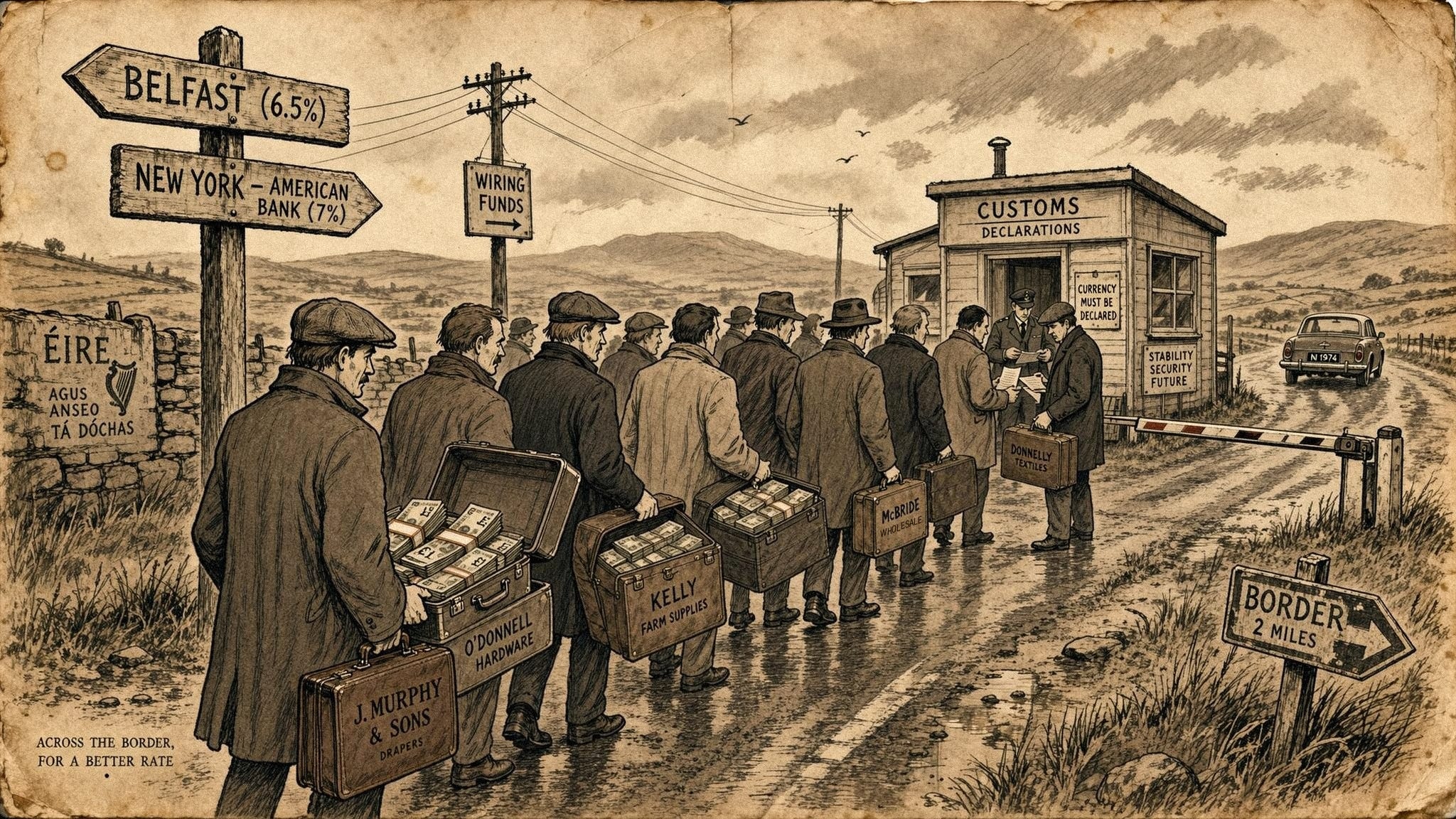
establishing a parallel interest rate and revealing capital flight.
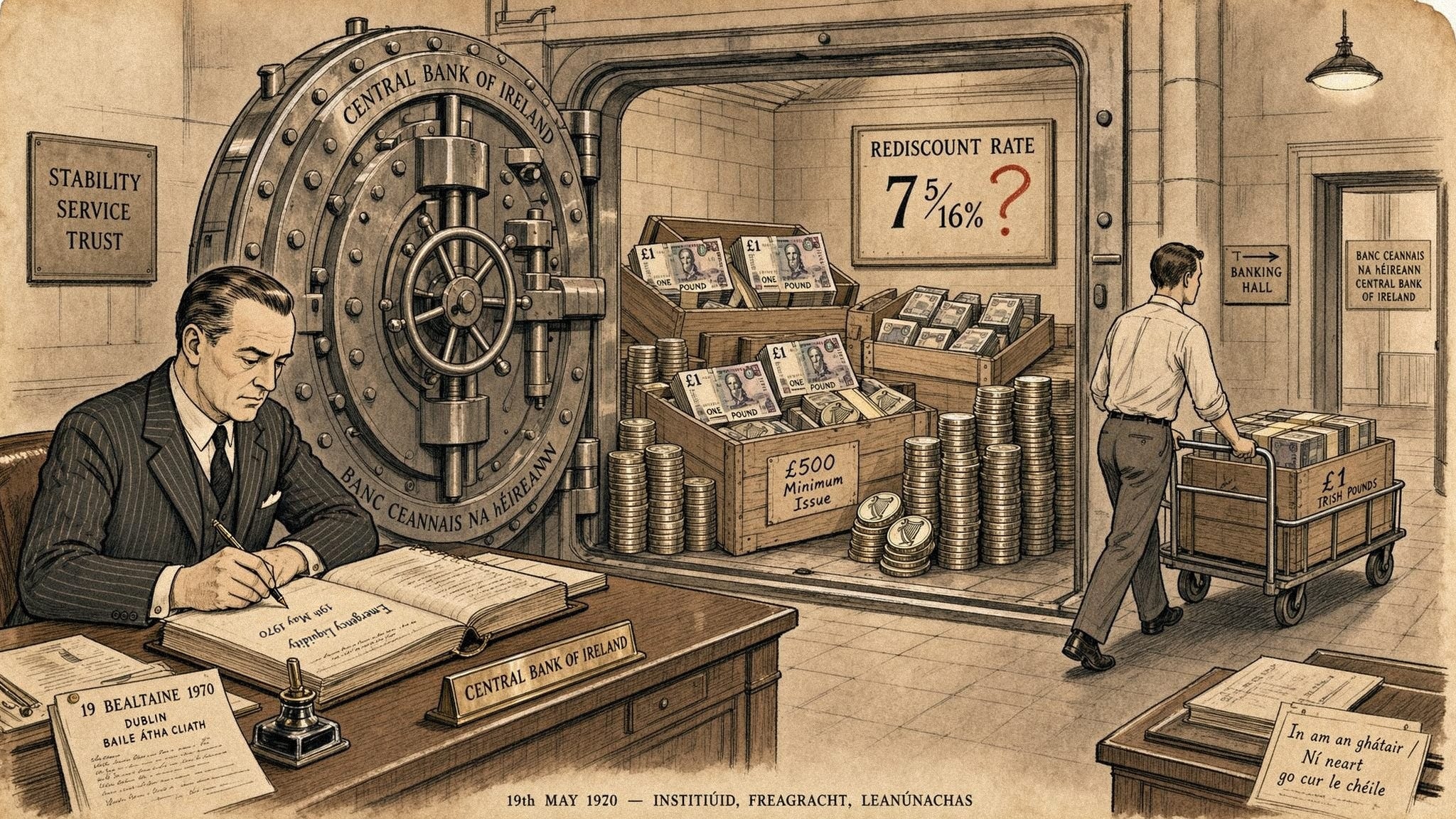
The Central Bank of Ireland played a limited role, increasing liquidity by £10 million in notes and coins, making “limited facilities” available to non-associated banks and issuing coin in minimum quantities of £500 (Irish Times, 19 May 1970), while maintaining a 7 5/16 per cent rediscount rate that had no operational significance without interbank lending. While the Central Bank (1971) claimed the economy performed “reasonably well,” this requires qualification regarding hidden costs.
Orthodox Economic Analysis
As Krueger (2018) argues, while trade credit substituted for bank deposits, the risks to transactors were rising. The orthodox framework identifies several critical functions the informal system could not replicate indefinitely:
Clearing: The absence of a central clearing mechanism meant inter-business debt could not be settled nationally.
Cash Drain: The progressive exhaustion of finite physical cash was observed as early as May 1970.
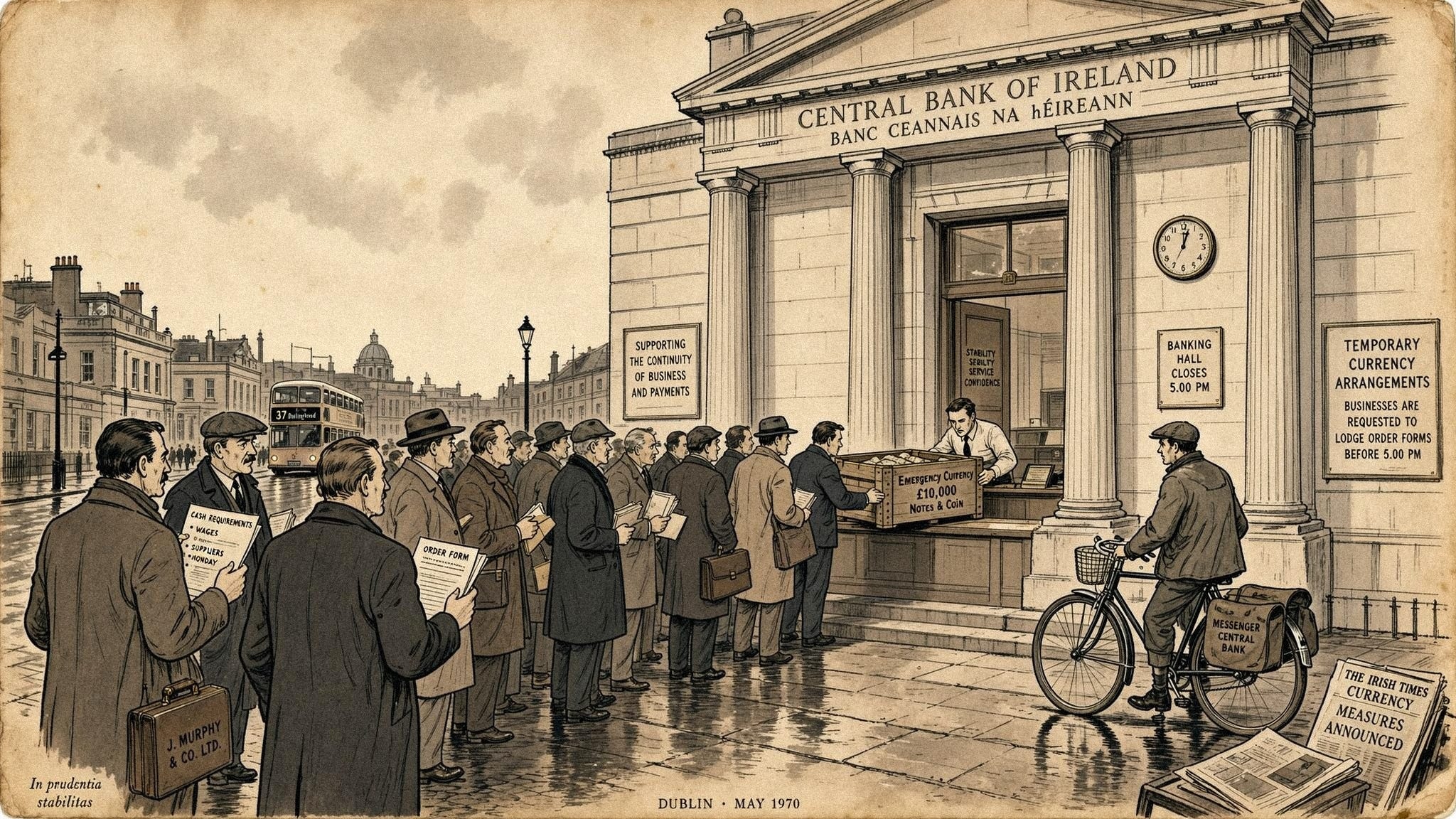
Liquidity: Publicans could only redistribute existing cash, lacking the capacity to create new money as a lender of last resort.
International Trade: Required bank instruments like letters of credit.
Capital Markets: Property transactions became “impossible or very complicated” as ownership documents were locked in bank vaults, freezing capital markets.
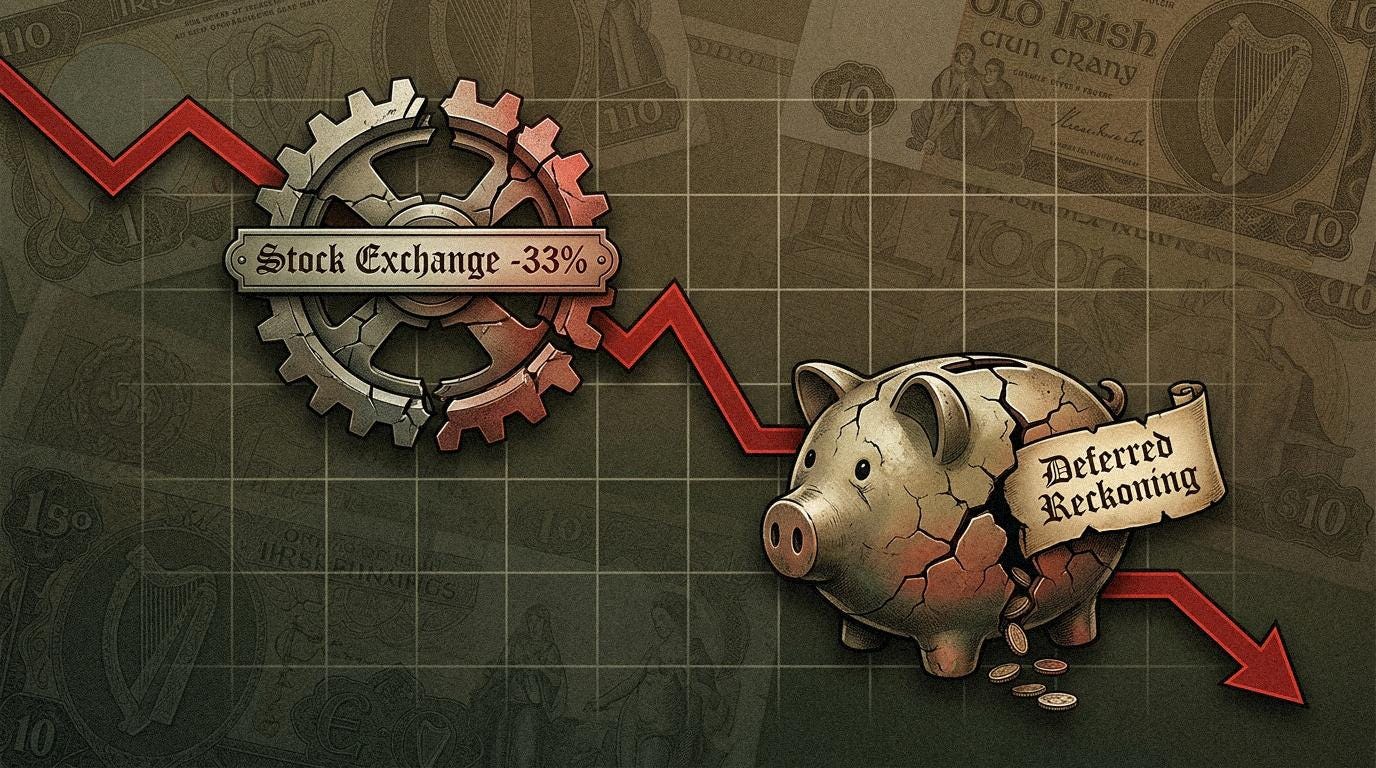
Macroeconomically, research on the similar 1966 strike showed a 6% deviation in economic activity from the counterfactual path. The Fogarty Report (1971) documented widespread strain and a substantial drop (approximately one-third) in non-government Dublin Stock Exchange transactions. The system’s fragility was ultimately exposed upon reopening, as banks faced a huge backlog and businesses faced deferred reckonings.
Post-Mortem and Hidden Failures
The Fogarty Report (1971), the definitive official inquiry, documented significant costs to individuals and businesses, particularly small enterprises. The government did not pursue legislation to establish a parallel payment system. The fate of Palgrave Murphy, a large transport company that failed upon the strike’s resolution, illustrates the delayed consequences of deferred financial reckoning.
When banks reopened, difficulties primarily involved businesses that had exceeded their overdraft limits (Murphy 1978). The informal credit did not eliminate underlying debts; it merely deferred and often exacerbated them.
The Modern Monetary Theory Perspective
MMT posits that a sovereign currency issuer faces no inherent financial constraint. The strike revealed the problem was institutional payment architecture, not government solvency. From an MMT perspective, the government’s refusal to intervene was a political, not technical, choice. The state could have legislated the Post Office to clear cheques, issued emergency currency, or temporarily nationalized the banks. The economy’s survival via the pub network demonstrated that private banks were operationally redundant in the short term; their survival reflected an ideological commitment to non-intervention.
Furthermore, banks demonstrated asymmetric contractual power by insisting on loan and mortgage payments during the strike while denying depositors access to their own funds. Conversely, the publican system operated on mutual dependency: “if you didn’t change the cheque you didn’t have clientele” (Smith, cited in BBC 2017). This circular flow relied on social trust and community reciprocity rather than state enforcement.
Inter-Pub Lending and a Possible Hawala Evolution?
The pub network could not, at that time, evolve into a Hawala-like system, which transfers value across distances through reciprocal broker settlements. The Irish network lacked inter-pub lending, settlement mechanisms, and sufficient cross-transactions. Publicans were competitors, not collaborators. This hyper-localism enabled excellent credit assessment but prevented scaling or risk-sharing across regions, making it a constellation of independent nodes rather than a coordinated financial network. With foresight and today’s communications networks, those impediments may no longer apply.
Bank Strikes in Other Jurisdictions
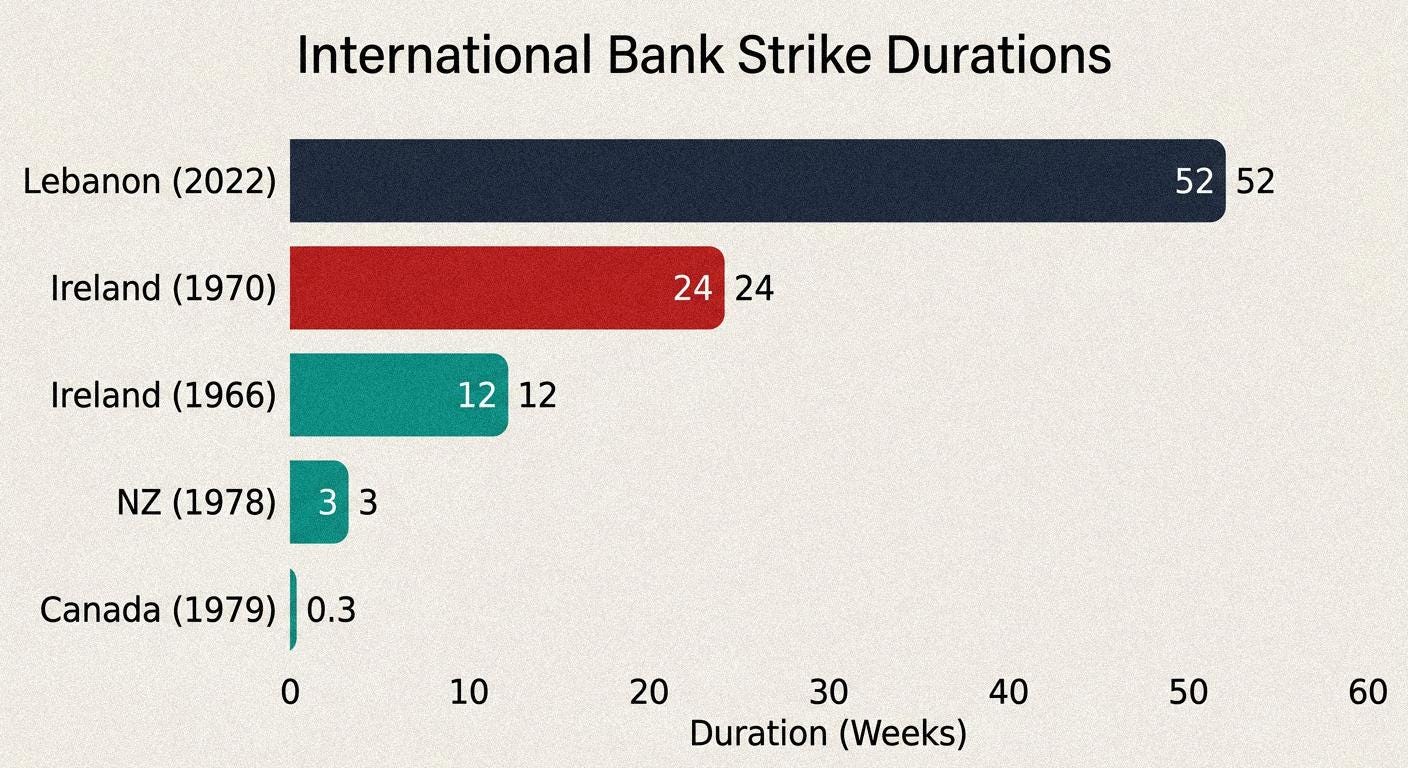
The 1970 strike was not isolated; similar 12-week strikes occurred in Ireland in 1966 and 1976, suggesting pub-based credit was a latent social infrastructure. Comparable events in Canada (1979, two days) and New Zealand (1978, localized) were less severe. Lebanon (2022) saw an open-ended bank strike amid broader economic collapse. The 1970 Irish strike remains exceptional in duration and the completeness of its informal substitution, owing specifically to the unique characteristics of the Irish pub.
Reconciling Orthodox and MMT Perspectives
The 1970 strike challenges and confirms elements of both orthodox and MMT frameworks. The orthodox view correctly emphasizes the limits of informal substitution: the lack of central clearing, finite cash, frozen property markets, and the 6% economic deviation. It was a costly improvisation, not a costless demonstration that banks are unnecessary. Conversely, the MMT perspective correctly identifies that government non-intervention was an ideological choice; the state possessed the capacity to maintain the payment system without private banks.
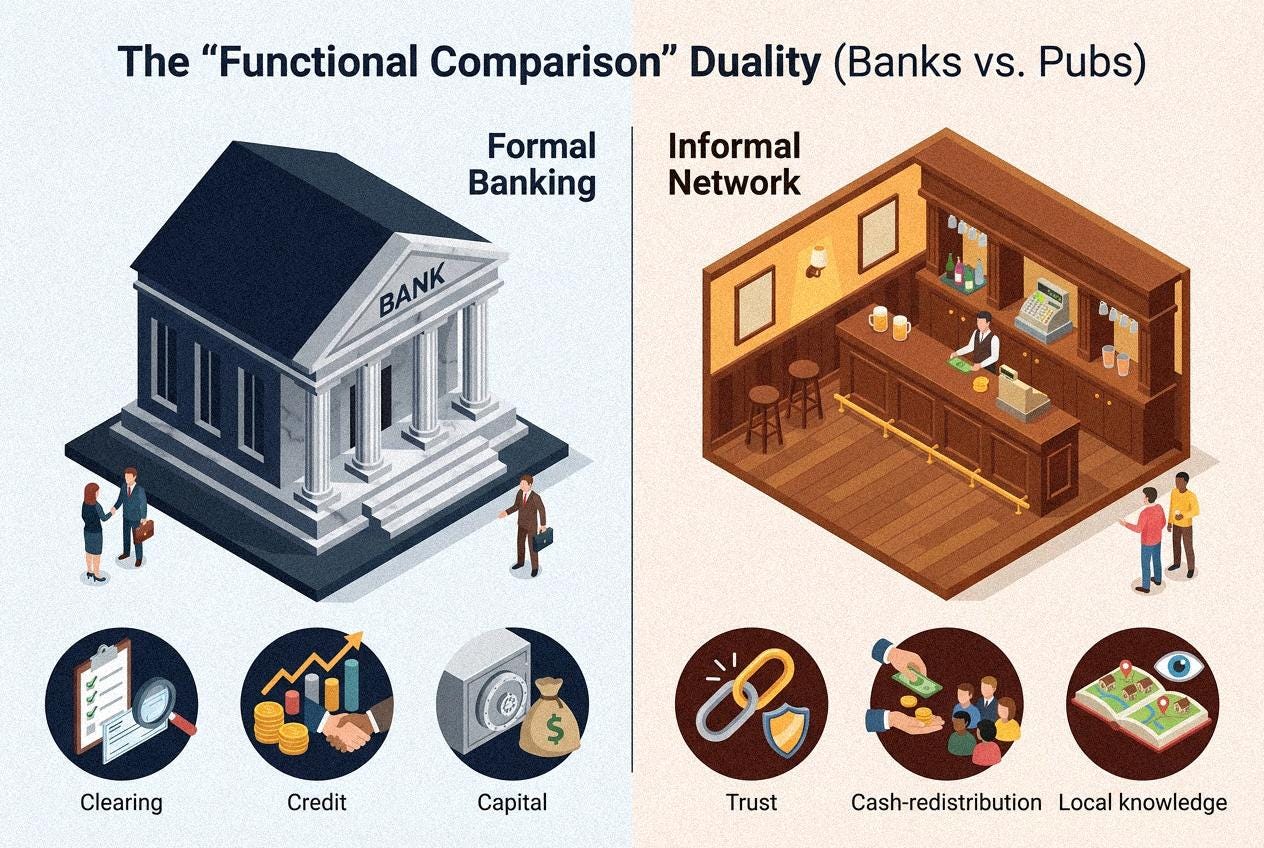
Reconciliation lies in recognizing that the informal system was a coping mechanism, not a permanent substitute for formal architecture. The state’s capacity to intervene does not negate the importance of formal banking but suggests a relationship of oversight and contingency planning rather than ideological non-intervention. The Dublin Port litigation further reinforced the orthodox conception of banking as a private contract rather than a public utility, placing systemic risk on the public. Ultimately, the strike demonstrates that monetary systems are embedded in social, legal, and institutional frameworks; both formal and informal systems possess distinct strengths and limitations, necessitating institutional pluralism in monetary design.
Parting Thoughts
Ultimately, the Irish state’s response, or calculated refusal to respond, laid bare an uncomfortable truth: when faced with a choice between safeguarding the public welfare and defending private banking interests, the government opted for the latter. Charles Haughey’s declaration of non-intervention was not a neutral act of free-market principle; it was a deliberate abdication of the state’s primary duty to provision its people and ensure the continuity of the national payment system. In that vacuum, the burden of economic survival fell squarely upon the shoulders of ordinary citizens, publicans, grocers, and shopkeepers who were never meant to be bankers.
And yet, against all odds, they stepped up. With no central clearing, no lender of last resort, and no legal protection, these 11,000 informal nodes rewrote the rules of commerce on the fly. They advanced cash on nothing but a handshake and a local reputation, absorbing legal risks that the banks refused to touch, simply to keep neighbouring factories running and supply chains intact. It was an act of collective ingenuity born of necessity, a messy, costly, and ultimately unsustainable improvisation, but a profound testament to the resilience of community ties in the face of institutional failure.
For five months, the pub network did what the formal economy could not: it preserved trust and liquidity in the absence of both. The strike exposed the hidden architecture of social reciprocity that underpins all monetary systems, and proved that when the state chooses to look away, the people, their businesses, and their communities will find a way to carry on. That they succeeded, however imperfectly, is less a vindication of the free market than a quiet rebuke to a government that left its citizens to fend for themselves.
References
Bank of England (2016) ‘The cheque republic: money in a modern economy with no banks’, Bank Underground, 20 January. Available at: https://bankunderground.co.uk/2016/01/20/the-cheque-republic-money-in-a-modern-economy-with-no-banks/
BBC (2017) ‘When Irish pubs saved the economy’, Witness History, 24 May. Available at: https://www.bbc.com
Business Insider (2016) ‘Pubs replaced banks in Ireland in 1970 and the economy was fine’, 20 January. Available at: https://www.businessinsider.com
Central Bank of Ireland (1971) Survey of Economic Effects of Bank Dispute, 1970. Dublin: Central Bank of Ireland.
Dáil Éireann Debates (1971) Vol. 252, 17 February 1971. Available at: https://www.oireachtas.ie/en/debates/debate/dail/1971-02-17/30/#spk_490
Dáil Éireann Debates (1971) Vol. 252, 23 February 1971. Available at: https://www.oireachtas.ie/en/debates/debate/dail/1971-02-23/45/
Dublin Port and Docks Board v The Governor and Company of the Bank of Ireland [1976] IESC 1; [1976] IR 118 (22 July 1976).
Fogarty, M.P. (1971) Report of Banks Inquiry: Report on Dispute of 1970 between the Associated Banks and the Irish Bank Officials’ Association, and Recommendations as to What Action Might Be Taken to Avoid the Risk of Closures through Industrial Action in the Future. Dublin: Stationery Office.
Irish Times (1970) ‘Bank strike leaves firms paying price for cash shortage’, 19 May, p.1.
Krueger, M. (2018) ‘Money and Credit: Lessons of the Irish Bank Strike of 1970’, Credit and Capital Markets, 51(4), pp. 645-667. doi: 10.3790/ccm.51.4.645.
Murphy, A.E. (1978) ‘Money in an Economy without Banks: The Case of Ireland’, Journal of the Statistical and Social Inquiry Society of Ireland, 23(5), pp. 67-98.
a wee social story
In the 80's, when payment by cheque to self-employed carpet fitters, plumbers, etc became common, and we Glasgow publicans used to cash them, with an advance on a Friday and settlement on the Saturday.
All great for footfall and cash trade,
until eventually HMRC realised what was going on and objected.
Happy Days.