
Two Views, Treasury and Temperature
Analogous Rhetorical Architectures in Fiscal and Climate Policy

A Graphic Novella
Abstract
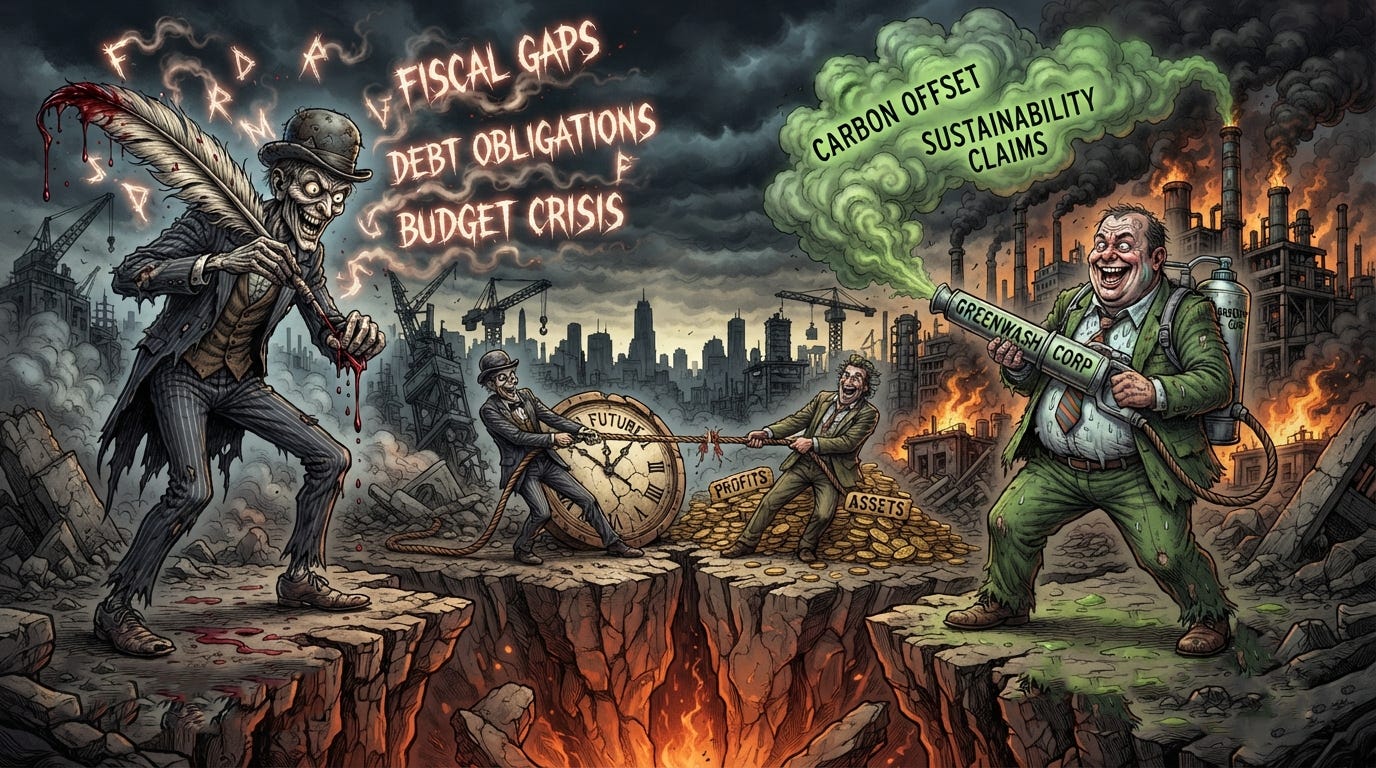
This article aims to, if not map, then at least probe the structural homology between the rhetorical topologies deployed by HM Treasury in their fiscal policy communication and that used by governmental and corporate actors in climate policy dialogue. Applying a Modern Monetary Theory viewpoint, the observed similarities are not coincidental but constitute functional homologies, both domains deploy near identical linguistic and institutional mechanisms to solve the same operational problem, avoiding the utilisation of idle real resources for public purposes, while sustaining the appearance of responsive and prudent governance. The article identifies seven core rhetorical operations common to both disciplines, supported by empirical evidence provided by linguistic analyses of corporate sustainability reporting and fiscal policy documentation. The resultant conclusion is that these topologies constitute an ingrained and distributed institutional mechanism for preserving incumbent profit and power structures.
Introduction
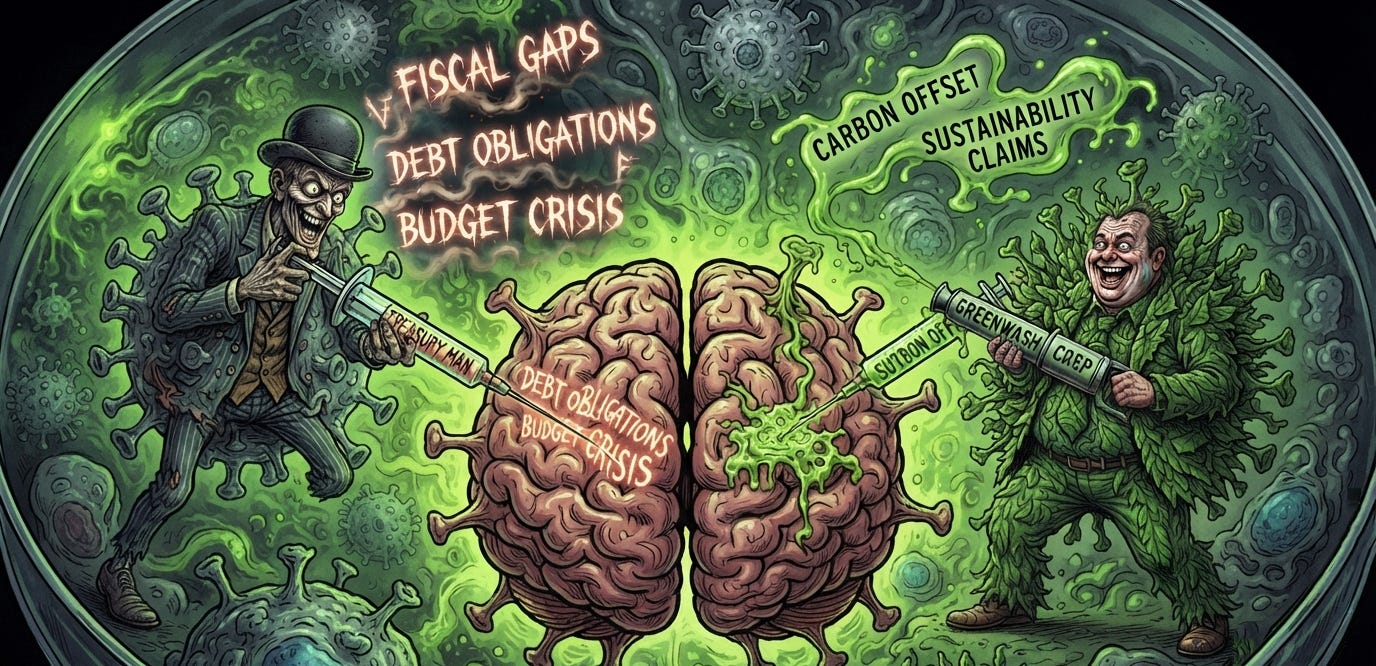
Looking through an MMT lens, the rhetorical similarities between post-gold-standard Treasury framing and mainstream climate policy constitute functional homologies (Wray, 2015, p. 78). While it would be convenient to view these parallels as incidental, the MMT framework posits that both administrative systems deploy identical linguistic and institutional mechanisms to solve a single operational problem, that of avoiding the utilisation of idle real resources, labour, materials, and industrial capacity, for public purposes while sustaining the appearance of fiscal probity. The conclusion drawn is thus that the observed analogies are not coincidental but structural.
Recent research supports this position. A large-scale linguistic analysis of corporate sustainability reports concluded that corporate net-zero narratives “often serve as symbolic reputation management rather than a blueprint for transformative climate action” (Fuoli and Beelitz, 2025).
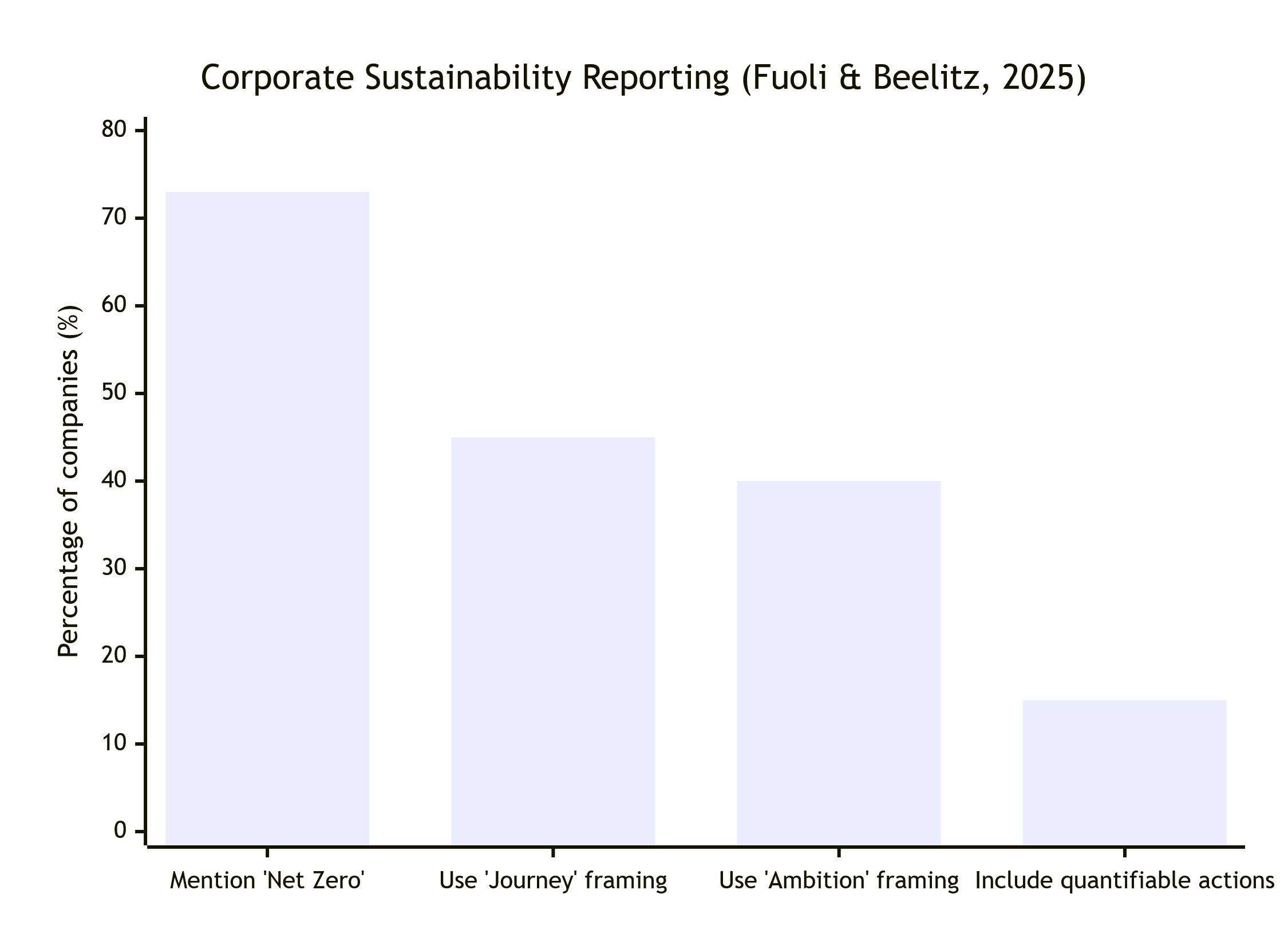
The study found that the term ‘net zero’ appeared in reports from nearly three-quarters of the companies analysed, yet many organisations employed vague, aspirational language, framing net zero as a “’journey’ or ‘ambition’” rather than specifying quantifiable actions (Fuoli and Beelitz, 2025). This linguistic structure, by which I mean the use of aspirational terminology without corresponding operational commitments, mirrors the fiscal rhetoric of “balancing the budget over the cycle”, a target whose time frame permits present inaction.
The conceptual framework underpinning this analysis draws on environmental legitimacy theory and rhetorical theory. As Beaulieu, Montgomery, and Lyon (2025) clarify, the main distinction between science denialism and greenwashing is that “science denialism seeks to undermine stakeholders’ perception of inconvenient scientific facts, whereas greenwashing involves acknowledging such facts while making deceptive claims about one’s environmental performance”. The Treasury view similarly acknowledges the desirability of public investment while deploying rhetorical mechanisms that render such investment unattainable within existing fiscal rules.
The Operational Rhetorical Architecture
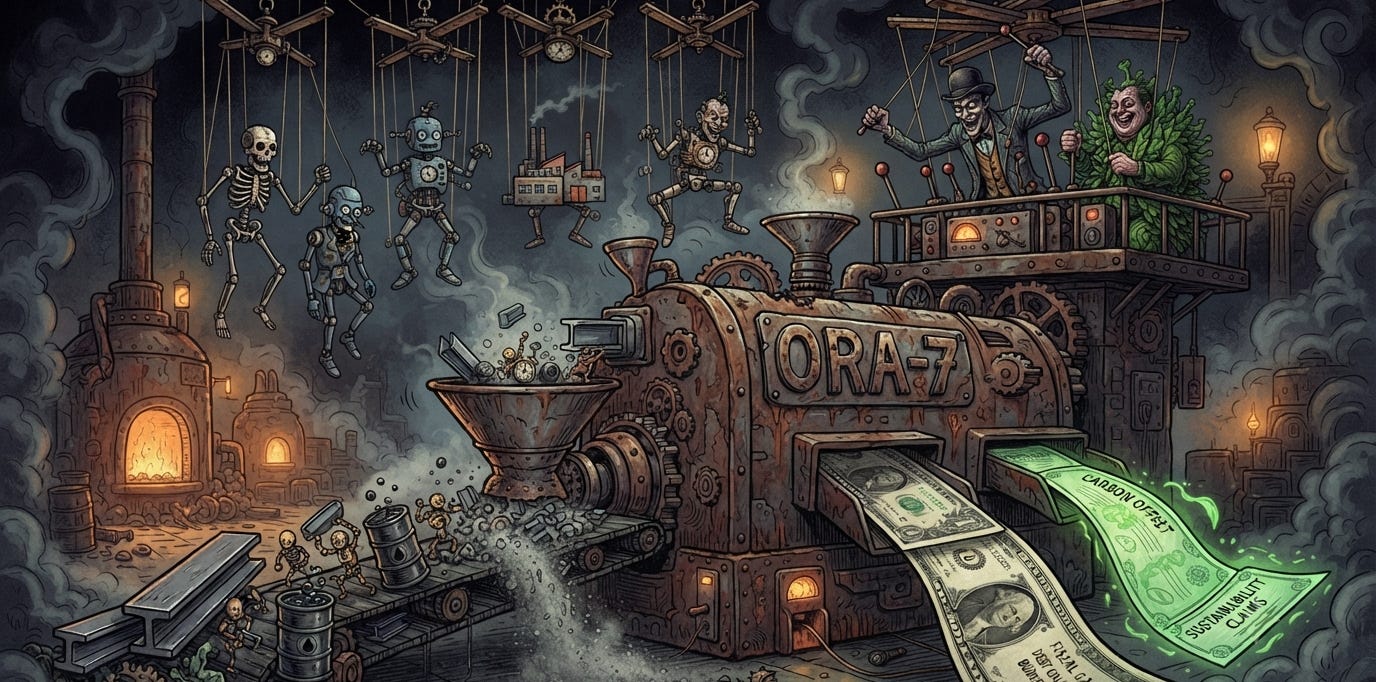
The operational rhetorical architecture (ORA) consists of seven core operations that appear consistently across fiscal and climate policy sectors. Each operation transforms a political choice into an apparent technical or financial necessity.
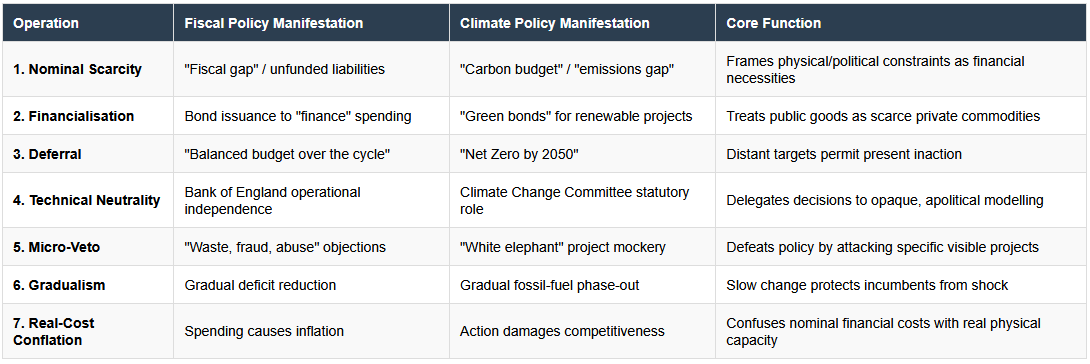
1. Nominal Scarcity
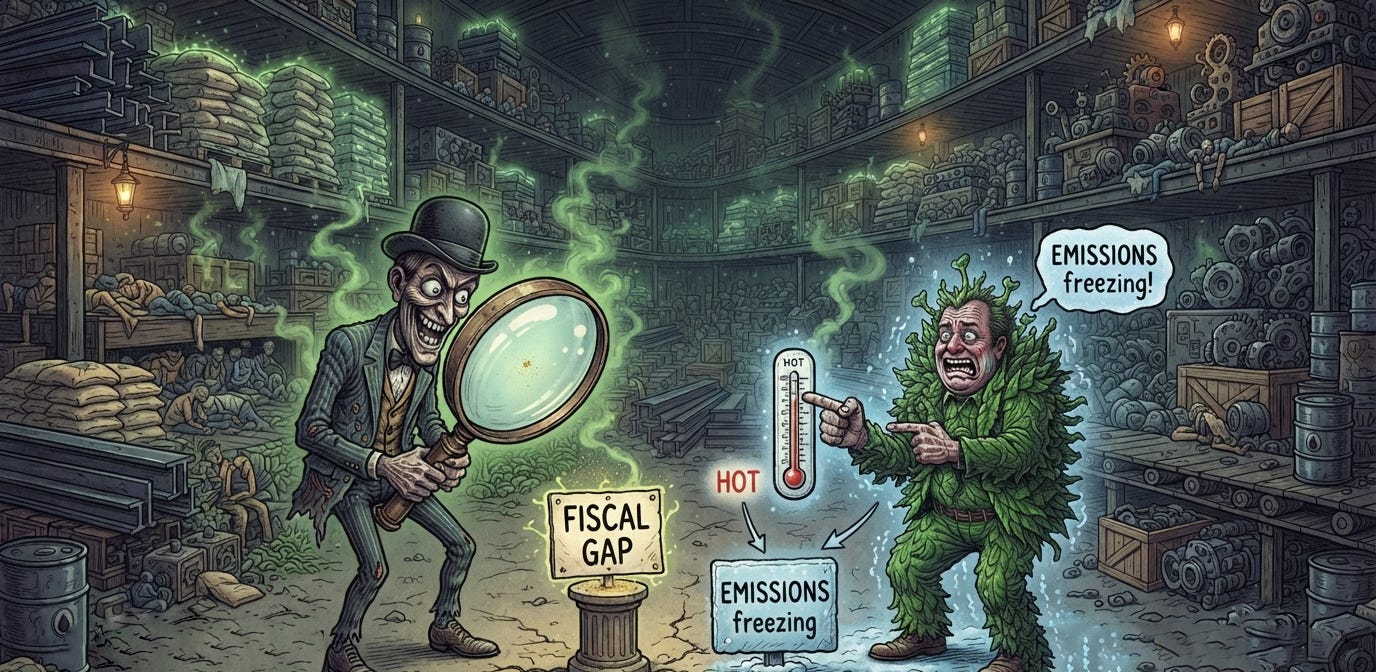
The first operation frames a physical or political constraint as a financial one. Treasury officials invoke a looming “fiscal gap” or future unfunded liabilities from pensions and healthcare to justify austerity in the present. Climate policymakers invoke a “carbon budget” or “emissions gap” to justify delayed action. As the United Nations Environment Programme’s Emissions Gap Report 2024 documented, there is a “massive gap between rhetoric and reality” as countries draft new climate commitments (UNEP, 2024). Furthermore, recent data indicates that global emissions grew by 2.3 per cent in 2024, yet the framing of this gap as a fiscal challenge rather than a mobilisation imperative persists (UNEP, 2025). The result is that “the investment gap for meeting climate targets must now be closed against a backdrop of higher borrowing costs, higher inflation, a tight labour market, less flexibility in government budgets (fiscal space) and, critically, less time” (Economics Observatory, 2022). Economically, the fiscal gap is a nominal accounting construct that can always be funded, the only real limit is real resources (Kelton, 2020). The emissions gap is physical, yet both are used not to mobilise action but to paralyse it.
2. Financialisation

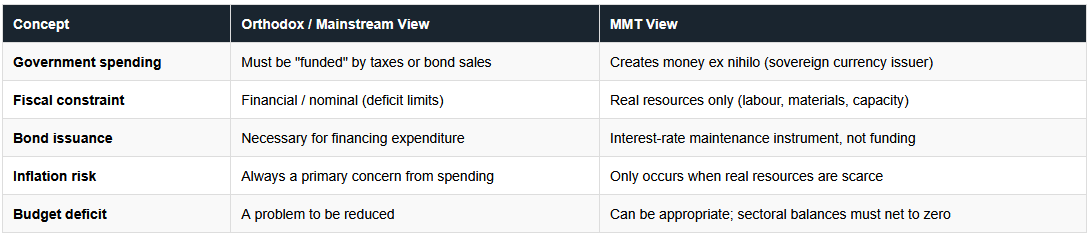
The second operation inserts a financial instrument as a prerequisite for action. Treasuries insist on issuing bonds to “finance” spending, treating the government as a borrower of its own currency. Climate finance elites insist on creating bespoke “green bonds” to fund renewable projects. As Bogojević (2025) notes, companies are incentivised to commit to ‘green’ production and market their business as such. Yet mounting evidence suggests a “gap between the suggested possibilities and the actual outcomes of green finance” (King’s College London, 2025). High-profile greenwashing scandals have further eroded trust, “raising questions about whether green finance is more a branding exercise than transformation” (King’s College London, 2025). The sleight-of-mouth is the treatment of a public good, currency in one case, atmospheric capacity in the other, as a scarce private commodity that must be sold to private markets prior to use. MMT states that a sovereign currency issuer, if possessing real capacity, could authorise direct spending without these instruments (Mitchell, 2019, p. 203).
3. Deferral
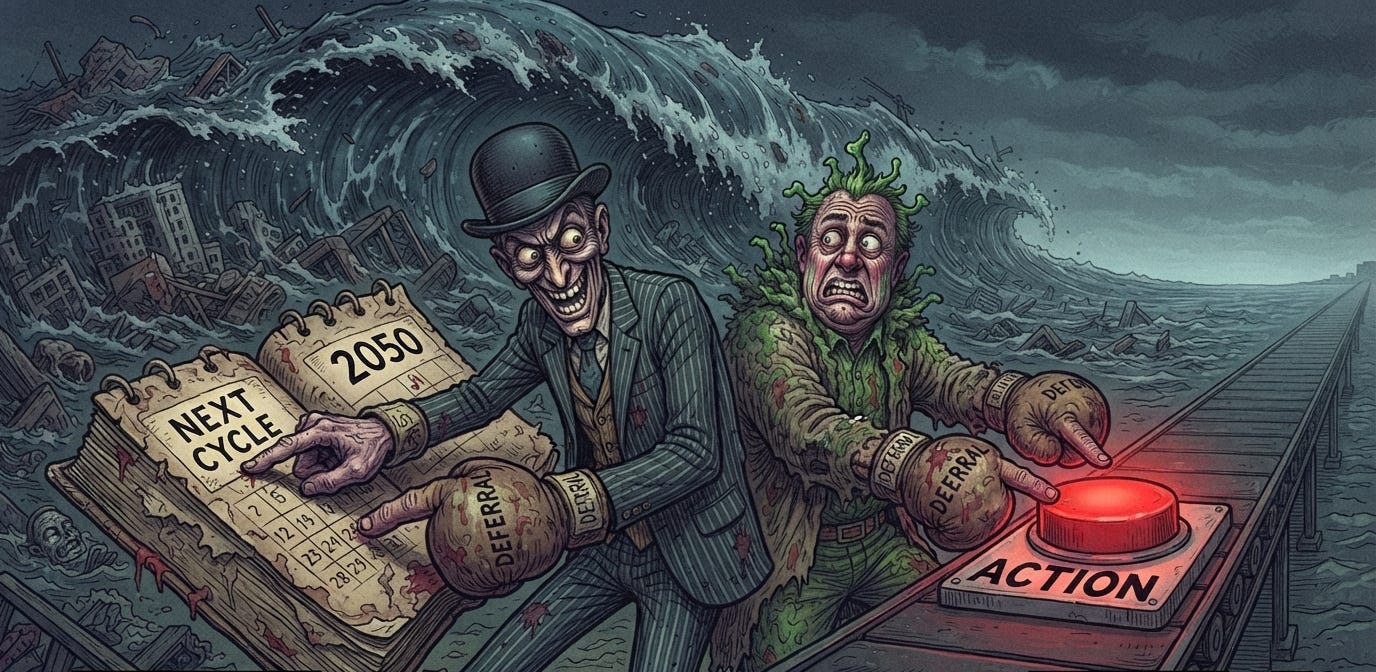
Our third iteration sets distant targets that permit inaction in the present. A “balanced budget over the economic cycle” allows deficits during recessions, hence never truly balancing. “Net Zero by 2050” permits continued emissions growth for a decade, with promised negative emissions later. Fuoli and Beelitz (2025) found that “while net-zero pledges are a step forward, their credibility hinges on transparency and measurable progress”. Without clearer strategies, “these pledges risk becoming another chapter in the long history of corporate greenwashing” (Fuoli and Beelitz, 2025).
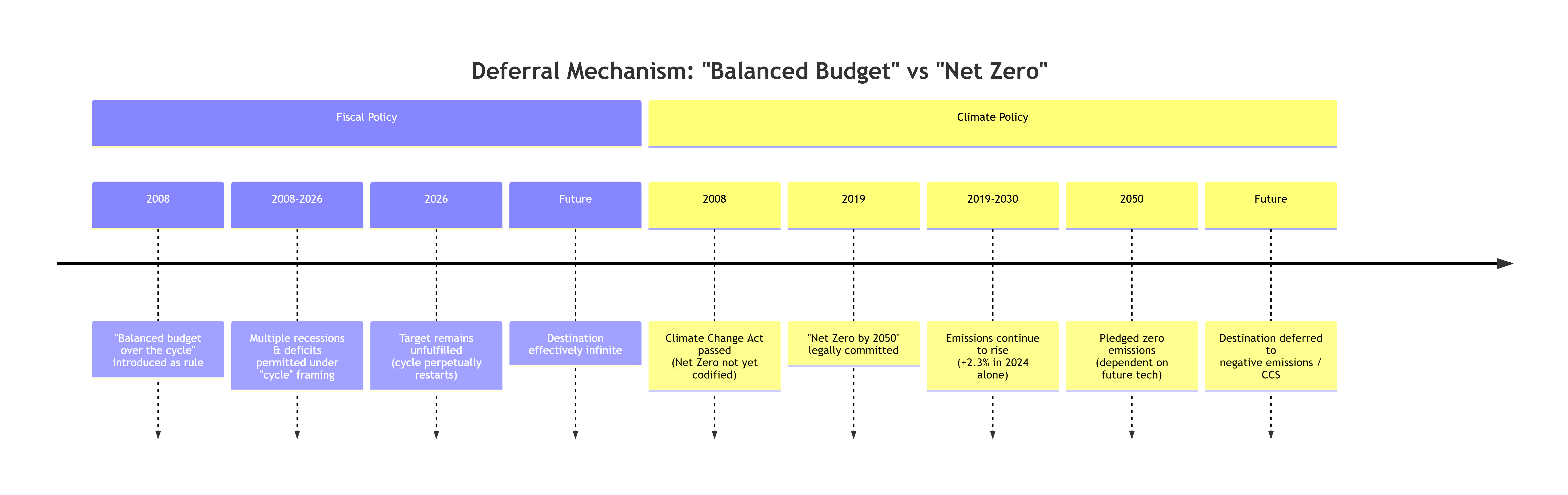
Both frameworks employ arbitrary, deferred destinations with weak interim milestones, ensuring the current profit model remains unaffected during the interim period (Wray, 2015, p. 156).
4. Technical Neutrality
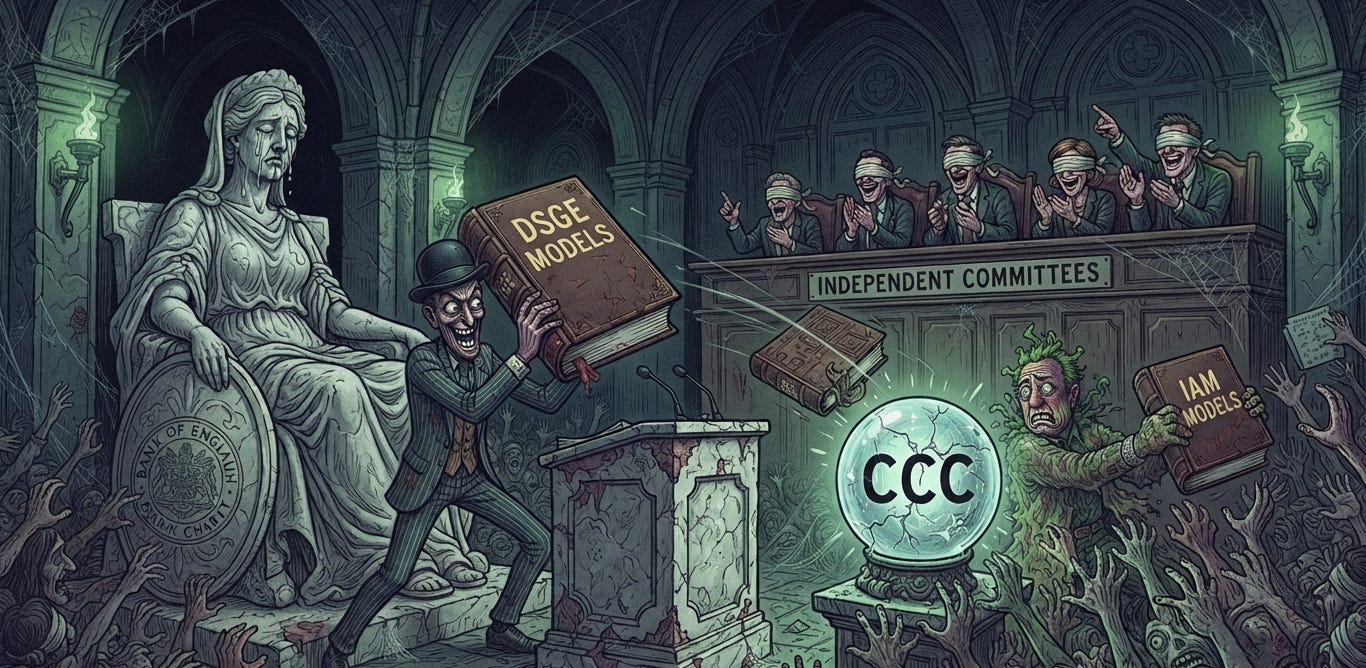
The fourth operation delegates decisions to ostensibly independent committees. The Bank of England operates with operational independence under Section 11 of the Bank of England Act 1998. The Climate Change Committee serves as a statutory advisory body under Section 32 of the Climate Change Act 2008. Both institutions use opaque modelling, DSGE models in the former, Integrated Assessment Models in the latter, to produce scientific justifications for minimal action, thereby shielding politicians from democratic accountability (Kelton, 2020, ch. 9).
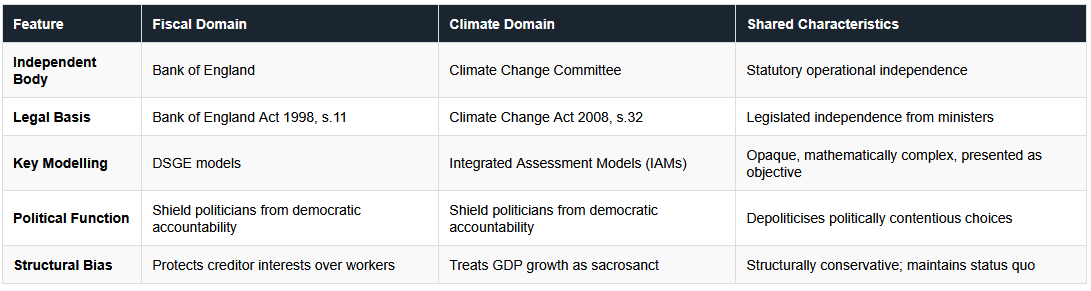
As the Environmental Audit Committee has noted, “the UK’s current economic framework remains fundamentally misaligned with the realities of climate change, biodiversity decline, and long-term societal resilience” (Finance Innovation Lab, 2026).
5. Micro-Veto
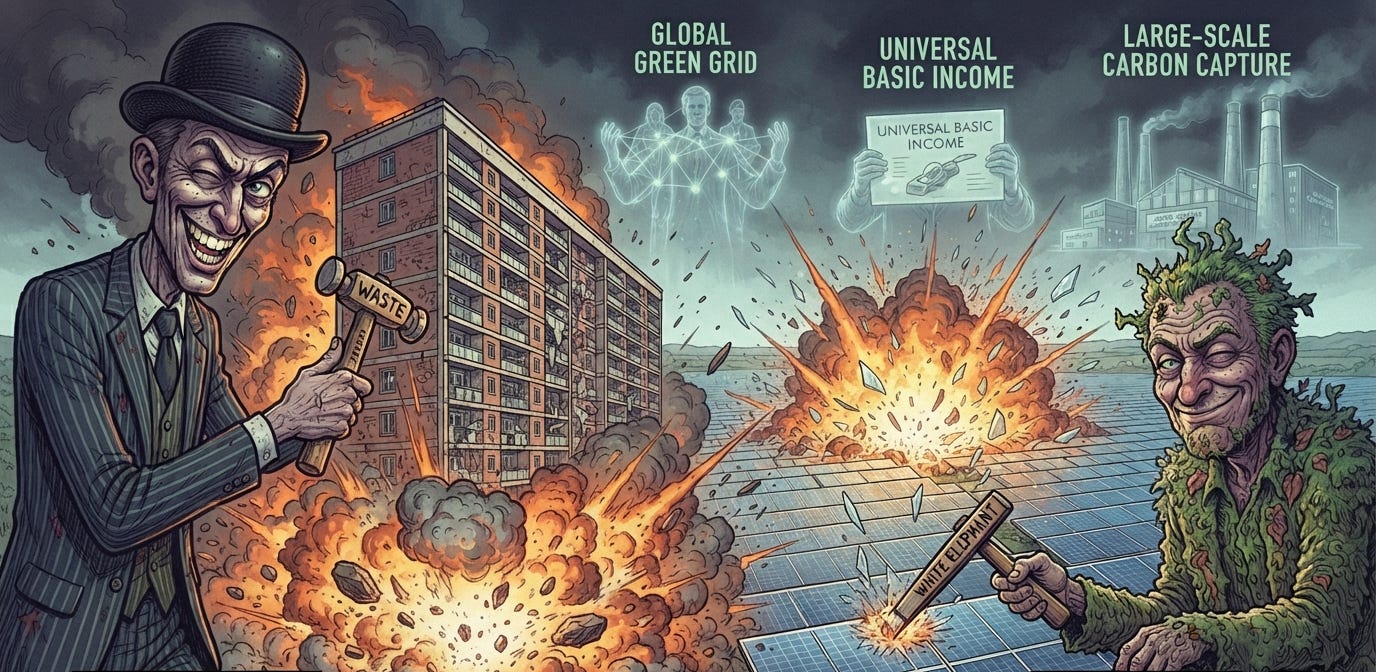
The fifth evolution defeats policy by attacking specific projects rather than the principle. The Treasury playbook cites “waste, fraud, and abuse” to oppose social spending. The climate opposition playbook mocks specific green projects as “inefficient” or visually objectionable, so-called “white elephants”. Research on greenwashing rhetoric documents that “positive framing and the potential for greenwashing, wherein optimistic rhetoric may compromise the integrity and trustworthiness of sustainability reports” operates through similar micro-level objections (Kochkina, Macchia and Floris, 2024, p. 4). If the macro-level objection fails, the micro-level objection is deployed, exploiting public distrust of state capacity to prevent large-scale mobilisation.
6. Gradualism

The sixth operation insists on slow, phased change to avoid “shock”. Treasury officials assert that deficit reduction must be gradual to avoid economic disruption. Climate policymakers assert that fossil-fuel phase-out must be gradual to avoid energy-system shock. Yet MMT observes that a currency issuer can alter fiscal stance overnight, as during the COVID-19 pandemic, and historical rapid mobilisations, such as during the Second World War, demonstrate that real-economy transitions can be extraordinarily fast (Wray, 2015, p. 189). Gradualism is not an economic necessity but a temporal buffer enabling incumbent rent extraction, obscuring the distinction that fiscal policy space should be understood “as the real resources a nation can command rather than as the amount of money” (Mitchell, 2020).
7. Real-Cost Conflation
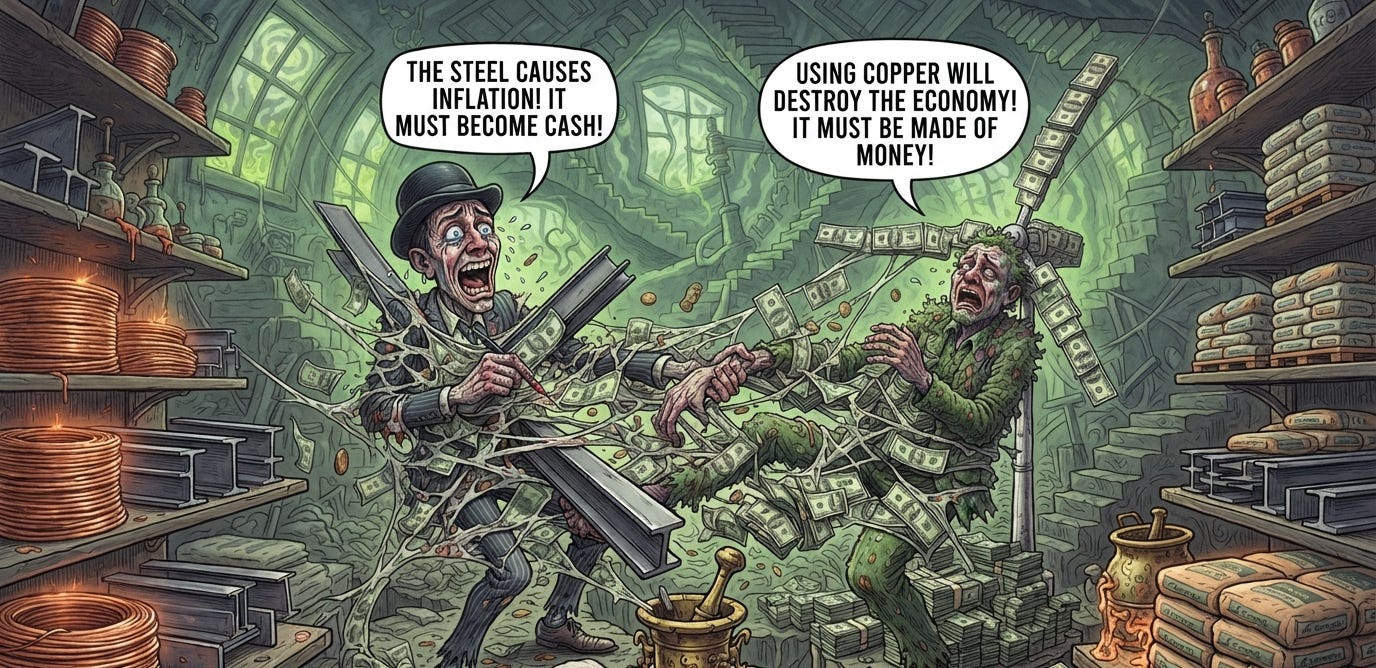
The seventh procedure treats nominal financial costs as if they were real-resource costs. Treasury officials assert that spending causes inflation, climate officials assert that action will damage economic competitiveness. Both statements conflate financial accounting with physical capacity. A currency issuer never lacks the money, it lacks the real resources: workers, steel, cement, copper (Kelton, 2020).
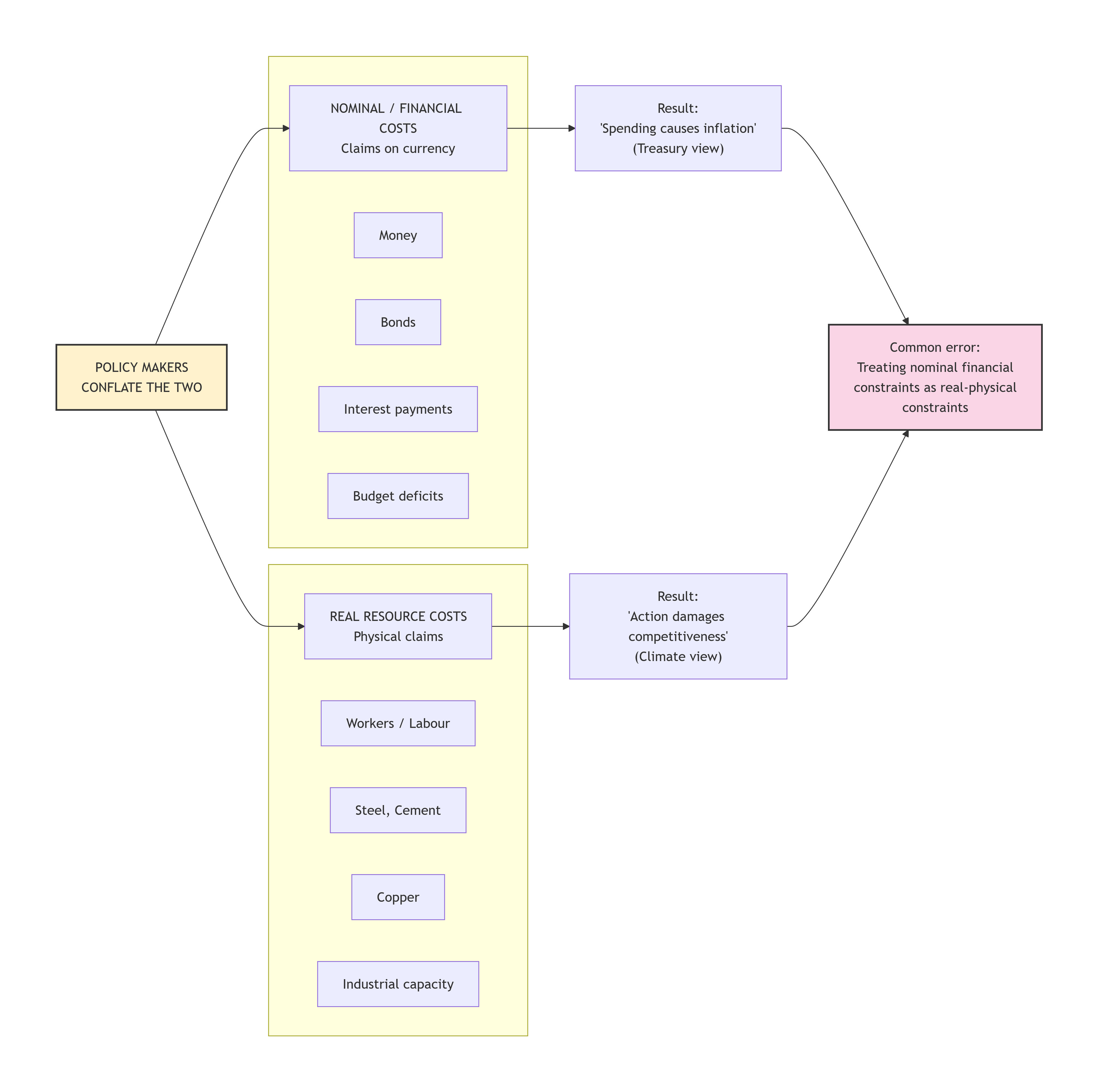
One analysis points out, “climate policy needs engineers, factories and infrastructure. Every policy depends upon the availability of real resources. We can always find the money if they exist. There’s no point creating the money if they don’t” (TaxResearchUK, 2026).
The Carbon Capture and Debt Management Office Analogy
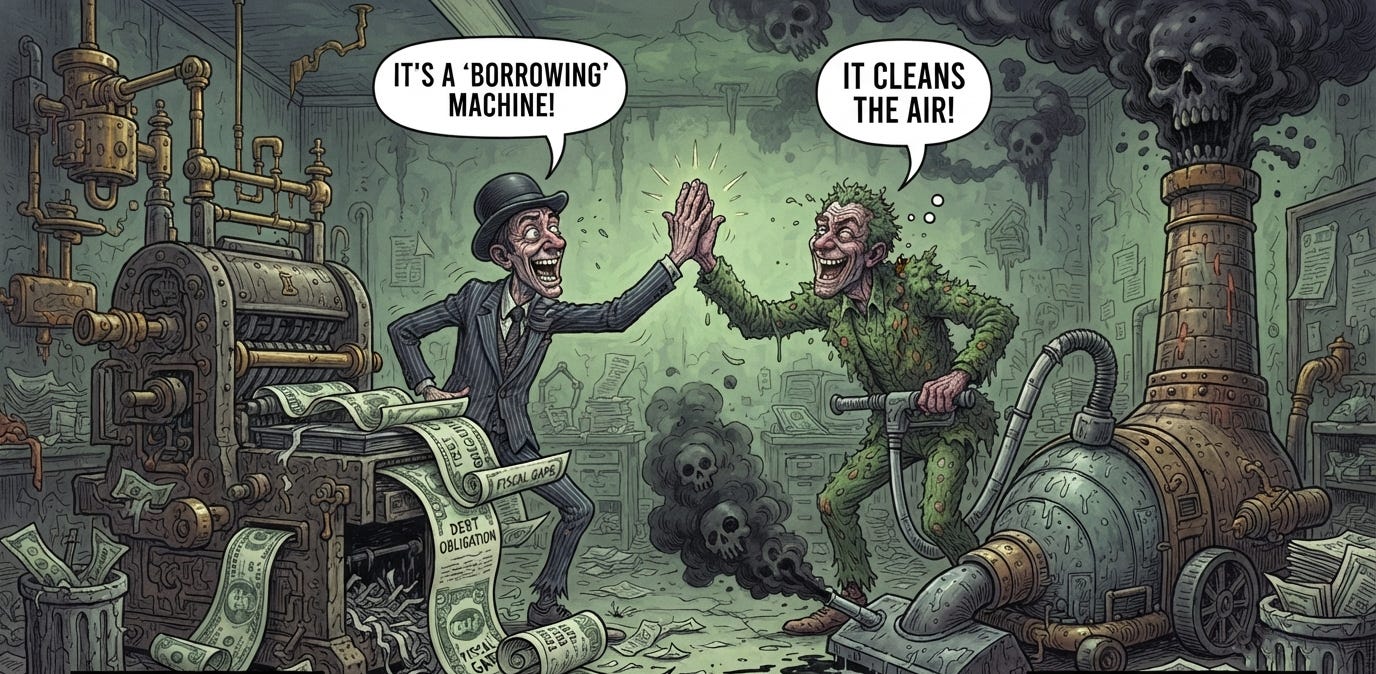
Debt Management Office (DMO) and the fully-funded spending rule function as administrative theatres, procedural vehicles that simulate a financing constraint for a currency-issuing government. DMO operationalises the pretence that the government must acquire funds in the bond market prior to expenditure, the fully-funded rule codifies the requirement that every new spending initiative be offset by tax increases or reductions elsewhere (Mitchell, 2019, p. 112). This mechanism obscures the technical reality that a sovereign currency issuer creates the funds ex nihilo, with bond issuance serving as an interest-rate maintenance instrument rather than a funding source (Kelton, 2020, ch. 4).
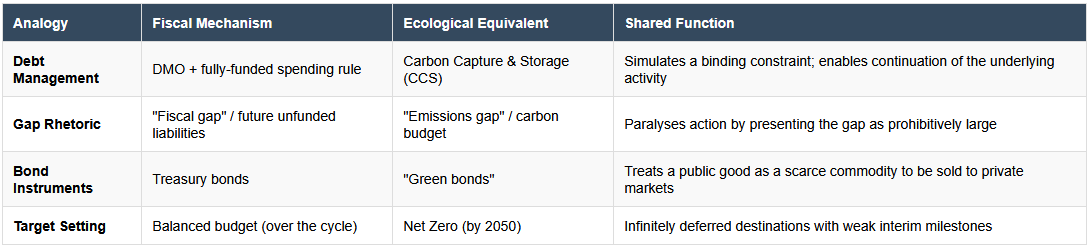
The equivalent ecological mechanism is carbon capture and storage (CCS). CCS enables the continuation of fossil-fuel extraction and combustion, the “spending” analogue, provided a technological offset accompanies each unit of emission. As research on fossil-fuel propaganda shows, “carbon capture (CCS) and carbon removal (CDR) will allow the widespread use of coal, oil, and methane gas (natural gas) to continue” (Oxford Academic, 2025). Both instruments are expensive, unproven at scale, and structurally designed not to disrupt the existing profit model, deferring the binding choice until a future technological fix.
The Fiscal Gap and Emissions Gap Analogy
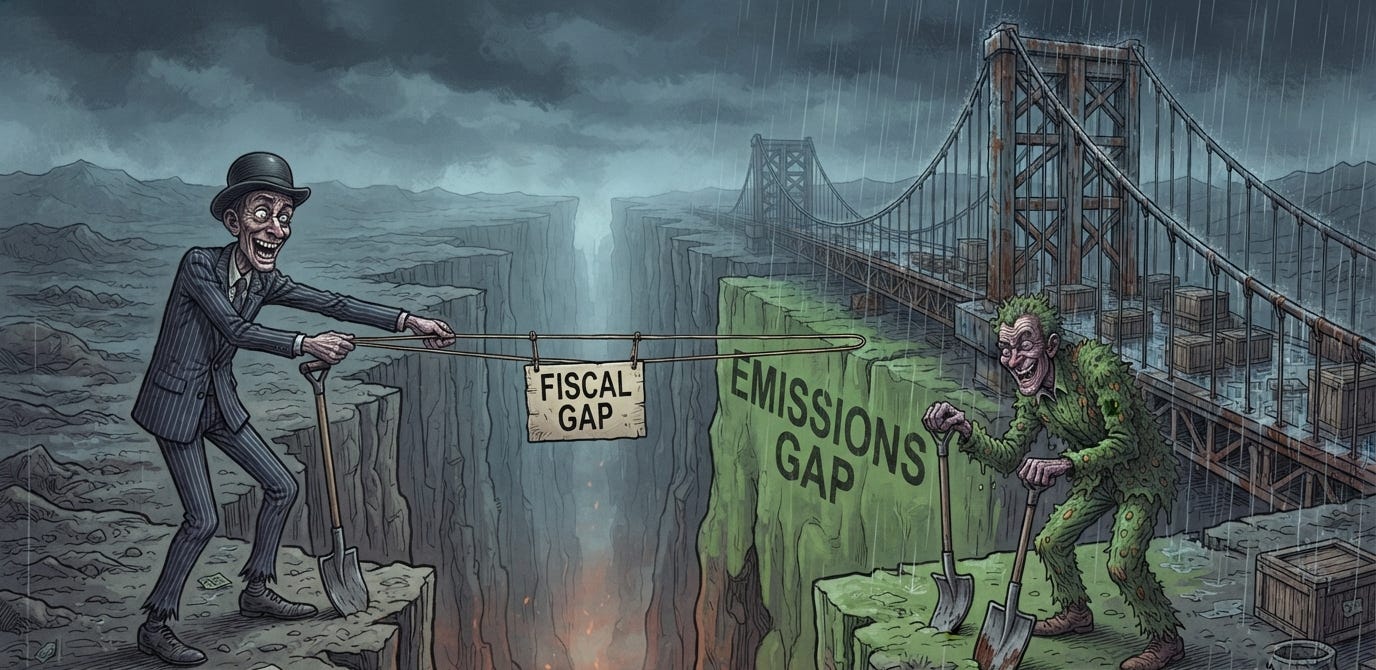
Treasury officials invoke a looming “fiscal gap” to justify austerity in the present. Climate policymakers invoke a “carbon budget” or “emissions gap” to justify delayed action. The UNEP (2024) noted a “massive gap between rhetoric and reality” in current climate commitments. Both gaps are presented as prohibitively large, requiring immediate sacrifice. However, the fiscal gap is a nominal accounting construct that can always be funded (Kelton, 2020, ch. 6), while the emissions gap is physical. Both are used to paralyse rather than to mobilise.
Green Bonds and Treasury Bonds Analogy
Treasuries insist on issuing bonds to “finance” spending, treating the government as a borrower of its own currency. Climate finance elites insist on creating bespoke “green bonds” to fund renewable projects. Research indicates that green bonds have failed to deliver decarbonisation, with studies highlighting a “concerning lack of enforceable promises” in the green bond market (Rajgopal, 2025). The sleight-of-mouth is that both treat a public good as a scarce private commodity that must be sold to private markets before it can be used.
Net Zero and Balanced Budget Analogy
Both “Net Zero by 2050” and “balanced budget over the economic cycle” are arbitrary, long-term nominal targets. A balanced budget over the economic cycle gives the impression of fiscal discipline while allowing deficits during recessions. Net Zero by 2050 permits emissions to continue rising for another decade, with the promise of drastic negative emissions later (Fuoli and Beelitz, 2025). In both frameworks, the destination is infinitely deferred, and the interim milestones are deliberately weak.
Independent Central Banks and Independent Climate Committees Analogy
Both independent central banks and independent climate committees are presented as depoliticised technical fixes. However, MMT points out that central banks are structurally conservative, protecting creditor interests over workers (Kelton, 2020, ch. 9). Climate committees, similarly, are captured by economic modelling that treats GDP growth as sacrosanct. Both institutions use opaque modelling to produce scientific justifications for doing the bare minimum, shielding politicians from democratic accountability.
Conclusion
For my sins I get to revisit the ‘Treasury View’ every couple of years. Over time, and with increasing frequency, I notice that the rhetorical methodology deployed in that arcane weapon of mass destitution has, like a novel pathogen, infiltrated political and business communications, and corrupted the mentation of both the political class and their victims. The Treasury View is virulent, and spreading fast.
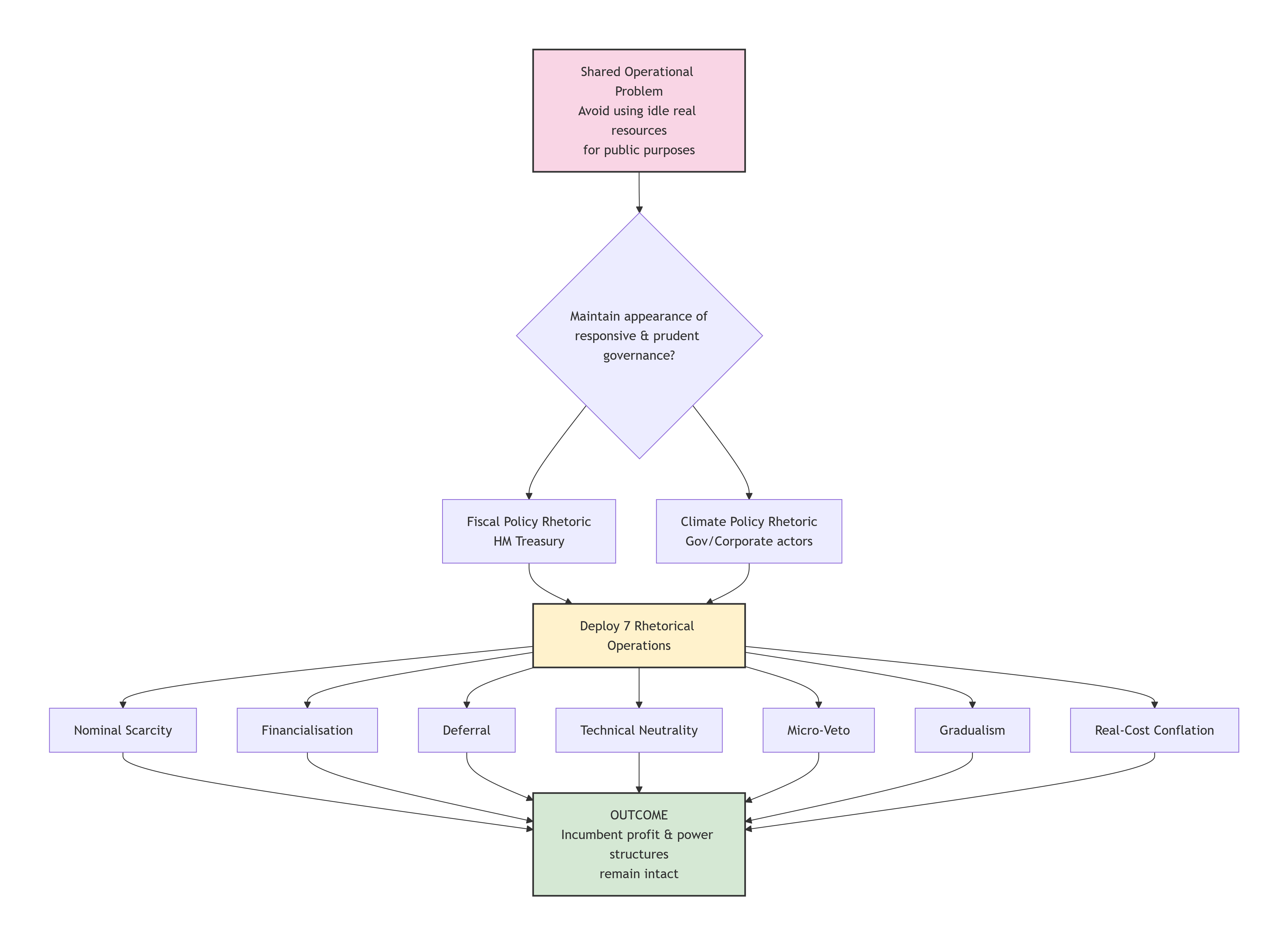
Comparison with greenwashing scripts shows an alarming similarity in the frames upon which the rhetoric is built. Increasingly erratic climate aberrations, coupled with increasingly abhorrent corrective proposals, suggest that the Treasury View, in modular form, has been packaged and distributed, its long history of successful obfuscation makes it an ideal turn-key solution to fool the population of your choice.
References
Beaulieu, J.O., Montgomery, A.W. and Lyon, T.P. (2025) ‘Deny or greenwash? Exploring the interactions between science denialism and greenwashing’, in Bruni, E. and Lefsrud, L.M. (eds.) Organized Science Denial: An Action Plan for Solutions. Oxford: Oxford University Press, pp. 90, 118. Available at: https://academic.oup.com/book/61532/chapter/536690917
Bogojević, S. (2025) ‘Regulating Greenwashing: Where Market Rules Meet Climate Action’, Journal of Environmental Law, 37(2), pp. 169, 174.
Economics Observatory (2022) ‘How can climate promises be met while maintaining fiscal sustainability?’. Available at: https://www.economicsobservatory.com/test/how-can-climate-promises-be-met-while-maintaining-fiscal-sustainability
Finance Innovation Lab (2026) ‘Written evidence to the Environmental Audit Committee: HM Treasury and the economics of climate and nature’. Available at: https://committees.parliament.uk/work/9753/hm-treasury-and-the-economics-of-climate-and-nature/publications/written-evidence/?page=2
Fuoli, M. and Beelitz, A. (2025) ‘Corporate buzzword or genuine commitment? A corpus-assisted analysis of corporate “net-zero” pledges by major global companies’, Applied Corpus Linguistics. Available at: https://www.sciencedirect.com/science/article/pii/S2666799125000255
Kelton, S. (2020) The Deficit Myth: Modern Monetary Theory and the Birth of the People’s Economy. New York: PublicAffairs.
King’s College London (2025) ‘Why “green” finance isn’t always as sustainable as it seems’. Available at: https://theconversation.com/why-green-finance-isnt-always-as-sustainable-as-it-seems-265240
Kochkina, N., Macchia, S. and Floris, M. (2024) ‘Strategic Language Use in Sustainability Reporting: An Empirical Study’, Sustainability, 16(23), p. 10229.
Mitchell, W. (2019) Macroeconomics. London: Macmillan.
Mitchell, W. (2020) ‘Fiscal space and real resources’. Available at: https://billmitchell.org
Oxford Academic (2025) ‘Innovation’, in The Language of Climate Politics. Available at: https://academic.oup.com/book/57398/chapter/464747819
Rajgopal, S. and Aswani, J. (2025) ‘Rethinking the Value and Emissions Implications of Green Bonds’, Management Science. Available at: https://www.linkedin.com/posts/jitendra-aswani-72800216_glad-to-share-that-my-work-on-%F0%9D%90%91%F0%9D%90%9E%F0%9D%90%AD%F0%9D%90%A1%F0%9D%90%A2-activity-7346057283019173888-Tj1e
TaxResearchUK (2026) ‘Trump’s war proves MMT right’. Available at: https://www.taxresearch.org.uk/Blog/videos/tax/
UNEP (2024) Emissions Gap Report 2024: No more hot air … please! With a massive gap between rhetoric and reality, countries draft new climate commitments. Nairobi: United Nations Environment Programme. Available at: https://www.unep.org/interactives/emissions-gap-report/2024/
UNEP (2025) Emissions Gap Report 2025. Nairobi: United Nations Environment Programme.
Wray, L.R. (2015) Modern Money Theory: A Primer on Macroeconomics for Sovereign Monetary Systems, 2nd edn. London: Palgrave Macmillan.
And one last comment.. I don’t think AI generated imagery benefits anyone’s post. But that’s just me.
There are other important remarks to be made about economics as a field, overly inured to every economic challenge being a financial one rather than one existing in a world of real constraints.
For example, the reality is that the easy to access and high-quality mineral resources, oil, copper, nickel, and into a large degree, even sand have are now “mature” with no new significantly large deposits identified. In the resource extraction business a mature field is one that has reached its maximum extraction output which can be maintained for a period of time, but is being depleted in what this means is that further extraction necessarily draws on a resource that is more difficult to extract end of lower quality. The consequence is that more and more resources, energy, money, machinery, etc. are necessary for the process of extracting the fundamental materials necessary for the economy to function. So in order for an economy just to stay in place, it has to expand total output just to maintain its current size.
I will not hear that as “mature” resources become exhausted, output, declines, and accelerates as the resource ages out.
The short form of this is no amount of money is going to fix the the reality that the resource intensity and scale of the global economy has for all intensive purposes, exhausted the resources it needs to function and the timeline for this is that things become a real problem around 2050.
With all this information in hand, the cost of adaptation is irrelevant. The most urgent economic issue for every individual community, figuring out how they are going to make their way without a global or even national supply chain. You’re gonna have to figure out how to feed clothes and how yourself from the resources less than 100 miles away.